All-Star Pro Elite CM3000 Catchers Mitt Review 2026
CatchersHome may earn a commission from qualifying purchases made through the links on this page, at no extra cost to you. We only recommend gear we would put behind our own plate.
The All-Star Pro Elite CM3000 is the catcher’s mitt to buy if you are done replacing a mid-range mitt every spring. This mitt uses premium Japanese-tanned steer-hide that owner reports describe as lasting multiple seasons. Expect about three weeks of real break-in work before it plays the way premium leather should. Best for high school, college, and adult catchers; skip it if you need a game-ready mitt inside a week or the $450–$500 band is a stretch this season.
Best for: a high school, college, or adult catcher ready to invest once instead of every year.
Skip it if: you need a mitt that is game-ready inside a week, or the price tag is a stretch right now — see the CM3100 alternative below.
Price: typically $450–$500 across All-Star Pro Elite CM3000 colorways and variants, as of July 10, 2026. Amazon and other retailers move prices without notice — check the current listing before you buy.
All-Star Pro Elite CM3000 (Black/Tan) — check price on Amazon
All-Star Pro Elite CM3000 specs and verdict
| Spec | Detail |
|---|---|
| Model | All-Star Pro Elite CM3000 |
| Sizes | 32in, 33.5in (most common adult size), 35in |
| Leather | Premium Japanese-tanned steerhide (tan pocket, black back) — what this leather grade actually means |
| Web | Two-piece web, extended pro pocket |
| Wrist protector | Not included |
| Colorways | Black/Tan, solid Black, Black with silver stitching |
| Break-in time | About 3 weeks to game-ready with regular use — no oil or microwave |
| Price band | Typically $450–$500 (as of July 10, 2026) |
| Best for | High school, college, and adult catchers playing a full competitive season |
Verdict: the All-Star Pro Elite CM3000 trades three weeks of stubborn break-in for leather that owners report still popping several seasons later, which makes it the right buy for a catcher playing enough innings to wear a mid-range mitt out and the wrong buy for anyone who needs a mitt working by next weekend.
How we evaluated the All-Star Pro Elite CM3000
- Rubric: the All-Star Pro Elite CM3000 was scored on five dimensions — leather quality, break-in cost, durability across seasons, feel and pop, and value against the rebuy cycle.
- Scope: the standard US CM3000 pattern, with the CM3100 and the Pro-Elite Japan Series compared alongside it rather than reviewed in full.
- Sources: All-Star’s own product language, retailer listings, and independent owner and reviewer reports, All Star sources preferred cross-checked where other sources disagreed. Pricing and availability retrieved July 10, 2026.
- Known gaps: All-Star publishes no single official spec sheet covering the full Pro Elite lineup, and the wrist-and-back closure has changed across model years without a model rename — so closure details here are described as a range, not a fact. The lace-stretch complaint below appears in one source only and is flagged as uncorroborated.
All-Star Pro Elite CM3000 build: leather, pattern, and pocket
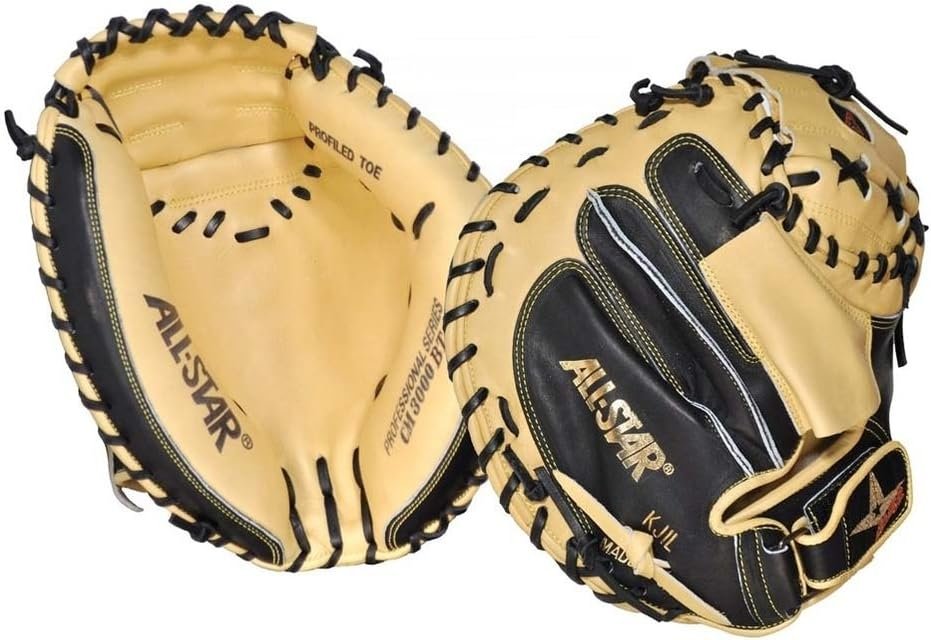
The All-Star Pro Elite CM3000 is built from premium-grade Japanese-tanned steerhide, with two different leathers doing two different jobs. All-Star describes the tan leather in the pocket as the more supple of the pair, meant to shape around the ball, while the black leather across the back is built for stability over a long season. That is the manufacturer’s own language for the split, and it lines up with what a two-leather build is generally for: give where the ball lands, structure where the hand works.
The CM3000 runs a two-piece web with an extended pro pocket — more catchable surface on exactly the pitches that miss the target low or to the arm side. That extra margin is not really about the catcher. A pitcher who has lost the zone in the fifth is looking for one piece of evidence: that the target is still worth throwing to. A mitt that swallows the miss instead of kicking it to the backstop hands over that evidence without a word being said, and a pitcher who believes the glove will find the ball starts competing again.
The All-Star Pro Elite CM3000 comes in Black/Tan, solid Black, and Black with silver stitching, so a catcher can match team colors without stepping down a leather grade. All-Star has also revised the wrist-and-back closure across model years, and sources do not agree on which version is current. If the closure style matters to you — locking tab versus an open back with an adjustable strap — check the photos on the live listing before you order. All-Star does not always rename a mitt when it changes the build.
Owners consistently call the CM3000 light for a mitt of its size, and that shows up late rather than early. Weight is a seventh-inning problem, not a first-inning one. When the rest of the field is running on fumes and the catcher is not fighting their own equipment, that catcher is the one still reading the game a batter ahead — calling the sequence that ends the inning instead of the one that survives the pitch. Responsibility tends to settle on whoever is still thinking clearly.
Breaking in the All-Star Pro Elite CM3000
Owner reports on the All-Star Pro Elite CM3000 agree on one thing without exception: this leather starts obstinate. Stiff as a clipboard, resistant to closing fully around a ball, for the first several sessions. Regular use — playing catch, taking bullpens, working the pocket by hand — brings it to game-ready in about three weeks, according to owner reports and reviewer consensus. Never use oil or microwave; at least one reviewer specifically warns against oiling the tan leather, since it can stain.
There is no shortcut worth taking here, and the three weeks are not wasted time. A mitt broken in by reps rather than by heat holds the shape those reps gave it, which is the difference between a pocket that fits the way you catch and one that fits the way a shortcut left it. Catchers who put the work in up front spend the season being the reliable one; catchers who cook the leather spend it re-learning a mitt that keeps changing on them.
All-Star Pro Elite CM3000 pros and cons
Praise for the All-Star Pro Elite CM3000 across multiple independent sources lands in the same few places, and so does the criticism.
Pros
- Premium Japanese-tanned steerhide that owners report holding up across multiple seasons — one reviewer calls the CM3000 some of the finest leather on the market.
- Loud, consistent pop; pitchers and catchers both notice the sound the ball makes finding the pocket.
- Extended pro pocket adds real catchable surface on missed spots.
- Light for a mitt this size once broken in, which means less in-game adjustment.
- Three colorways at the same leather grade.
Cons
- About three weeks of stiff, obstinate break-in before the mitt catches the way it is supposed to.
- $450–$500 (as of July 10, 2026) is a real outlay for a catcher playing one season.
- No wrist protector — All-Star’s CM3100 includes one.
- One source reports the laces stretching over time; not independently confirmed elsewhere.
- Wrist-and-back closure has changed across model years without a model rename.
| Dimension | All-Star Pro Elite CM3000 |
|---|---|
| Leather quality | High |
| Break-in | Medium — real work, but faster than most comparable pro-grade mitts |
| Durability | High |
| Feel / pop | High |
| Value | Medium-high |
The durability line is the one that compounds. A mitt that plays the same in July as it did in March takes a variable off the table for everyone else on the field: the infield stops wondering whether the ball in the dirt is coming back, and that saved attention gets spent somewhere it actually wins games. Consistency in the catcher is cheaper for a team than talent anywhere else.
Is the All-Star Pro Elite CM3000 worth $450 to $500?
The All-Star Pro Elite CM3000 is expensive measured against one season and reasonable measured against three to four. A mid-range mitt feels great in March; by July the pocket has flattened, the leather has gone soft in the wrong places, and every ball in the dirt stings a little more than it used to. Next spring you are back at the store. Across a travel-ball career, that cycle costs more than the CM3000 does — and it costs something harder to price, since a mitt breaking down mid-tournament takes confidence with it.
The three-week break-in is the other honest objection, and this review is not going to pretend otherwise. What owner reports do consistently say is that this leather breaks in faster than comparable pro-grade mitts, without oil or heat. The way to shorten the window is unglamorous: daily catch, bullpen reps, and working the pocket by hand.
All-Star Pro Elite CM3000 (Black/Tan) — check price on Amazon
All-Star Pro Elite CM3000 vs CM3100 vs Pro-Elite Japan Series
Most competing reviews of the All-Star Pro Elite CM3000 never answer the question every buyer asks next: how it compares to the rest of the Pro Elite lineup. Based on retailer and brand sourcing rather than a single official spec sheet, here is the generally understood breakdown, with prices retrieved July 10, 2026.
| Dimension | CM3000 (Pro Elite) | CM3100 (Pro Series) | Pro-Elite Japan Series |
|---|---|---|---|
| Leather grade | Higher-grade Japanese-tanned steerhide | A step down from CM3000 | Premium Himeji Japanese leather |
| Wrist protector | Not included | Included | Not specified |
| Extended pro pocket | Extended pocket with a profiled toe | Larger overall pocket | |
| Built for | Block-and-smother, all-around | Value, all-around | Receiving and framing |
| Price band (as of July 10, 2026) | $450–$500 | $249.99 (33.5in CM3100SBT, checked Aug 18, 2026) | ~$500, about a $50 premium over the standard CM3000 |
The All-Star CM3100 is the value pick within the same family — a step down in leather grade, but it adds a padded wrist guard the CM3000 does not include at any price. Both mitts run an extended pocket, so pocket size is not what separates them. What does: the CM3000’s higher-grade hide, and the CM3100’s pre-oiled leather, which starts softer and gives up some of the mitt’s later life.
The All-Star Pro-Elite Japan Series, launched in 2025, is a different animal entirely. It runs a rotated hand pattern with a wider palm, looser webbing, and a lower-profile pinky and thumb region, built for a receiving-first, framing style rather than the block-and-smother approach the standard US pattern favors. It is modeled on mitts used in Japanese professional baseball, built from a distinctly named premium leather grade, and available in 34in only. One buyer described it as noticeably larger and shaped more like a catcher/first-base hybrid than a traditional US mitt — worth knowing if you are set on the classic shape.
All-Star Pro-Elite Japan Series 34in — check price on Amazon
If you are weighing the CM3000 against Rawlings’ flagship line instead of All-Star’s own lineup, our premium mitt guide scores the Heart of the Hide against the CM3000 on the same five dimensions.
All-Star Pro Elite CM3000 (Black/Tan) — check price on Amazon
Which All-Star catcher’s mitt should you buy?
Buy the All-Star Pro Elite CM3000 if…
Buy the All-Star Pro Elite CM3000 if you catch a full competitive season at the high school, college, or adult level and you have worn out a mid-range mitt before. You are buying the leather and the extended pocket, and you are paying for them with three weeks of break-in reps you would be putting in anyway.
Buy the All-Star CM3100 instead if…
Buy the All-Star CM3100 instead if you want the same family at the value tier, or if a built-in wrist protector matters more to you than the top leather grade. It is a step down in hide, not in intent.
Buy the All-Star Pro-Elite Japan Series if…
Buy the All-Star Pro-Elite Japan Series if your value behind the plate is framing rather than blocking, you are comfortable at 34in, and a wider, looser, more hybrid-feeling pattern sounds like an upgrade rather than an adjustment.
Buy none of these if…
Buy none of these if you are a first-year catcher, playing recreationally, or you need a mitt that is game-ready inside a week. The price and the break-in period both assume enough innings to make the investment pay off, and there is no shame in earning the mitt before you buy it. Our premium mitt guide rounds up lower price-point options worth a look instead.
All-Star Pro Elite CM3000 FAQs
Is the All-Star Pro Elite CM3000 worth it?
The All-Star Pro Elite CM3000 is worth it for a catcher playing enough competitive innings to wear a mid-range mitt out within a season or two. The leather quality, pop, and multi-season durability owners report justify the $450–$500 band once you compare it to rebuying a cheaper mitt every spring. Casual players, or anyone who needs a mitt game-ready fast, should look at a lower tier first.
What size All-Star Pro Elite CM3000 should a catcher buy?
The All-Star Pro Elite CM3000 comes in 32in, 33.5in, and 35in, and 33.5in is the most common adult size. Larger patterns give a bigger target and more forgiveness on missed spots; smaller patterns close faster and transfer quicker on throws to second.
CM3000 vs CM3100 — what’s the difference?
The All-Star CM3100 uses a lower leather grade than the CM3000 but adds a padded wrist guard the CM3000 does not include. Both run an extended pocket, so that is not the difference — the CM3100’s leather is pre-oiled and breaks in faster, while the CM3000’s higher grade lasts longer. The CM3100 was $249.99 in the 33.5in size when we checked on August 18, 2026.
What’s different about the All-Star Pro-Elite Japan Series?
The All-Star Pro-Elite Japan Series uses a rotated hand pattern, a wider palm, and a looser web built for framing rather than blocking, modeled on gloves used in Japanese professional baseball. It runs in 34in only, in a distinct premium leather grade, at roughly a $50 premium over the standard CM3000 as of July 10, 2026.
How do you break in a new catcher’s mitt fast?
You break in a new catcher’s mitt fastest through regular use — daily catch, bullpen reps, and working the pocket by hand — which takes about three weeks for the All-Star Pro Elite CM3000’s leather. Avoid oiling tan leather, since it can stain; glove conditioner is fine in small amounts. Skip the microwave and the oven entirely.
Is it a baseball glove or a baseball mitt? What’s the difference?
A catcher’s mitt has no individual fingers and uses a hinged, mitten-style pocket built to trap pitches, while a fielder’s glove has separate finger stalls. The phrases “all star catchers mitt” and “catcher’s glove” get used interchangeably online, but the All-Star Pro Elite CM3000 is a true mitt, built specifically for the position.
All-Star Pro-Elite Japan Series 34in — check price on Amazon
All-Star Pro Elite CM3000 (Black/Tan) — check price on Amazon
Bottom line
CatchersHome verdict: 4.7 / 5
The All-Star Pro Elite CM3000 asks for about three weeks of real break-in work and $450–$500 up front, and gives back leather that owner reports describe still popping several seasons later. For a catcher tired of rebuying gear every spring — and for the pitchers who need the same target every night — that trade is worth making.
All-Star Pro Elite CM3000 — check price on Amazon
Explore the rest of the lineup at All-Star’s full catchers gear lineup, or see how the CM3000 stacks up against the field at our mitts hub and the baseball catchers mitts collection.