
All-Star CM3000 vs CM3100: Which Pro Elite Catcher’s Mitt?
Affiliate disclosure: CatchersHome earns a commission on qualifying purchases through the Amazon links below, at no extra cost to you. We only recommend gear we’d hand to our own catcher.
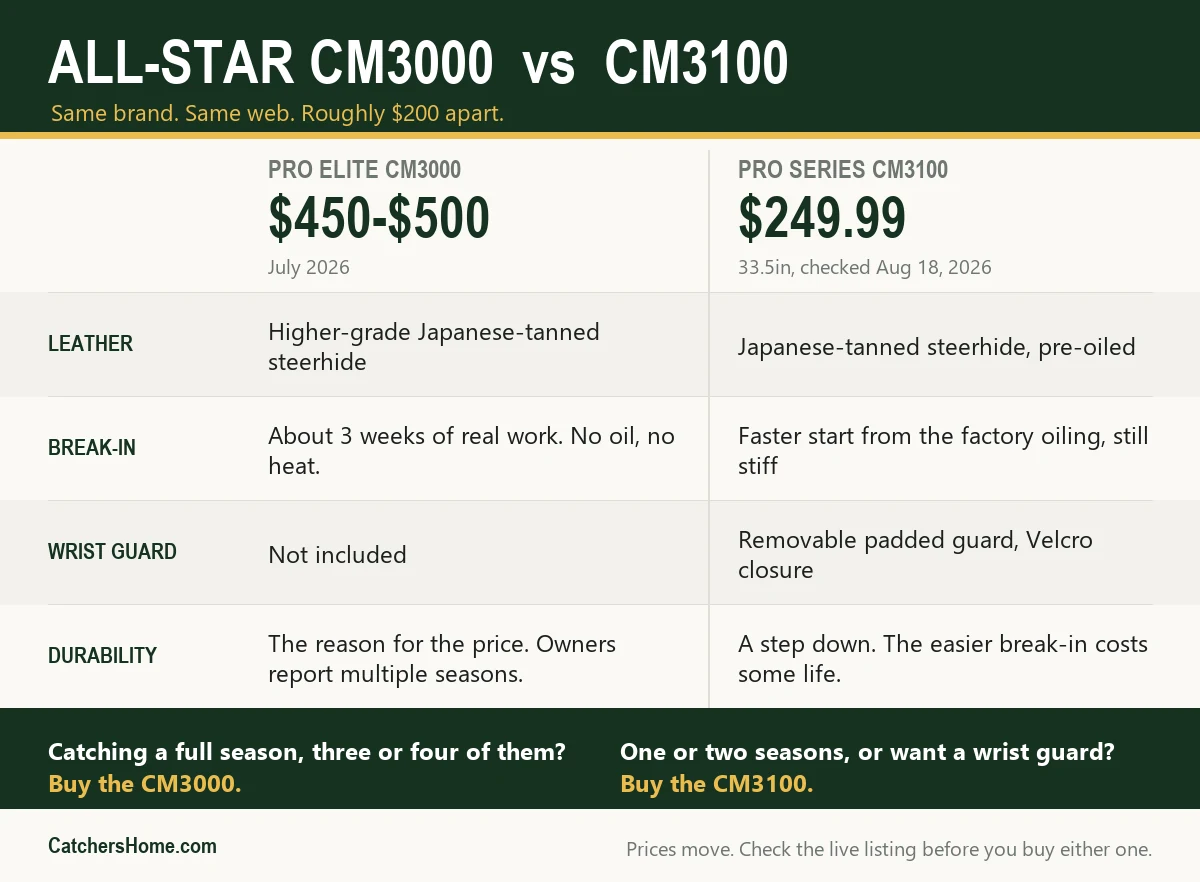
Buy the All-Star Pro Elite CM3000 if you catch a full competitive season and need the mitt to last three or four of seasons. Otherwise buy the CM3100, which gives you most of that mitt for a little over half the money — plus the CM3100 has a wrist the CM3000 omits. The gap is real. The CM3000 runs $450 to $500, while the 33.5-inch CM3100 was $249.99 on Amazon when we checked on August 18, 2026. So this page is about whether roughly $200 buys enough leather to matter for the catcher you actually are.
Price as of Oct 23, 2026 · may have changed
CM3000 vs CM3100 at a glance
| All-Star Pro Elite CM3000 | All-Star CM3100 (Pro Series) | |
|---|---|---|
| Price | $450–$500 (July 2026) | $249. – $300, 33.5in (checked Aug 18, 2026) |
| Leather | Higher-grade Japanese-tanned steer-hide | Japanese-tanned and pre-oiled U.S. steer-hide |
| Break-in | About 3 weeks of real work, no oil or heat | Faster start from the factory oiling — but still stiff |
| Wrist guard | Not included | Removable padded guard, Velcro closure |
| Web | Two-piece, extended pro pocket | Two-piece closed, extended pocket with profiled toe |
| Sizes | 32in, 33.5in, 35in | 33.5in (CM3100SBT), 34–35in (CM3100BT) |
| Durability | The reason for the price — owners report multiple seasons | A step down; easier break-in costs some life |
| Best for | High school, college and adult catchers, full seasons | A season or two, or a catcher who wants the wrist guard |
▶ Watch: what the $200 actually buys (47 seconds)
Prices move, and premium leather moves fastest. Check the live listing before you buy either one.
Where the $200 actually goes
It goes into the hide, and almost nowhere else. All-Star builds both mitts from Japanese-tanned steerhide, but the Pro Elite line uses a higher grade than the Pro Series. That single difference drives the three things a catcher notices over a season. How the mitt breaks in, how long it holds its pocket, and how it feels in the fourth month.
Nothing else in the build explains the gap. Both run a two-piece closed web. Both have an extended pocket rather than a standard one. Both use heavy-duty U.S. rawhide lacing. In fact the cheaper mitt is the one that adds a feature. The CM3100 includes a wrist guard, and the CM3000 does not. So if you were expecting a longer spec list to justify the price, there isn’t one. You are buying leather grade. Our leather explainer covers why that spec predicts more than any other.
Leather grade: the only spec that really splits them
All-Star’s Pro Elite hide is the better one, and retailers who stock both say so plainly. The CM3000 uses a higher-quality Japanese-tanned steerhide than the CM3100, so it is more durable and harder to break in. Those two things travel together. Denser, less processed leather resists you at the start and rewards you later.
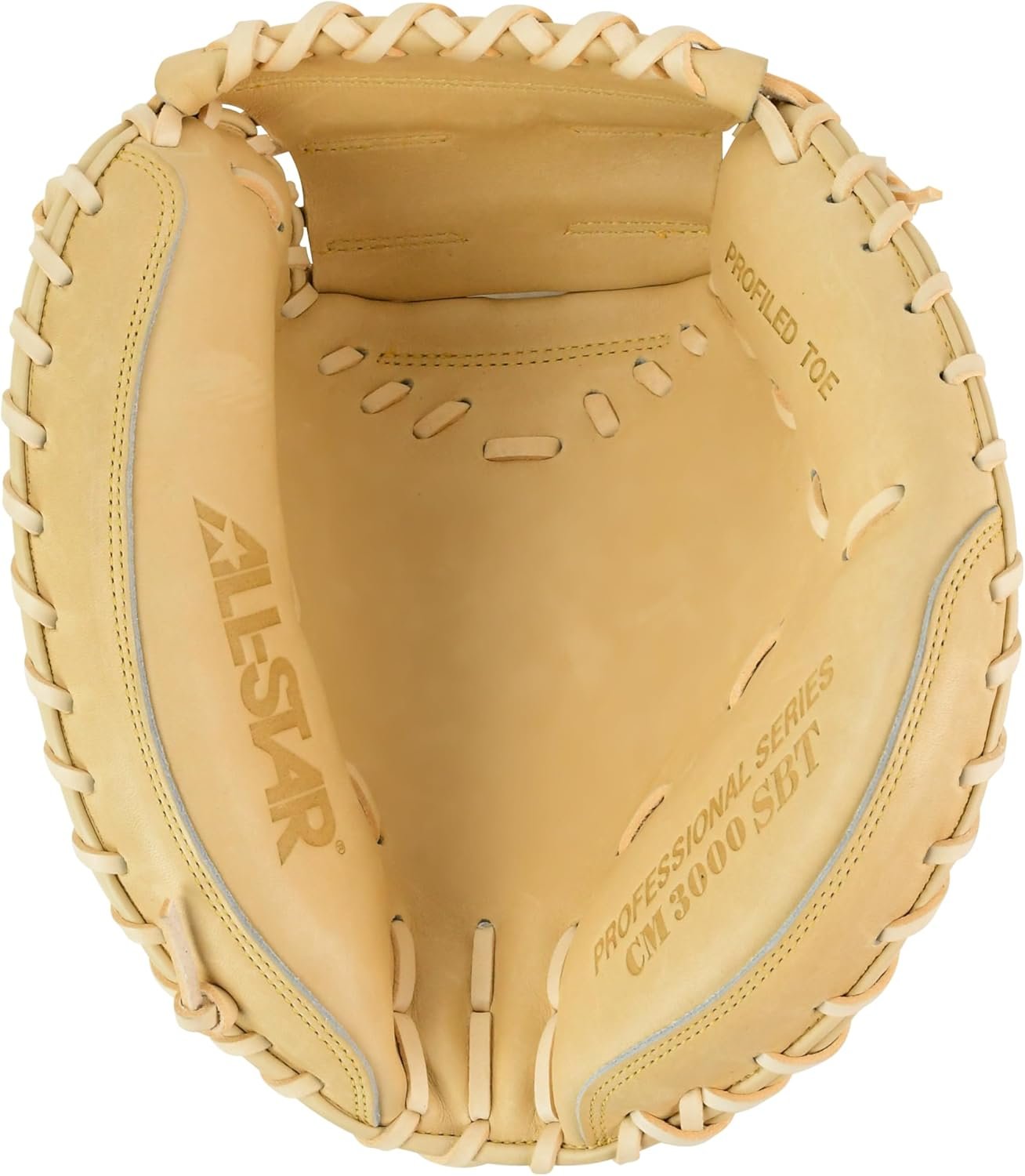
The CM3000 pairs two leathers doing two jobs. A supple tan pocket shapes around the ball, while a stable black back holds structure through a season. Our full CM3000 review scores that build against the rest of the premium field. Meanwhile the CM3100’s steerhide arrives pre-oiled from the factory. That is a deliberate trade, because softening is a withdrawal against the mitt’s later life.
▶ Watch: leather grade, up close (19 seconds)
Break-in: faster is not free
The CM3000 arrives raw. Owner reports agree it starts ‘bull-headed’ (obstinate): stiff, and resistant to closing fully around a ball. It comes to game-ready in about three weeks of regular use. No oil, no microwave. At least one reviewer warns specifically against oiling the tan leather, since it can stain.
The CM3100 starts ahead because the factory already oiled it. But read the buyer reports rather than the marketing. The mitt is still described as extra stiff, and several owners put the real break-in at weeks rather than days. So expect that the less expensive CM3100 shortens but doesn’t eliminate the break-in window. Either way, break it in with reps rather than heat. A pocket formed by catching holds the shape those reps gave it.
▶ Watch: how to break in a catcher’s mitt in six steps
There is a design detail worth knowing here. The CM3100 has a flex-action crease near the heel and a wider heel channel. All-Star’s retail copy describes that as helping younger hands close the mitt. That is aimed squarely at a 13-to-16-year-old catcher who has not built the hand strength yet. The flex-action crease is a real advantage for teen players, but irrelevant to an adult.
The wrist guard: the one thing the cheaper mitt has
The CM3100 ships with a removable padded wrist guard with a Velcro closure, plus an index finger hood on the shell backing. The CM3000 includes no wrist protector at all.
This flips the usual logic, so it is worth stating plainly: on protection, the value mitt wins. A catcher who has taken a foul tip off the wrist does not need to be reminded of a possible injury. Meanwhile a catcher who already wears a separate wrist guard won’t care because its removable, any way. Either way, do not assume the more expensive mitt is more protective, because on this specific point it is not.
A correction to the comparison you will see elsewhere
Most CM3000-versus-CM3100 comparisons describe the CM3100’s pocket as standard against the CM3000’s extended pro pocket. An earlier version of our own did too. All-Star’s own retail copy does not support that. The CM3100 is described with an extended pocket and a profiled toe designed to make scooping easier. So both mitts are extended-pocket mitts, and pocket size is not the axis that separates them.
This matters because pocket shape is the spec a blocker should be shopping on. If that is your question rather than a price question, our framing versus blocking guide is the better page. The CM3000 and the CM3100 land on the same side of that decision.
Which All-Star catcher’s mitt should you buy?
Buy the CM3000 if…
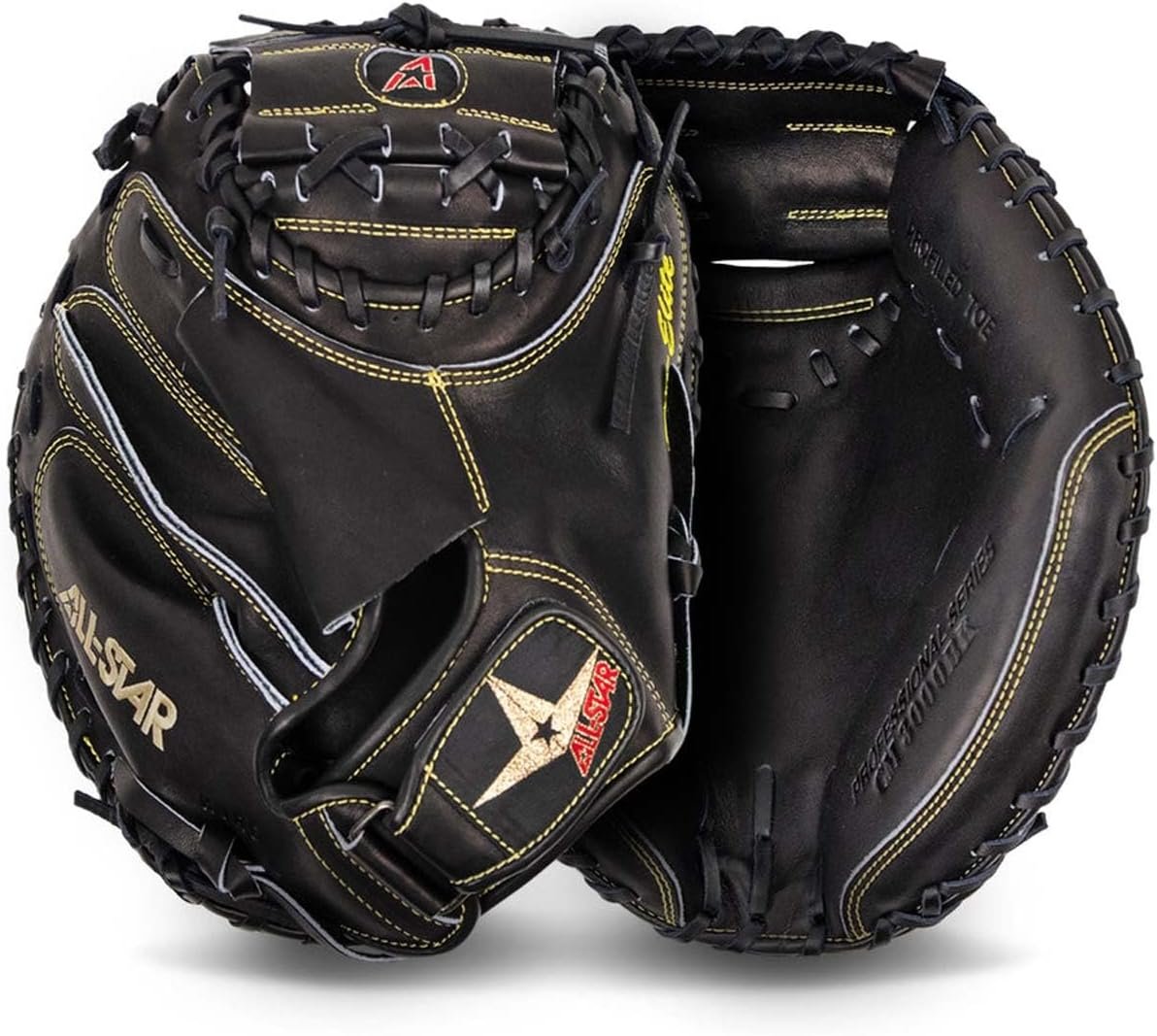
Buy the All-Star Pro Elite CM3000 if you catch a full competitive season at high school, college or adult level. It especially fits a catcher who has already worn out a mid-tier mitt. The higher-grade hide is the purchase, and three weeks of break-in reps you were going to put in anyway is the price. It is also the mitt Martin Maldonado wears in a custom build. That is a fair signal about the pattern, if not about your budget.
Price as of Oct 23, 2026 · may have changed
Buy the CM3100 if…
Buy the All-Star CM3100 if your horizon is a season or two. It also fits when the wrist guard matters, or when the catcher is 13 to 16 and still building hand strength. The wider heel channel was designed for exactly that player. You give up leather grade and some seasons of life, and you keep roughly $200. BTW, the CM3000 is perfect for Freshman in College or high school player getting a lot of advanced practice time.
Buy neither if…
Buy neither if you are a first-year catcher, still growing, or playing recreationally. Both mitts assume enough innings to pay back a break-in period. After all, there is no shame in earning the mitt before you buy it. Start at how to choose a catcher’s mitt instead, and size with our size chart before anything else.
Where the Japan Series fits
All-Star’s third option confuses this comparison, so here it is briefly. The Pro-Elite Japan Series, launched in 2025, is not a tier above the CM3000 so much as a different shape. It runs a rotated hand pattern with a wider palm, looser webbing, and a lower-profile pinky and thumb. That build is meant for receiving rather than block-and-smother. It comes in 34 inches only, at roughly a $50 premium over the standard CM3000. So it belongs in a framing conversation, not a value one. See our premium mitts roundup for where all three sit against Rawlings and Wilson. The two flagships they land against carry their own reviews: the Rawlings Pro Preferred and the Mizuno Pro Select.
Price as of Oct 23, 2026 · may have changed
What we could not verify
- All-Star publishes no single official spec sheet covering the full Pro Elite and Pro Series lineup. So the build details here come from All-Star’s retail channel and independent owner reports, cross-checked where sources disagreed.
- All-Star has revised the wrist-and-back closure across model years without renaming the mitt. Check the photos on the live listing before you order if closure style matters.
- The exact leather grades are not published as a scale the way Wilson’s Pro Stock Select is. So ‘higher grade’ here is the retailers’ language and All-Star’s, grade is not a measured number.
- One major glove retailer lists the 33.5-inch CM3100SBT as discontinued. Yet Amazon still stocked it at $249.99 on August 18, 2026, so availability may be shorter-lived than this page.
- We could not source a photograph we are confident shows a CM3100. The photographs on this page are all CM3000.
All-Star CM3000 and CM3100 FAQs
What is the difference between the All-Star CM3000 and CM3100?
The CM3000 uses a higher grade of Japanese-tanned steerhide and costs roughly $200 more. The CM3100 uses a pre-oiled steerhide that breaks in faster. It also includes a padded wrist guard the CM3000 leaves out. Both run a two-piece closed web with an extended pocket. So the pocket is not what separates them. Leather grade, break-in path, the wrist guard and price are.
Is the All-Star CM3000 worth twice the price of the CM3100?
Yes, if you catch enough innings that a mitt has to survive three or four seasons. No, if this is one or two seasons of ball. The CM3000’s higher-grade hide is what you are buying, and it only pays back over time. Meanwhile a catcher on a two-season horizon gets most of the mitt for a little over half the money.
Does the All-Star CM3100 come with a wrist protector?
Yes. The CM3100 ships with a removable padded wrist guard with a Velcro closure, and the CM3000 does not include one at all. That is the single clearest feature difference between the two mitts. So if a built-in wrist guard matters to you, the cheaper mitt is the one that has it.
Which All-Star catcher’s mitt breaks in faster?
The CM3100, because its leather is pre-oiled at the factory. The CM3000 arrives raw and stubborn, and owner reports put it at about three weeks of regular use before it plays properly. However, do not read that head start as game-ready out of the box. Buyers still describe it as extra stiff, and several report weeks of work.
What sizes do the All-Star CM3000 and CM3100 come in?
The CM3000 comes in 32, 33.5 and 35 inches, and 33.5 is the most common adult size. The CM3100 comes as the CM3100SBT at 33.5 inches, plus the CM3100BT at 34 to 35 inches. So the 33.5-inch pattern is the only size where you can compare the two directly.
Is the All-Star CM3100 discontinued?
One major glove retailer lists the 33.5-inch CM3100SBT as discontinued. Yet the same mitt was in stock on Amazon at $249.99 when we checked on August 18, 2026. Treat it as a line that is winding down rather than gone. So if the CM3100 is your pick, buy it while the size you want is still on a shelf.
Comparing outside the All-Star family? Our premium mitts roundup scores the CM3000 against the Wilson A2K, the Wilson A2000 and the Rawlings Heart of the Hide on the same five dimensions. Everything here sits under baseball catcher’s mitts.