
The Buster Posey Award: The Comeback Behind the Name
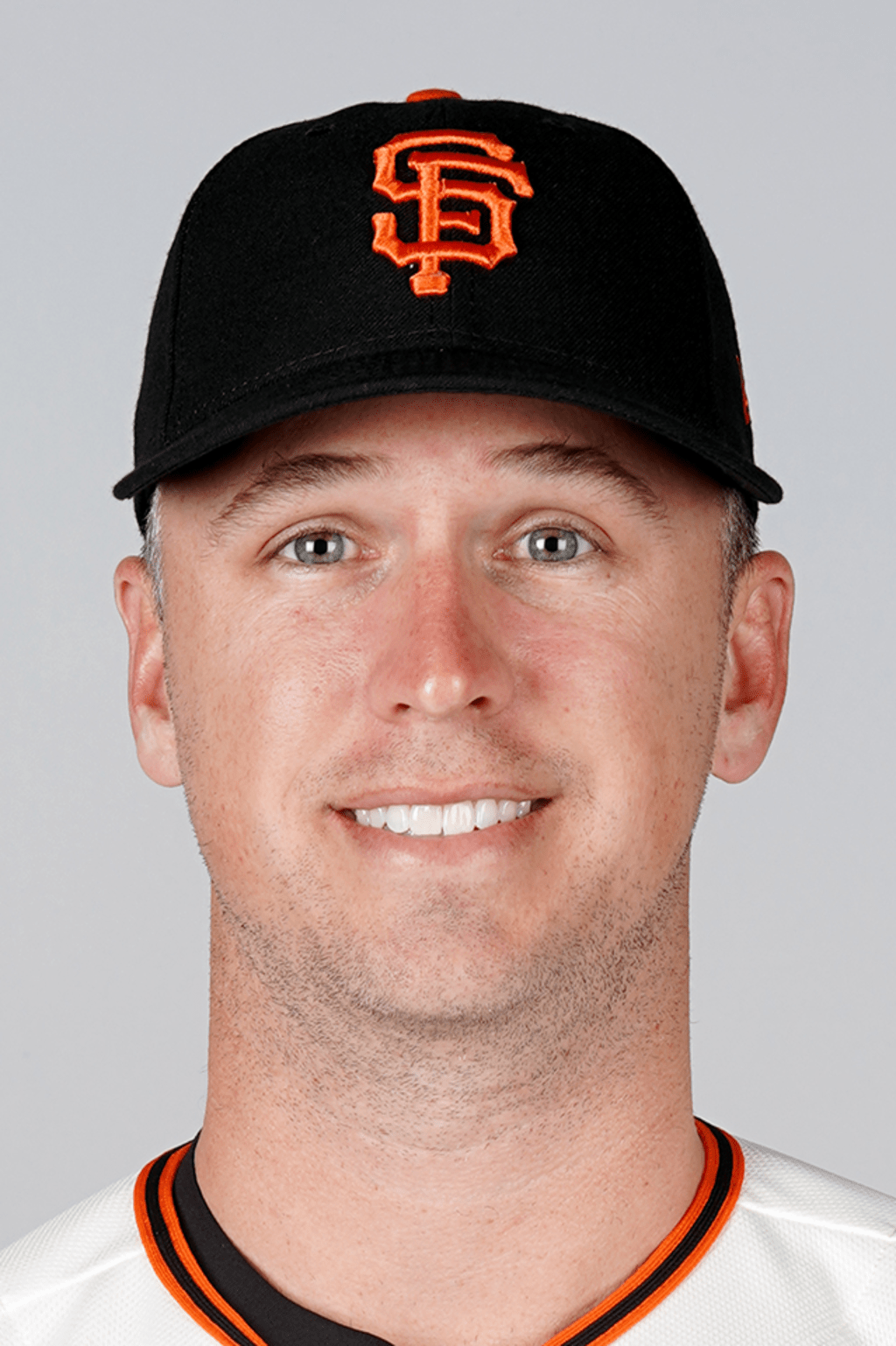
▶ Watch this story in under a minute — or read on.
He started over at the hardest position on the field, survived the collision that changed baseball’s rules, and came back an MVP. This is the man behind the Buster Posey Award, and the college catchers chasing his name.
The Giants and Marlins were tied in the twelfth inning, late on a May night in San Francisco in 2011. A fly ball dropped into short right field, and the runner on third broke for home. Buster Posey took the throw on a short hop and turned toward the plate. Scott Cousins arrived at full speed. The run scored, and Posey stayed down in the dirt.
His left leg told the story: a broken fibula and three torn ankle ligaments. He was 24 years old, the reigning Rookie of the Year, seven months removed from a World Series title. His season ended that night. Nobody could promise the rest of his career hadn’t ended with it.
Fifteen years later, the best catcher in college baseball wins an award that carries his name. Every June, the Buster Posey Award goes to the top catcher in NCAA Division I. But a name on a trophy means more when you know what that name survived. This is that story — the kid from Georgia, the collision, the comeback, and the winners chasing him now.
Who is Buster Posey?
Gerald Dempsey “Buster” Posey III grew up in Leesburg, Georgia, and starred at Lee County High School. Florida State brought him in as a shortstop. Then, before his sophomore season, he moved behind the plate.
Think about that move for a second. Catcher is the hardest job on the field, and he had never played it. Instead of polishing his draft stock at a position he already owned, Posey strapped on the gear and started over.
The bet paid off in historic fashion. As a junior in 2008, he put up one of the best offensive seasons college baseball has ever seen:
| AVG | OBP | SLG | HR | RBI |
|---|---|---|---|---|
| .463 | .566 | .879 | 26 | 93 |
He made only eight errors all season while learning the position’s thousand small skills. One afternoon that spring, Florida State even let him play all nine positions in a single game, including a turn on the mound.
The awards swept in behind the numbers. The Golden Spikes Award — USA Baseball’s honor for the best amateur player in the country — went to Posey. So did the Dick Howser Trophy, college baseball’s player of the year. And so did the Johnny Bench Award, given each year to the nation’s best college catcher.
Hold on to that last one. The award Posey won as a junior is the same trophy that now carries his own name. We will get there.
The San Francisco Giants drafted him fifth overall that June. By 2010 he was in San Francisco to stay — Rookie of the Year by November, and the catcher for the franchise’s first championship since it moved west from New York.
The collision that changed the rules
Then came the twelfth inning in May 2011, seven months after the parade. The play was legal at the time. Runners had crashed into catchers for a century, and broken bodies were treated as part of the job description.
Baseball finally did something rare in response. In time for the 2014 season, MLB adopted Rule 7.13, which everyone in the game simply calls the Posey Rule. A runner can no longer leave his path to initiate contact with the catcher, and a catcher without the ball can no longer block the plate. Youth and high school leagues carry versions of the same protection. The sport looked at Posey’s ankle and rewrote its rulebook.
Posey’s own response was rarer still. He never made a villain of Scott Cousins, though plenty of angry fans did. Years afterward, he was still going out of his way to say so publicly. That is what leading from behind the plate looks like when you cannot even stand on it.
The comeback season
What Posey did next is the reason his name belongs on a trophy.
He returned in 2012 and caught 148 games on the rebuilt ankle. He hit .336, and the National League batting title belonged to a catcher for the first time since Ernie Lombardi in 1942. The league named him Most Valuable Player and Comeback Player of the Year in the same season. Then the Giants won the World Series again.
One year removed from the dirt at home plate, he was the best player in his league. Let that arc sink in.
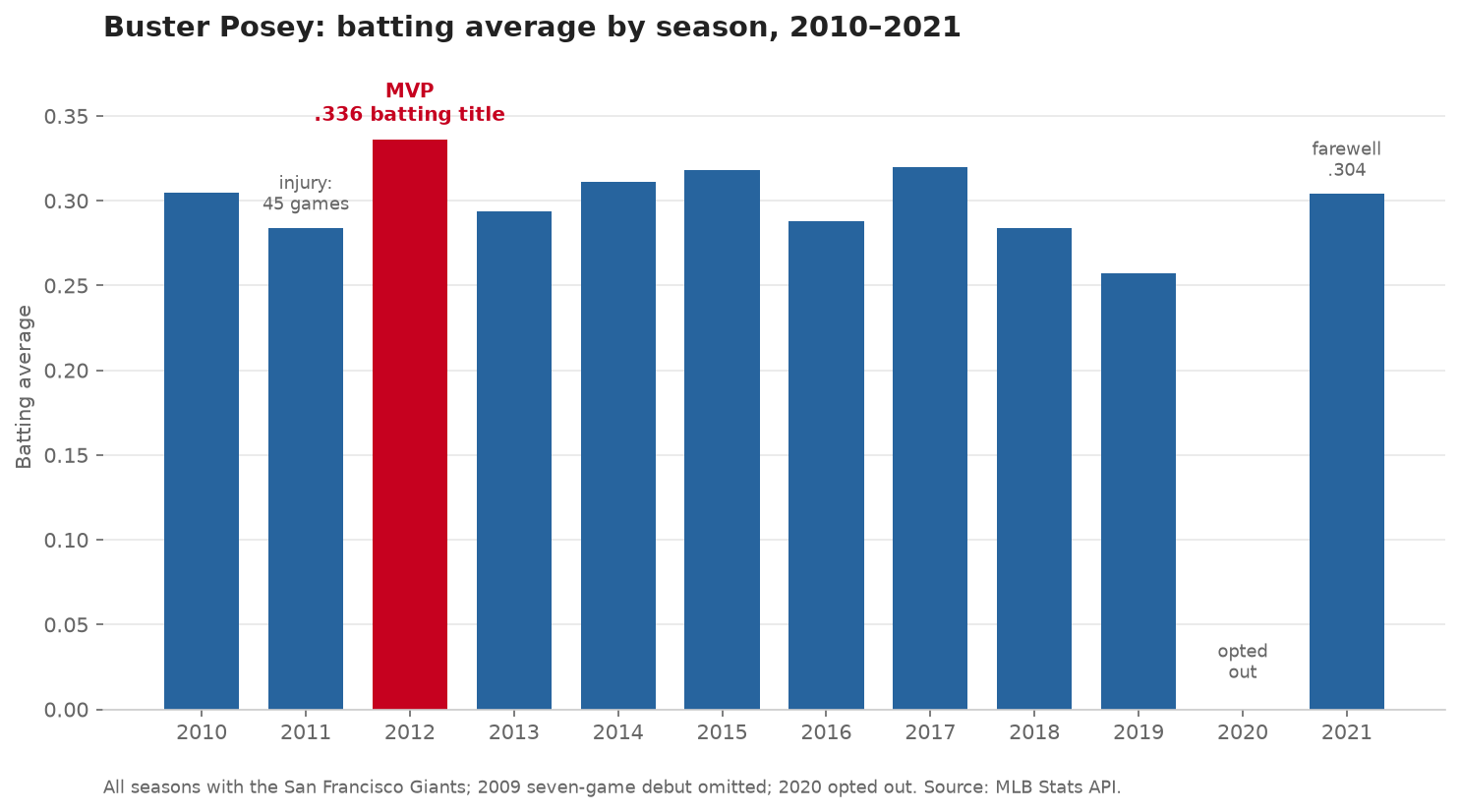
The rest of the career reads like a Cooperstown argument. A third ring came in 2014. Wilson named him baseball’s Defensive Player of the Year in back-to-back seasons, and a Gold Glove followed in 2016. He made seven All-Star teams and won five Silver Sluggers — the award for the best hitter at each position. The full line is the quiet kind of overwhelming:
| G | AVG | H | 2B | HR | RBI |
|---|---|---|---|---|---|
| 1,371 | .302 | 1,500 | 293 | 158 | 729 |
A .302 career average from a man who squatted for twelve seasons is the rarest line on that card. Most catchers would sign for .270 and consider it a win.
Family first, then a farewell
The 2020 season asked Posey a different kind of question. That July, he and his wife Kristen adopted twin girls, born eight weeks premature and starting their lives in intensive care. With a pandemic outside the hospital walls, Posey opted out of the entire season to protect them. “Not a difficult decision,” he called it.
He came back in 2021, at age 34, and hit .304 with 18 home runs. The league sent him to another All-Star Game and handed him a second Comeback Player of the Year award. Then, that November, he retired — still near the top of his game, choosing his family and his health over one more contract.
He didn’t go far. The Giants brought him back in September 2024 as president of baseball operations, the executive who shapes the entire roster. His boldest early hire says plenty about where his heart still lives: he made Tennessee’s Tony Vitello the first manager ever hired straight from a college program into a big-league dugout. Posey knows what the college game can produce. He was what the college game can produce.
What is the Buster Posey Award?
The award is older than its name. The Greater Wichita Area Sports Commission created a national award for the country’s best Division I catcher in 2000 and asked Johnny Bench to be its namesake. For nearly two decades, the top college catcher in America won the Johnny Bench Award — including a Florida State junior named Buster Posey in 2008.
The family tree split in 2019. Bench moved his name to a new award run by the Reds Hall of Fame in Cincinnati, and we tell that whole story in our Johnny Bench Award guide. Wichita kept its original award and renamed it for the best catcher it had ever honored. So college baseball now crowns two catchers each summer, and the two trophies share a family tree.
The Posey Award runs on a season-long funnel. A watch list comes out in February, built from nominations by college coaching staffs. Semifinalists are named in mid-May — sixteen made the cut in 2026 — and five finalists follow in early June. Finally, the winner is announced in Omaha during the Men’s College World Series, on the sport’s biggest stage.
Then comes the part our readers should love. Each winner is honored at a banquet in Wichita and helps teach a youth catchers’ camp named for the least glamorous skill in the gear bag. The camp is called Just Block It. The best catcher in college baseball, teaching kids to block pitches in Kansas: that is the position’s culture in one picture.
The standard the name sets
Line up the two halves of this story, and the lesson writes itself. Posey volunteered for the hardest position on the field and started over. He got hurt as badly as a catcher can get hurt, then came back as the best player in the league. He stepped away from a season for his family, returned, and won Comeback Player of the Year a second time.
The award that carries his name is really an award for that. Skill, yes — but skill rebuilt every time something knocked it down.
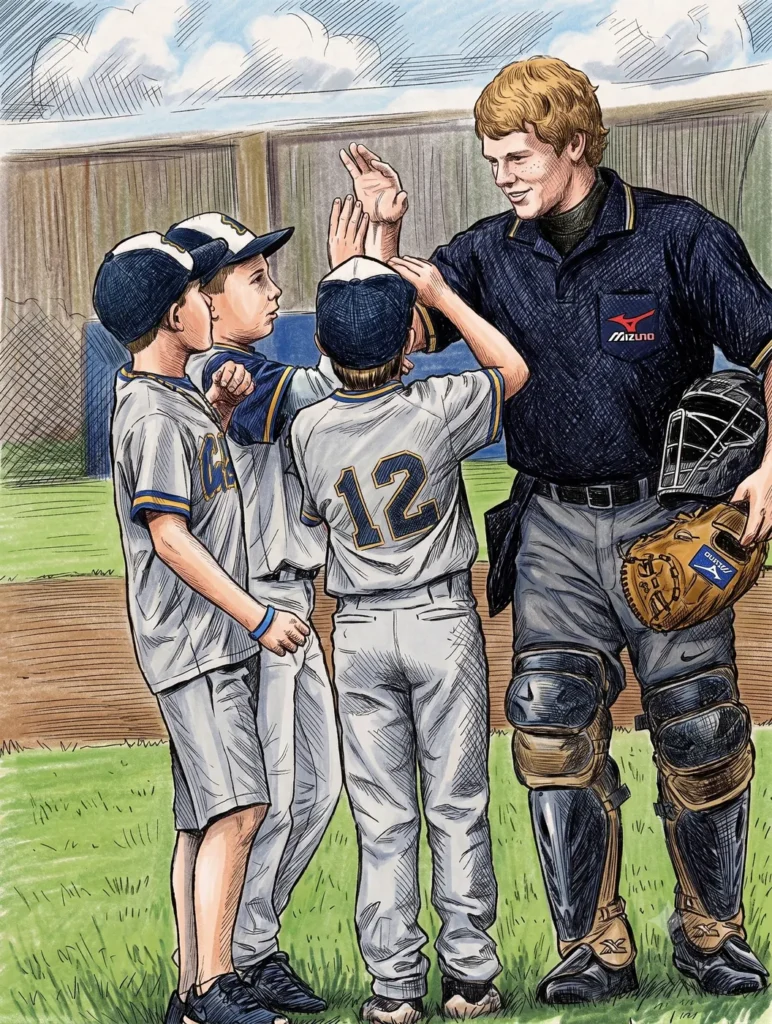
No part of that standard is reserved for first-round picks. The foul tip stings the same at 12U as it does in Omaha, and the choice to start over at something hard is waiting for you at every practice. Resilience is a rep, and you can take that rep this week.
Sweat the gear and never fear.
The winners chasing his name
An award is measured by its winners, and this list travels fast.
| Year | Winner | How he earned it |
|---|---|---|
| 2019 | Adley Rutschman | Oregon State. Swept the Golden Spikes Award, the Johnny Bench Award, and this one in the same spring, then went first overall in the draft. He homered for the Red Sox just this week. |
| 2020 | Not awarded | The pandemic wiped out the College World Series. |
| 2021 | Matheu Nelson | Florida State — Posey’s own program. Slugged 23 home runs, and the trophy went home. |
| 2022 | Kevin Parada | Georgia Tech. The loudest bat in school history: a single-season-record 26 home runs while hitting .360. |
| 2023 | Kyle Teel | Virginia. Contact and sheer workload — he hit .407 and caught all 65 of the Cavaliers’ games. |
| 2024 | Walker Janek | Sam Houston. Won it with his arm as much as his bat: a .368 average, more than half of base stealers thrown out, and Defensive Player of the Year in his league. |
| 2025 | Caden Bodine | Coastal Carolina. A Gold Glove behind the plate for a team that won 56 games and played for the national championship. |
| 2026 | Daniel Jackson | Georgia. The SEC Triple Crown and a national-award sweep. The Rockies drafted him 37th overall in July. |

Now look at what scouts think of the list. Every winner since the renaming has been drafted inside the top 40 picks the summer he won. Rutschman went first overall, Kevin Parada eleventh, Kyle Teel fourteenth. Winning this award has become a strong signal that a big-league team is about to call your name.

The newest winner might be the biggest star yet. Georgia’s Daniel Jackson — “Rhino” to his teammates — won the 2026 award during an awards sweep we covered as it happened, stacking it with the Dick Howser Trophy and the Golden Spikes Award. He batted .379, drove in 87 runs, and led the nation in total bases while catching 53 games. The Rockies drafted him 37th overall in July.
Try this at your next practice
- Posey Rule footwork. The modern tag play is pure technique. Set up in front of the plate, leave the runner’s lane open, and practice catching a throw while dropping your left knee into a sweep tag. Take ten dry reps, then ten more with a partner throwing from the outfield side. Speed comes after the pattern is clean.
- The comeback log. Posey’s 2012 didn’t start on Opening Day; it started in rehab, one boring rep at a time. Pick the weakest part of your game right now and give it ten focused minutes at every practice. Write down each session. A month of entries is a comeback in progress.
- Quiet-glove receiving. Posey won defensive awards because strikes stayed strikes in his mitt. Have a partner throw 20 pitches at the bottom of the zone. Catch each one and hold it dead still for a full second — no drift, no stab. Film ten of them and see how quiet your glove really is.
Sources: Buster Posey Award — Wichita Sports Commission; Past winners — Wichita Sports Commission; Posey wins Golden Spikes Award — Florida State Athletics; MLB adopts rule on collisions at plate — ESPN; Posey opts out of 2020 season — San Francisco Chronicle; Buster Posey retires — ESPN; Giants name Posey president of baseball operations — Washington Post. Career statistics verified against the MLB Stats API.