
The Johnny Bench Award: The Name Every Catcher Chases
▶ Watch this story in under a minute — or read on.
He changed how the position is played. Then he lent his name to the award that crowns the best college catchers in baseball and softball. This is the man, the standard, and the winner who chased it to the big leagues.
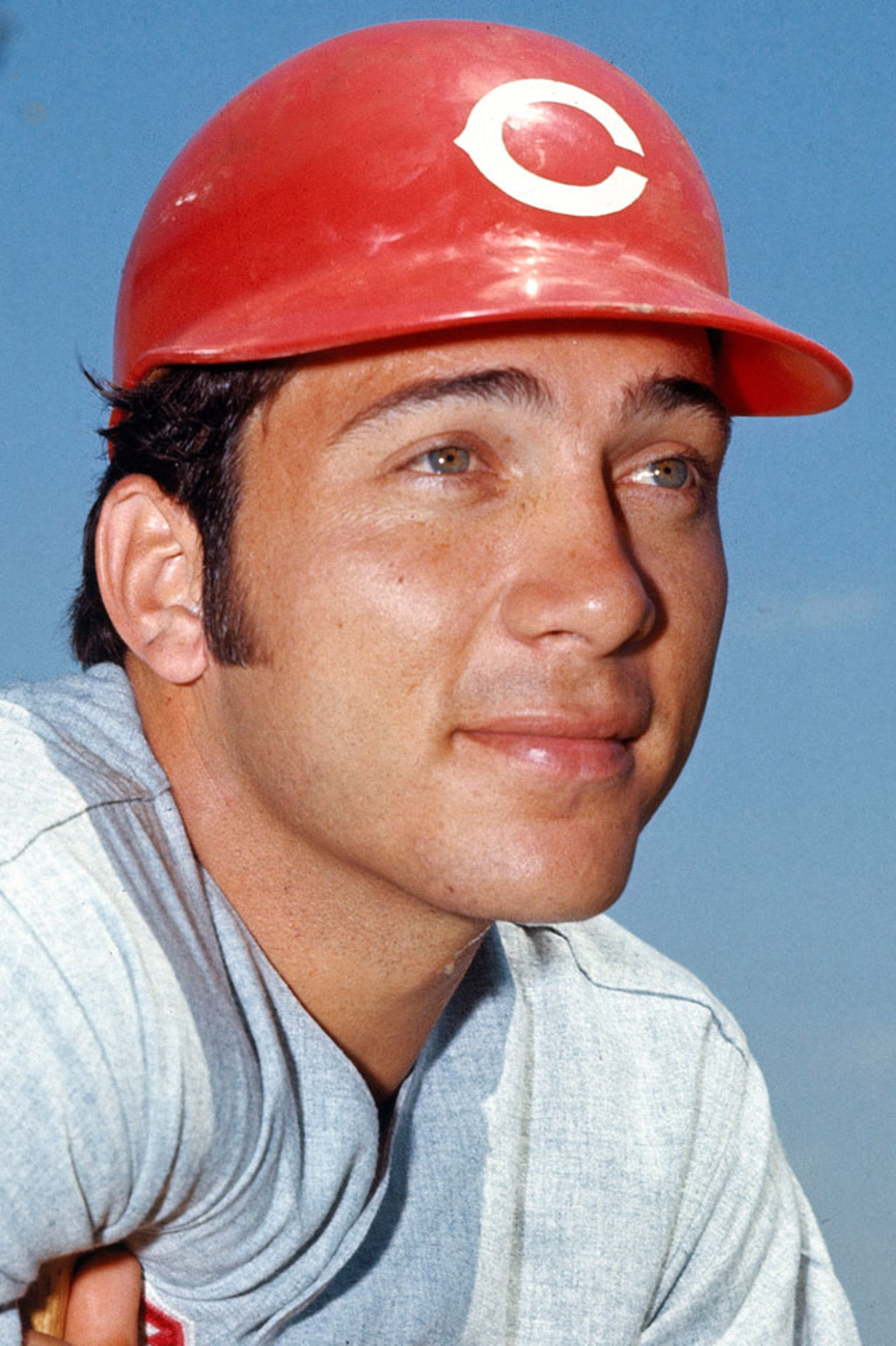
October 1976, and the Cincinnati Reds have just swept the Yankees out of the World Series. The man they hand the Series MVP trophy to is Catcher, Johnny Bench. Bench slugged over 1.000 in those four games. He was 28 years old, and he already owned two league MVP awards.
Fifty years later, the best college catchers in America still chase his name.
Every year, the best Division I baseball catcher and the best Division I softball catcher win the Johnny Bench Award. So do the best high school catchers in four states.
This is the Johnny Bench story — the man, the standard he set, and the winners who have perfected the catcher’s position.
Who was Johnny Bench?
Start in Binger, Oklahoma. The town is small enough that Bench is still the only big leaguer Binger High School has ever produced, and the Reds drafted him in the second round in 1965 straight out of it. The nickname that stuck came later, the Little General, but the first one told you where he was from: the Binger Banger.
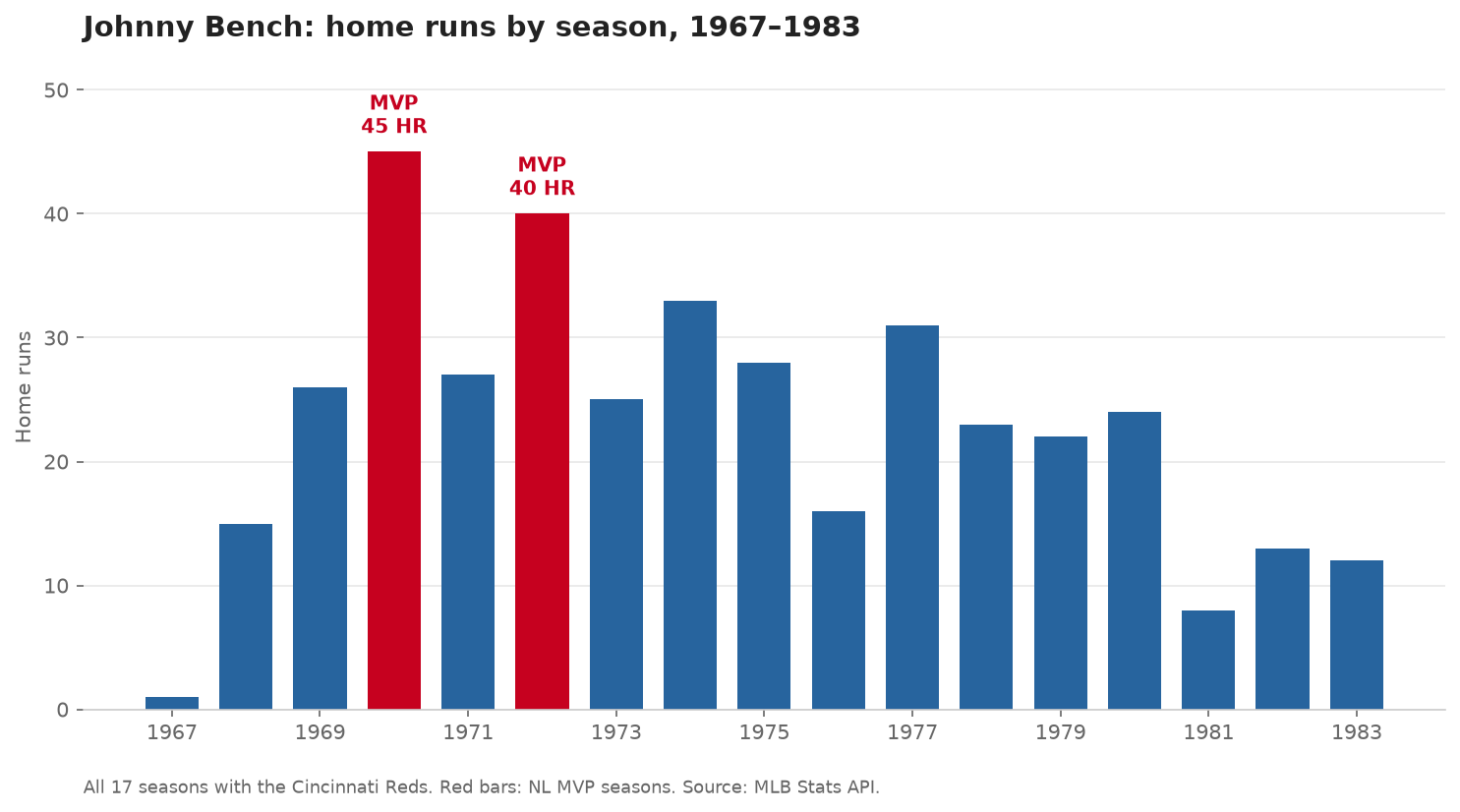
Johnny Bench caught 17 seasons for the Cincinnati Reds, from 1967 to 1983. He hit 389 home runs, still one of the highest totals ever by a catcher. In fact, the full career line reads like a job description for the Hall of Fame:
| G | AVG | H | HR | RBI |
|---|---|---|---|---|
| 2,158 | .267 | 2,048 | 389 | 1,376 |
The awards came just as fast. In 1968, Bench became the first catcher ever to win National League Rookie of the Year. He caught 154 games that season — as a 20-year-old.
Collectors still chase that first season. His rookie card, the 1968 Topps #247, is a shared “Rookie Stars” card with a pitcher named Ron Tompkins, and a gem-mint PSA 10 copy sells for $88,000 or more. A well-worn one runs under $200.
Then came an MVP award in 1970, built on 45 home runs and 148 RBI. Two years later he won his second MVP, and he had not yet turned 25.
Meanwhile, the defense never slipped. Bench won the NL Gold Glove every single season from 1968 through 1977. Ten seasons, ten Gold Gloves, no gaps.
He also made 14 All-Star teams. The Reds had retired his number 5 in 1984. In 1989, the Hall of Fame called.
Some of his marks have since fallen. Mike Piazza passed his career home-run total, and Salvador Perez broke his single-season record of 45. But more than forty years after his last game, the catcher record book still lists Bench first in the categories that measure a whole career:
| Record (among catchers) | Mark | Status |
|---|---|---|
| Most RBI in a season | 148 (1970) | Still stands |
| Highest career bWAR | 75.2 | Still stands |
| Highest single-season bWAR | 8.6 (1972) | Tied — Gary Carter matched it in 1982 |
| Highest JAWS rating | 61.2 | Still stands |
There was also Bench’s contribution to the Reds’ success during the 1970s. Bench anchored the Big Red Machine, the Reds dynasty that took back-to-back World Series titles in 1975 and 1976. The rivalry between the Big Red Machine and the Lumber and Lightning (the Pirates) were epic. The Big Red Machine (the Reds) are remembered for their stars at every position. Still, the man calling the pitches sat at the center of all of it.
Bench earned two character-centric honors along the way. Bench won the Lou Gehrig Award in 1975. The Lou Gehrig award is given to the major league player who best exemplifies Lou Gehrig’s character on and off the field. The Lou Gehrig award was given to Bench to recognize his philanthropy and community outreach initiatives. In our estimation, the Lou Gehrig award is MLB’s equivalent to the Gary Payton Award given to similarly affective NFL players. A few notable winners were, Hank Aaron (1970), Harmon Killebrew (1971), Willy Stargell (1974 – Lumber and Lightning). The Lou Gehrig Memorial Award Plaque is engraved with the names of every award winner, and it hangs in the Baseball Hall of Fame in Cooperstown. Yes, Cooperstown was Bench’s Destiny!
Bench won the Hutch Award in 1981, an award given for character traits such as Honor, Courage, and Dedication. Those were the traits Fred Hutchinson showed when he managed the Reds through the entire 1964 season while dying of cancer. If you’re here to learn about players who persevered despite the odds, reading about the players who won the Hutch Award is a good place to start. Mickey Mantle won the first award in recognition of his grit and endurance. Other notable recipients are George Brett, Andre Thornton, and Jon Lester.
Later, in 2007, MLB named him to its All-Time Gold Glove Team.
He changed how catchers catch
Numbers alone don’t explain why the award carries his name. Bench also changed the position itself.
Before him, catchers caught with two hands, the bare hand hovering beside the mitt. Foul tips found that bare hand constantly, and broken fingers were part of the trade.
Bench had the hands to try something different. They were famously enormous — he liked to prove it by holding seven baseballs in one of them — and they let him work a new kind of mitt with one hand.
Bench is credited with popularizing the hinged catcher’s mitt and the one-handed catching style that came with it. The hinged mitt closed around the ball like a first baseman’s glove. As a result, the throwing hand could hide safely behind the back or the knee until it was needed.
Watch any catcher today, from the big leagues down to 10U, and you are watching Bench’s idea. That is a lineage — a skill handed down from one generation of catchers to the next, whether they know the source or not.
The style also worked. Bench threw out 43 percent of the runners who tested him over his career, eight points better than the league average of his era. In 1975 he caught more than 1,000 innings without a single passed ball.
He caught one no-hitter, Jim Maloney’s thirteen-strikeout masterpiece against Houston on April 30, 1969. The one he missed tells its own story: when Tom Seaver threw the Reds’ next no-hitter nine years later, Bench was on the disabled list, and backup Don Werner ended up in the history books instead.
Bench left behind a simple framework for what the position demands. Writing in The Players’ Tribune, he named the requirements: hit for power and average, own a strong arm, play fearless defense, keep your feet quick, and move the ball from glove to hand fast. Five items. No shortcuts.
We will come back to that list. For a young catcher, it is the most useful thing in this article.
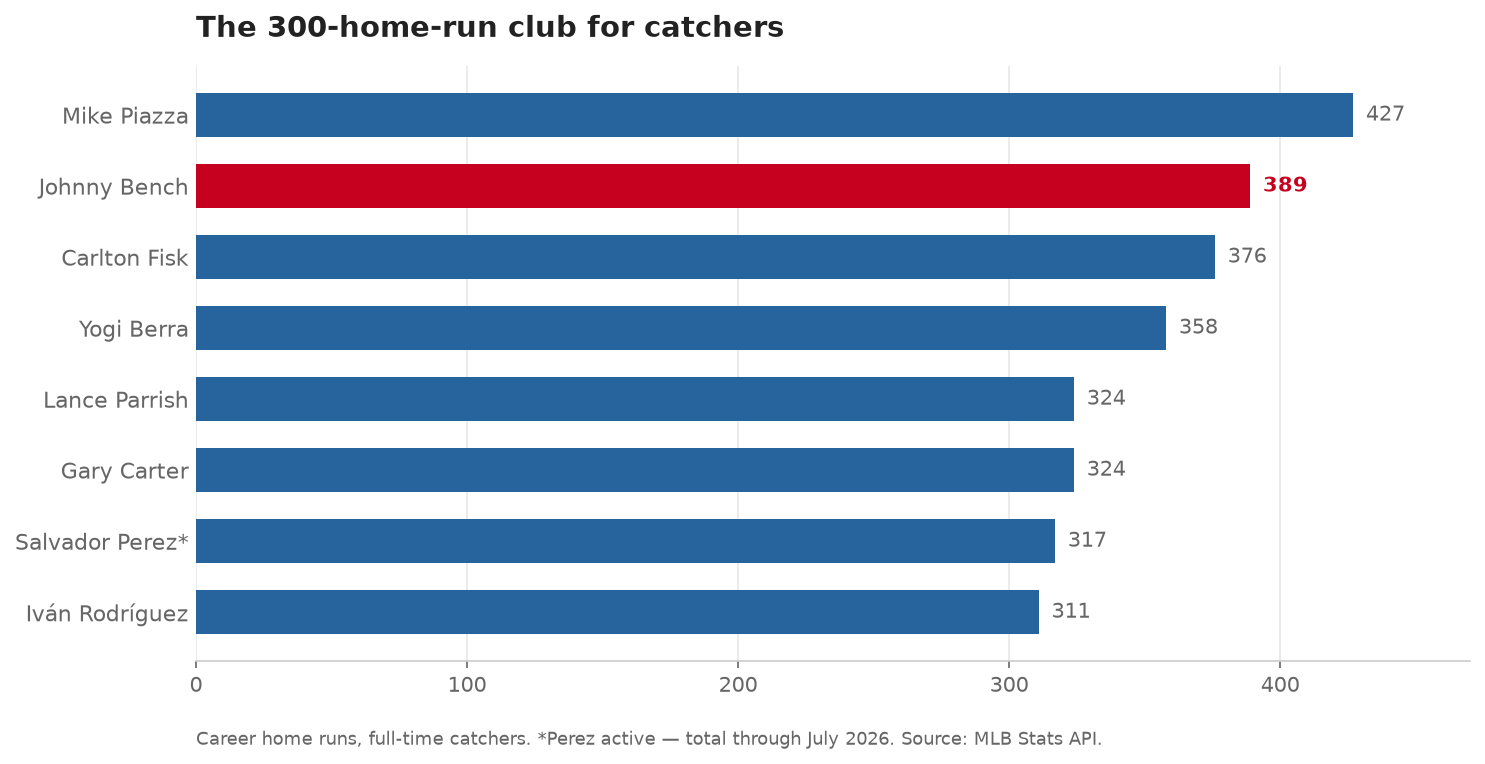
For context on where his bat stands, only eight full-time catchers have ever reached 300 career home runs. Bench’s 389 trails only Mike Piazza’s 427. We keep the full list in our catchers with 300 home runs breakdown.
One more detail for the gear-minded. Auction-verified game bats show Bench swinging 35.5-inch, 32-to-33-ounce lumber early in his career, then trimming down to about 34.5 inches and 31 ounces by the end. The bat got smaller as the legend got bigger, which is its own lesson in adjustment.
What is the Johnny Bench Award?
The award began in 2000, when a Wichita sports commission created it for the nation’s top Division I baseball catcher. Then in 2019 it found a permanent home in Cincinnati. The Reds Hall of Fame & Museum runs it now, at Great American Ball Park — Bench’s own ballpark.
Since then it has grown into something bigger. The award now honors ten catchers every year: the top NCAA Division I baseball catcher, the top Division I softball catcher, and the top high school baseball and softball catchers from Ohio, Kentucky, Indiana, and West Virginia.
Since the move, the winners gather each summer for an awards luncheon at Great American Ball Park. Then they are honored on the field before a Reds game. In 2026, Bench himself was there to shake their hands.
That last detail matters. Plenty of awards mail you a plaque. This one, though, hands you the standard in person.
Look at the reach, too. One award covers both college games and the high school ranks in four states. A high school sophomore in Kentucky and a college All-American are chasing the same name. Few honors in any sport stretch that far down the ladder.
The winners who made it to the big leagues
An award earns its reputation through its winners. The Bench Award’s track record would flatter any trophy in college sports. Consider a few names.
In the National League, the headliner is Buster Posey. He won the Bench Award at Florida State in 2008. Two years later he was NL Rookie of the Year for the Giants. In 2012 he added the NL MVP award, and by 2014 he owned three World Series rings. No winner has traced Bench’s own arc — rookie award, MVP, championships — more closely.
Georgia Tech has produced three winners of its own. Joey Bart took the award in 2018 and went second overall in that summer’s draft. Kevin Parada followed in 2022, and then Vahn Lackey in 2026, who went third overall to the Twins. Danny Hall, the ninth-winningest coach in college baseball history, is the golden thread connecting all three — he recruited every one of them before stepping away in 2025. And not to be overlooked, Zeke Pinkham, the assistant coach who works with Tech’s catchers, helped Parada and Lackey sharpen their game.
In the American League, the model is Adley Rutschman. He won at Oregon State in 2019 and went first overall in that June’s draft. Since then, he has become an All-Star behind the plate for the Orioles.
Before him, Mike Zunino won at Florida in 2012 and went third overall to Seattle. Kurt Suzuki, the 2004 winner out of Cal State Fullerton, turned his award into a 16-year big-league career.

| Year | Winner | School | What came next |
|---|---|---|---|
| 2004 | Kurt Suzuki | Cal State Fullerton | 16-year MLB career |
| 2008 | Buster Posey | Florida State | NL Rookie of the Year, NL MVP, 3x World Series champion |
| 2012 | Mike Zunino | Florida | No. 3 overall pick, MLB All-Star |
| 2018 | Joey Bart | Georgia Tech | No. 2 overall pick |
| 2019 | Adley Rutschman | Oregon State | No. 1 overall pick, Orioles All-Star |
| 2022 | Kevin Parada | Georgia Tech | Georgia Tech’s second winner |
| 2023 | Kyle Teel | Virginia | Turned pro |
| 2025 | Caden Bodine | Coastal Carolina | Turned pro |
| 2026 | Vahn Lackey | Georgia Tech | No. 3 overall pick, Minnesota Twins |
| 2026 | Kendall Wells | Oklahoma (softball) | First freshman winner in award history |
2026: a draft pick and a first
This year’s winners both made history, and CatchersHome covered both as it happened.
On the baseball side, Georgia Tech junior Vahn Lackey won the 2026 award. He hit .397 with 20 home runs and 78 RBI. A month later, the Twins drafted him third overall.
Remember, Lackey went undrafted out of high school. The standard is built, not born.
On the softball side, Oklahoma’s Kendall Wells became the first freshman ever to win — any division, any year.
She hit .358 with 39 home runs and 88 RBI, then met Bench himself at the July luncheon in Cincinnati. She has since been added to the USA Softball national team player pool.
Notice what the award is saying with those two names. The catcher’s standard does not belong to one game. It belongs to the baseball and fastpitch position equally.
What a catcher can learn from this
Go back to Bench’s five-item framework: hit for power and average, arm strength, fearless defense, quick feet, fast transfer. Yet nothing on that list requires a college scholarship. Every item scales down to a 12-year-old at a Tuesday practice.
That is the real lesson of the Johnny Bench Award. The winners did not find a secret. Instead, they stacked ordinary work — thousands of blocked balls, thousands of throws — until the ordinary became elite.
Posey did it. Rutschman did it. Wells did it as a freshman.
A name on an award is an invitation. This one is addressed to you.
Try this at your next practice
- One-handed transfer reps. Bench’s innovation is your daily drill. Receive 20 pitches with your bare hand behind your back, then 20 more working glove-to-hand as fast as you can. Time your transfer; chase your own record, not anyone else’s.
- The framework check. Write Bench’s five items on a card: power, average, arm, fearless defense, quick feet and transfer. Rate yourself honestly, one to five, on each. Then pick the lowest score and give it one focused month.
- Long-toss ladder. Arm strength is built, not issued. Twice a week, stretch your throws ten feet past comfortable. Then finish with five throws at game distance, on a line. Track the farthest clean throw. When it stops moving, add a week of lower-half work and try again.
Sources: Johnny Bench — Baseball Hall of Fame; Johnny Bench career and award winners — johnnybench.com; 2026 Johnny Bench Award winners announced — MLB.com; Vahn Lackey Wins 2026 Johnny Bench Award — Georgia Tech Athletics; Johnny Bench in The Players’ Tribune. Career statistics verified against the MLB Stats API.