
Jocelyn Erickson, Left-Handed Catcher
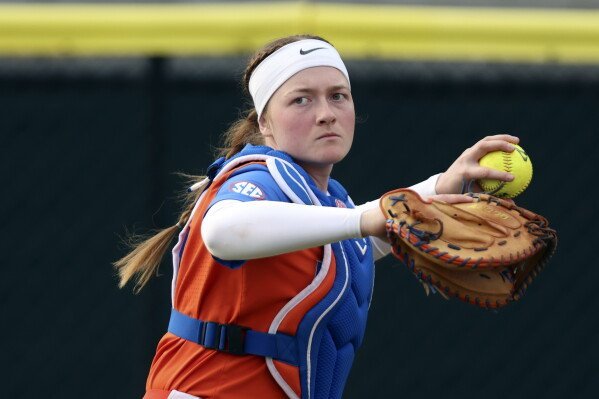
Jocelyn Erickson’s path to the Chicago Bandits proves that convention is not the same as impossibility.
Jocelyn Erickson grew up in Phoenix and started playing college ball at Oklahoma, then transferred to Florida. She won two Rawlings Gold Gloves and got drafted fifth overall by the Chicago Bandits. We covered her AUSL debut in July. But this week, MLB.com told the part of her story that does not show up in a box score.
Erickson is a left-handed catcher. At the highest level of professional softball, that is nearly unheard of.
Nobody ever told her it was a problem.
Who Jocelyn Erickson Is
Her senior season at Florida said everything. Erickson batted .400 — a career high — and finished with 80 hits, 17 doubles, 21 home runs, and 71 runs. Her career line at Oklahoma and Florida together reads .360 with 58 home runs and 251 RBIs.
She won the Rawlings Gold Glove Award twice. The Gold Glove is one of the top defensive honors in college softball. It goes to the best fielder at her position in Division I. She earned first-team All-SEC in 2026. The Chicago Bandits drafted her #5 overall.
Then, on July 13, she hit her first AUSL home run.
That is the résumé of a player who found a path no one handed her.
The Rule Nobody Enforced
Left-handed catchers are rare — genuinely rare — not because any rulebook prohibits them. The rules say nothing about which hand throws the ball. The rarity comes from tradition. Coaches at every level steer left-handed players toward first base or the outfield. Catching clinics are built for right-handers. The footwork, the mechanics, the assumed geometry of the position — all of it points the same direction.
Erickson went the other way.
According to the MLB.com feature on her, no coach ever told her she could not catch. So she caught. She worked the throws. She logged the reps. She learned to make the plays that are genuinely harder from the left side. Then she made them well enough to earn two gold gloves doing it.
Convention, it turns out, is not the same as impossibility.
What a Catcher Can Learn From This
The first question a left-handed player gets when they say they want to catch is: can you really do that?
The honest answer is yes — with extra work in specific spots. The cross-body throw to third is harder from the left side. The footwork on steal attempts is different. There are real adjustments. But none of those is a wall. Erickson’s whole career is the proof.
But here is the more important question. It applies to every catcher, not just the ones who throw left: who told you that you couldn’t?
If the answer is nobody, then you are already further along than you think. The position does not belong to people who fit a template. It belongs to people who squat down, do the work, and refuse to wait for permission.
That is something every catcher behind every plate can use.
Try This at Your Next Practice
- Left-side throw drill. From a receiving crouch, practice your throw to third — footwork, pivot, release. If you throw right-handed, you already train this. If you throw left, you need more reps here than anyone else. Set up a target at third and throw 20 from the squat, focusing on a clean pivot rather than arm strength.
- Non-dominant-side receiving. Have a partner throw to your glove-side corner over and over, forcing you to adjust your glove path. This is not about handedness — it is about learning to work a position where your body has to adapt. Erickson’s whole story is about adaptation. This drill makes the lesson physical.
- Film your mechanics. Set up a phone on a tripod and record your footwork on a steal attempt. Watch it back. What feels natural in your body looks different on video. Finding and fixing one mechanical habit is worth a season of informal reps.
Sources: AUSL’s Jocelyn Erickson is a rare left-handed catcher (MLB.com) · TV20 Sideline Spotlight: Jocelyn Erickson in the AUSL (WCJB) · Ex-Gator Jocelyn Erickson Hits First AUSL Home Run (WRUF ESPN) · Chicago Bandits ink Jocelyn Erickson (AUSL).