
Glove or Mitt? What Actually Makes a Catcher’s Mitt Different
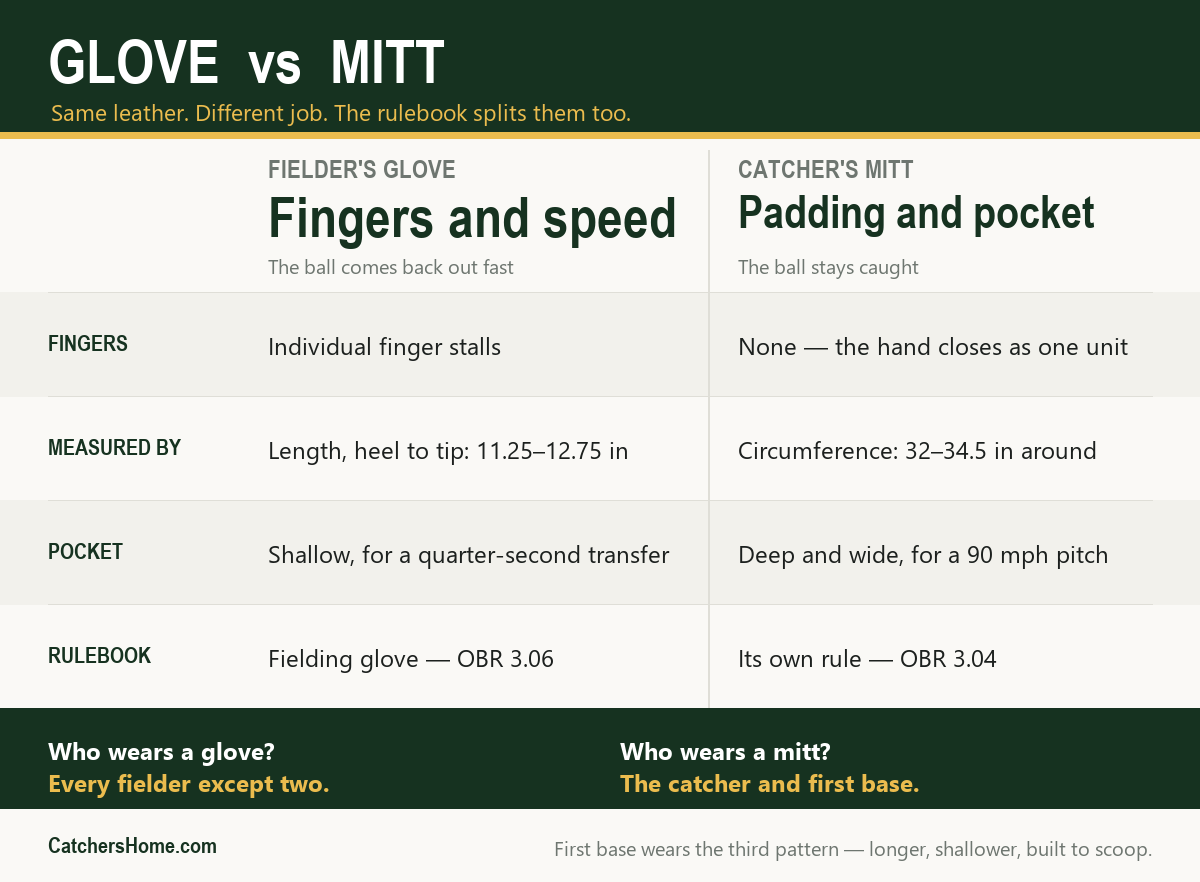
The difference between a baseball glove and a mitt(en) is fingers: a glove has individual finger stalls, and a mitt has none. Only two players on the field wear mitts — the catcher and the first baseman. Everyone else wears a glove. That one design choice explains the padding, the pocket, the sizing numbers, and even the rulebook, so it is worth two minutes to see how.
One word, two meanings
Baseball uses mitt in two ways at once, which is where the confusion starts. In casual speech, every glove on the field is a mitt. After all, nobody hands a shortstop their glove and gets corrected. On a product page, though, the word is technical: it means hand protection without separated fingers, named after the mitten it resembles.
That second meaning is the one that matters when you are buying. A retailer who lists a catcher’s mitt is telling you about the construction, not being folksy. And the construction is the whole difference, so start there.
What actually makes a mitt a mitt
Put a fielder’s glove and a catcher’s mitt side by side and three things stand out immediately.
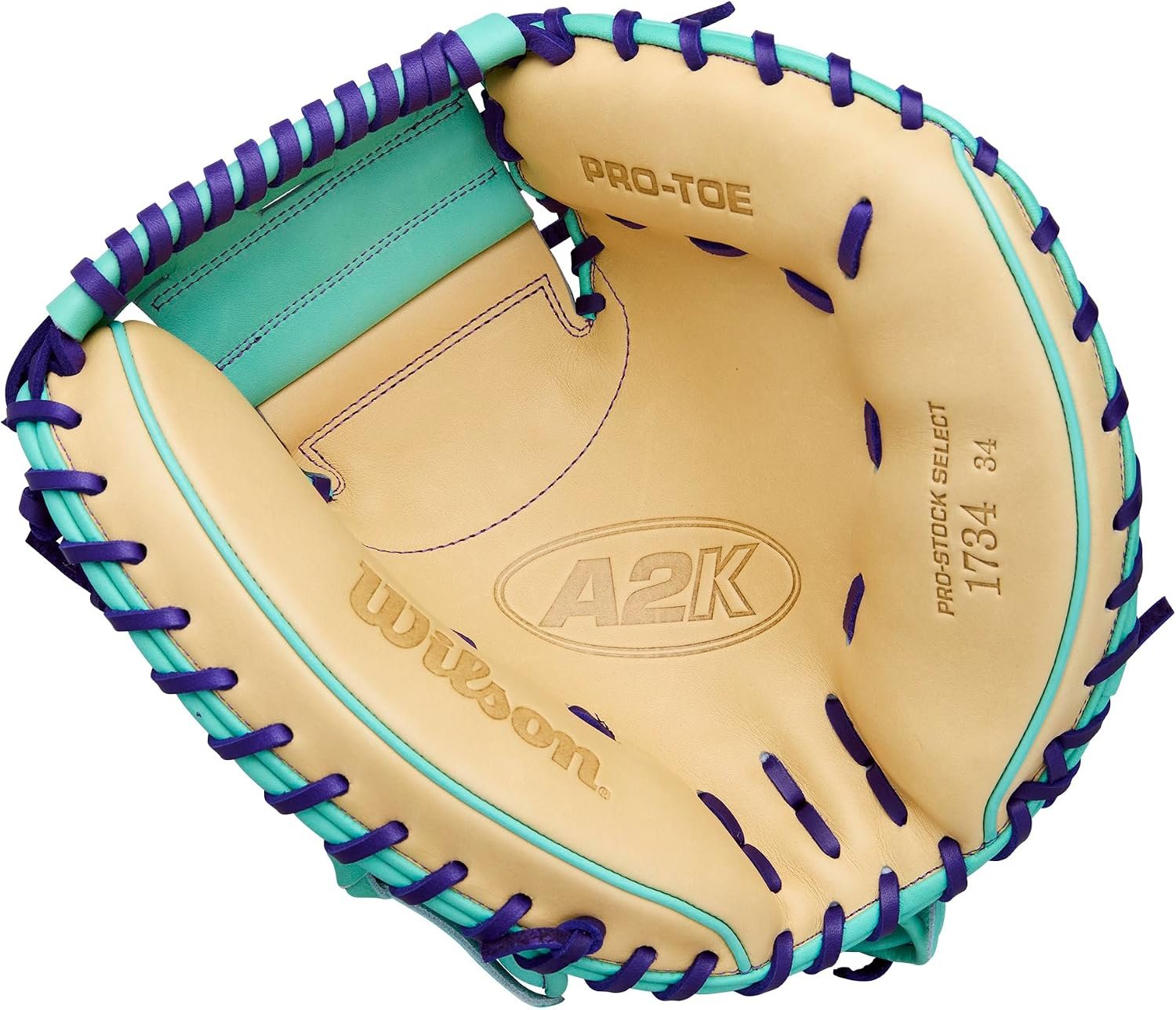
- No finger stalls. The catcher’s fingers sit together behind one continuous padded shell, so the hand closes as a single unit. As a result, the squeeze is stronger, and leather rather than fingertips sits in the path of the ball.
- A deep, wide pocket. A fielder’s glove is shallow on purpose, because an infielder needs the ball back out in a quarter second. A mitt, however, does the opposite job. The ball arrives at 90 miles an hour, so it needs to stay caught.
- Padding everywhere. A catcher takes well over a hundred pitches a game. So the heel pad, the extra-thick palm, and the reinforced hinge exist because no other position absorbs impact as a full-time duty.
There is a fourth difference hiding in the sizing numbers, and it trips up nearly every first-time buyer. Gloves are measured in length, from the heel to the tip of the longest finger — typically 11.25 to 12.75 inches. Mitts, in contrast, are measured in circumference, all the way around the catching edge. That is why adult catcher’s mitts run 32 to 34.5 inches. So a 33.5-inch mitt is not three times the glove — it is a similar hand size measured a different way, and our size chart translates between the two.
Where the mitt came from
The split is as old as catching itself. In the 1870s, catchers worked bare-handed or in thin work gloves, and their careers were short. The first real protection, in the 1880s, was shaped exactly like a mitten: a round pad of leather with no fingers at all. Players called it a mitt, and the name stuck.
Then, Fielders’ Gloves grew finger stalls over the following decades, because their job rewarded dexterity over protection. The catcher’s mitt kept the mitten shape but slimmed down over a century — from the fingerless pillow of the 1920s to the hinged, one-hand-closing design catchers use today. So the two designs are not variations on one glove. Instead, they are separate tools that have been diverging for 140 years.
The rulebook splits them too
This is not just marketing language. The Official Baseball Rules give each design its own rule and its own size limits.
| Equipment | Who wears it | Rule | Size limit |
|---|---|---|---|
| Catcher’s mitt | Catcher only | OBR 3.04 | 38 in. around, 15.5 in. top to bottom |
| First baseman’s mitt | First baseman | OBR 3.05 | 13 in. top to bottom |
| Fielding glove | Everyone else | OBR 3.06 | 13 in. top to bottom |
Notice that the catcher’s mitt is the only one measured around its edge. It also gets by far the most generous limit, because the rulebook is acknowledging what the position needs: the largest, most padded target on the field. Meanwhile, youth leagues carry the same three-way split, usually with the same numbers.
So what does the first baseman wear?
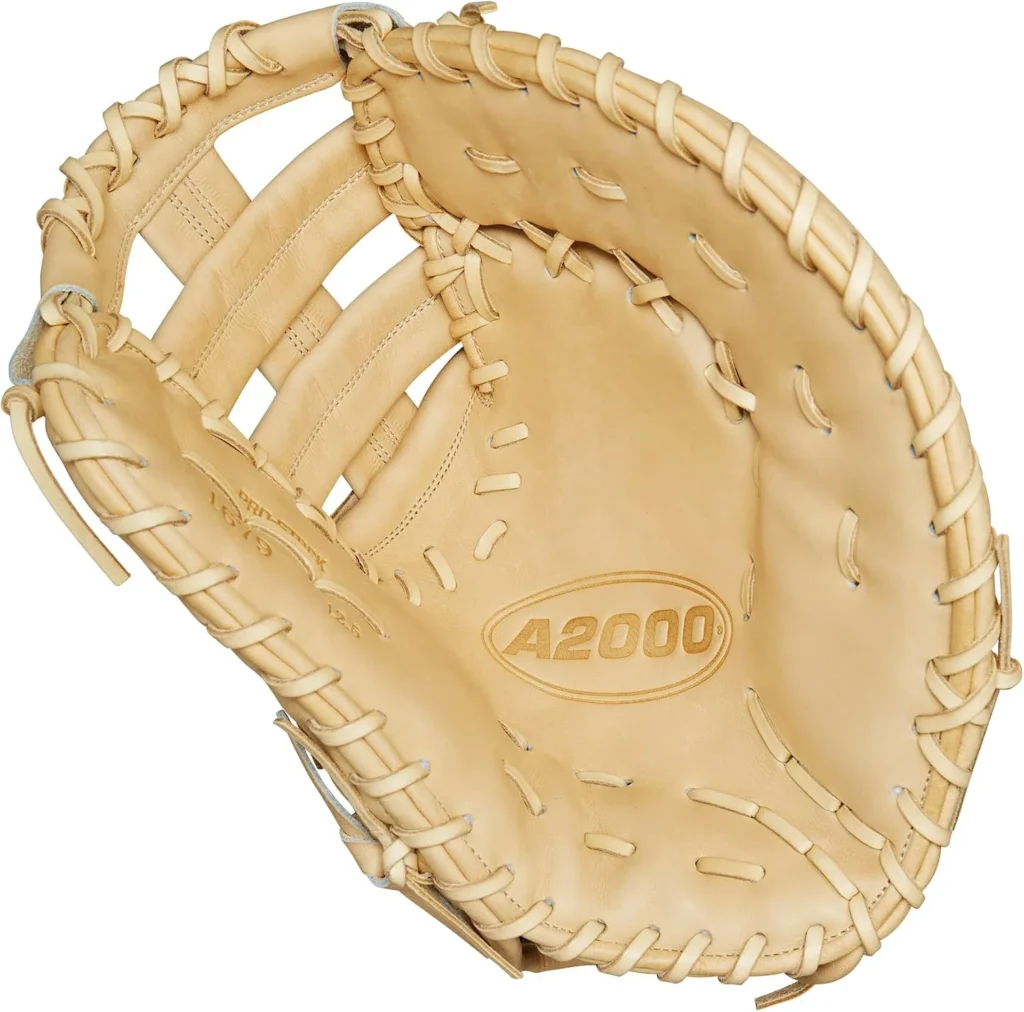
The other mitt on the field is the first baseman’s. Unlike the catcher’s mitt, it is longer, shallower, thinner, and far more flexible. A first baseman spends the game stretching for throws and scooping short hops out of the dirt. So the mitt is built like a shovel rather than a catcher’s wall.
That is also the honest answer to whether one mitt can do the other’s job. Beyond the rulebook assignment, a catcher’s mitt is simply bad at first base. It has too much padding, too little reach, and a pocket that swallows the ball when you need a fast transfer. In short, the designs diverged a century ago because the jobs did.
The mitt this page is not about
One more piece of equipment borrows the word and confuses shoppers: the sliding mitt, the oven-mitt-shaped guard baserunners wear to protect their hand when they slide head first. It is not a fielding mitt at all — you cannot catch anything with it. A sliding mitt is a different thing entirely, and we cover it separately.
What this means when you buy
For a catcher, the label to look for is catcher’s mitt, and the number to expect is a circumference in the low thirties. But if the listing shows an 11.75-inch size or visible finger stalls, you are looking at a fielder’s glove wearing loose language. That mix-up is common on marketplace listings, because a whole family of gloves often shares one product page. It is also why we read the leather and the stamp, never just the title, before recommending anything.
From there, the decision becomes the normal one: ball type, size, leather, pattern, and tier, in that order. Our five-decisions guide walks the whole sequence, and a mitt-shaped question this page did not answer probably lives there. For a young catcher, the youth mitt roundup narrows the shelf to models a growing hand can actually close.
Glove or mitt? FAQs
What’s the difference between a baseball glove and a baseball mitt?
A glove has individual finger stalls. A mitt does not. On a mitt, the fingers sit together behind one padded shell, the way they would in a mitten. That single difference drives everything else — the deeper pocket, the heavier padding, and the fact that mitts are measured around the outside edge instead of tip to heel.
Is it a glove or a mitt?
If it has fingers, it is a glove. If it does not, it is a mitt. In casual speech, players call everything a mitt, and no umpire will correct you. On a product page, though, the words are exact. A catcher’s mitt and a catcher’s glove are the same item, but a fielder’s glove is a different piece of equipment entirely.
Why are baseball gloves called mitts?
The word comes from mitten, and it stuck to all gloves through a century of casual use. The earliest catchers’ hand protection in the 1880s really was mitten-shaped — no fingers, just padding. Fielders’ designs later grew finger stalls, but the old word never left the language. So today, mitt is slang for every glove and the technical name for exactly two of them.
Who wears a mitt in baseball?
Two players: the catcher and the first baseman. Everyone else wears a fielding glove with separated fingers. Each of the two mitts gets its own rule in the Official Baseball Rules, with its own size limits, because each is shaped for a job no other position has.
Can a catcher’s mitt be used at first base?
Not in rulebook baseball — each mitt is assigned to its own position. The Official Baseball Rules define the catcher’s mitt for the catcher and the first baseman’s mitt for first base. In a rec league nobody is measuring, but the mitt itself will argue with you anyway. It is built to trap a pitch, not to stretch and scoop a low throw.
Is a softball catcher’s mitt different from a baseball catcher’s mitt?
Yes — a fastpitch catcher’s mitt has a slightly longer, thinner shape and a pocket sized for the bigger 12-inch ball. The glove-versus-mitt distinction works exactly the same way in softball. The catcher wears the mitt, and every fielder wears a glove. Our fastpitch mitts guide covers the models built for that ball.
Ready to look at actual mitts? The baseball catcher’s mitts guide organizes every tier we cover, the fastpitch guide does the same for softball, and the break-in guide takes over the day the new one arrives. Everything sits under our catcher’s mitts pillar.