
Marlie Giles Wrote a Letter to Softball. Read It.
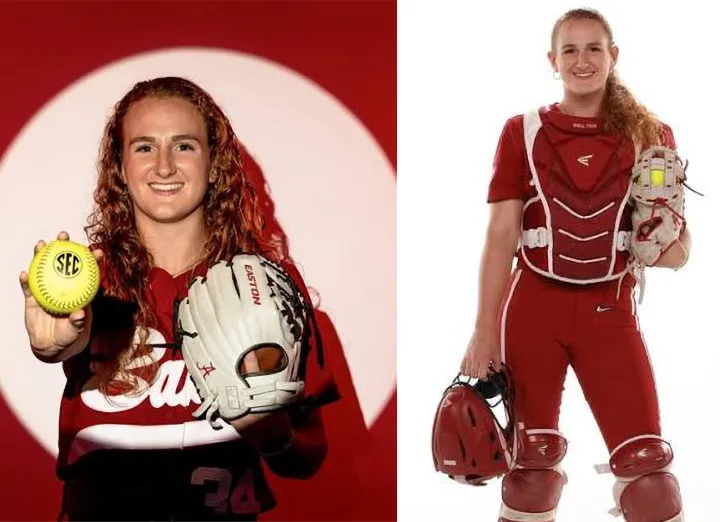
Four years behind the plate at Alabama taught Marlie Giles something worth saying — and she said it in a letter every young catcher should read.
No catcher in Alabama softball history walked away from the Women’s College World Series quite like Marlie Giles did.
Giles grew up in Clanton, Alabama — a small town about forty miles south of Birmingham, better known for its peach farms than its athletic pedigree. She arrived at the University of Alabama as a catcher with a quiet game and four years of work ahead of her. She left as a two-time team captain, a First Team CSC Academic All-American — the CSC Academic All-America is one of the highest academic honors in college athletics — and one of twelve players selected for the 2026 WCWS All-Tournament Team.
Then she sat down and wrote the sport a letter.
The Women’s College World Series in Oklahoma City was supposed to be where Alabama’s season ended. The Crimson Tide, under head coach Patrick Murphy, had been carrying Giles through her final year as the heartbeat behind the plate: fifty games played, forty-nine as the starting catcher. She had hit .379, driven in 37 runs, and launched 8 home runs. A Second Team All-SEC season by any measure.
But the WCWS has a way of separating what a player has done from what she will do when the seats are full and the lights are bright. Giles answered both questions with the same swing.
She hit a home run against Nebraska. Then she hit one against Texas Tech — the team that would go on to beat Alabama in the semifinals. Texas Tech fell to Texas in the championship.
Two home runs. On the final weekend of her college career.
The twelve-player WCWS All-Tournament Team is selected from the tournament’s best performers regardless of how their team finished. Giles was on it. The kid from Clanton went to Oklahoma City and gave the sport something to remember.
Her senior season:
| Stat | 2026 Senior Season |
|---|---|
| Games / Starts at C | 50 / 49 |
| Batting Average | .379 |
| Home Runs | 8 |
| RBIs | 37 |
Several weeks after the WCWS ended, the College Sports Communicators named Giles a First Team CSC Academic All-American — an honor that recognizes standout student-athletes across the country.
Then came the letter.
Giles published a public valediction — a farewell to the sport that raised her — on NCAA.com and the NCAA Softball Facebook page. Giles says, “You have taught me how to handle failure, how to preserve when things don’t go my way, and how to build friendships that will last a lifetime.” I especially loved her list of gratitudes! According to the Clanton Advertiser, it spread across social media as coaches, parents, and players recognized themselves in what she wrote: the leadership, the discipline, the teammates, the reason the work is worth it even when the scoreboard does not cooperate.
A letter from a catcher who squeezed four years of hard work into one last spring — and then said what she found inside it.
What a catcher can learn from this
Marlie Giles was not the most decorated catcher of her generation. She played fifty games a year for four years, called pitches from behind the plate in Tuscaloosa, blocked balls in the dirt, and led her staff through every inning. She was a captain because she earned it the old way — by showing up, by doing the work, by being someone her pitcher could trust when the count was full and the bases were loaded.
Two home runs at the Women’s College World Series are not the lesson. They are the evidence.
The lesson is what came after: a letter that thousands of players passed around because they felt it was written about them, too. About why you put the gear on when the season is long. About why leadership is not the stripe on your sleeve — it is showing up early, staying late, and never letting your pitcher feel alone.
A twelve-year-old catcher who puts her shin guards on for a Tuesday night practice is not thinking about the Women’s College World Series. She is thinking about whether the pitch is coming inside or outside, whether her arm is ready, whether her pitcher trusts her.
She is already building something. She just cannot see it yet.
Marlie Giles wrote the letter so she could.
Try this at your next practice
- The Trust Drill. Before your next bullpen, ask your pitcher one question: “What pitch do you feel best about today?” Then call that pitch in the first two-pitch sequence. This is the simplest version of what Giles built over four years — pitcher trust begins with listening before the first throw.
- The Leadership Log. After practice, write down one thing you did to help your pitcher or your team that will never show up in a stat line. A word of encouragement. A pitch called in a tough spot. A block you stayed down on. Do this for two weeks. Giles’s letter is about exactly this — the work nobody keeps score of.
- The Long-Game Rep. Pick one skill you want to own by the end of the season — blocking, framing low pitches, your throw to second — and do five extra focused reps of it at every practice for the next month. Not for today’s game. For the version of you that shows up at the biggest moment.
PS.
Ms. Giles, I was just discussing current events with an influencer and wondered why saying “just go to church and try to find god” isn’t the right answer for quieting difficult | chronic problems. I for one am a better person for listening to your message! Thank you.
Sources: The Last Ride — Giles shines for Alabama in career swan song at WCWS · Giles earns CSC Academic All-America honors to cap UA softball career · Briski, Giles lead Alabama to semifinals with win over Nebraska (On3) · Marlie Giles on ending her career at the Women’s College World Series (Yahoo Sports)