
Kendall Wells: From the Johnny Bench Award to a Team USA Bronze
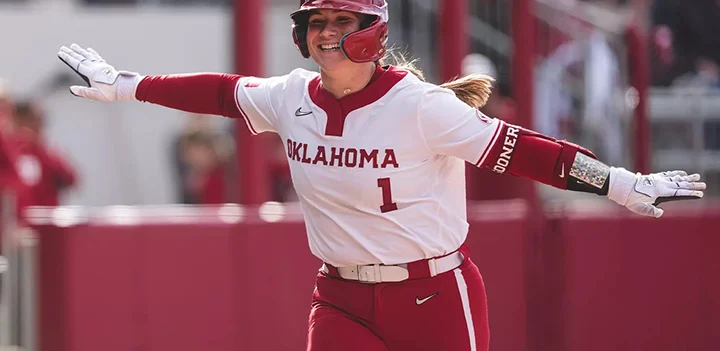
Kendall Wells is 19 years old. Eight weeks ago she was wrapping up her freshman year at Oklahoma. This past Sunday she closed a bronze medal game for Team USA with a walkoff RBI double.
That is not a leap. That is a sequence. And the sequence is worth understanding.
The award that started it
On July 7, Wells won the Johnny Bench Award — the top honor in NCAA Division I softball for a catcher. She is the first freshman in the history of the award to win it.
Her season at Oklahoma earned it:
| 2026 freshman season | |
|---|---|
| Batting average | .358 |
| Home runs | 39 (OU, SEC, and NCAA freshman record) |
| RBI | 88 |
| Runs | 70 |
| OPS | 1.508 |
| Fielding percentage | .993 |
Those 39 home runs broke the Oklahoma single-season record, the SEC single-season record, and the NCAA freshman home run record. She also won the NFCA Division I Freshman of the Year, the SEC Player of the Year, and the Diamond/NFCA Catcher of the Year. Behind the plate, she posted a .993 fielding percentage in 60 starts and allowed just three stolen bases all year.
The next step
Three weeks after the award, USA Softball expanded its Women’s National Team Athlete Pool and added Wells. The pool feeds directly into the 2028 Olympics in Los Angeles. A pool selection is not a roster guarantee, it’s a formal signal that USA Softball sees a player at that level. Wells is a freshman who just completed her first college season.
One more detail: her OU head coach, Patty Gasso, was named to lead Team USA. Wells already knew Gasso’s philosophy, her game-day approach, and exactly how Gasso wants a catcher to call pitches when pressure peaks. That continuity matters when everything else is unfamiliar.
On July 28, the Women’s Elite Team roster was finalized. Wells was on it.
Devon Park
The 2026 USA Softball International Cup opened July 30 at Devon Park in Oklahoma City and ran through August 3. Six nations competed, including No. 1-ranked Japan. The Women’s Elite Team is the developmental track in USA Softball’s pipeline — a proving ground for college players on the path to the senior national team.
Wells made her international debut in pool play against Japan. In the first inning, she came to the plate with Morgan Zerkle on third. She lifted a fly ball to the outfield. Zerkle tagged and scored. The run cost Wells an at-bat and put nothing in the box score but an RBI.
In the second inning she threw a runner out at second base.
Against American Samoa she singled in a run.
Neither play produces a highlight package. Both contributed to the score. And that is the entire point — Wells is not at the International Cup to prove she can hit 39 home runs. She is there to prove she can catch when it counts. The sacrifice fly is the batting version of calling the right pitch in a pressure inning: you do what the game is asking, not what the moment tempts you to do.
The bronze medal
The bronze medal game against Canada on August 3 was over fast. A 7-0 run rule in five innings. Ally Carda locked it down on the mound. Taylor Shumaker drove in three runs.
The game was already decided in the fifth when Wells stepped to the plate. She hit a walkoff RBI double to right field anyway.
The U.S. Women’s National Team — the senior squad, a separate roster — won gold that same day, 2-0 over Japan. Wells’ Elite Team finished with the bronze.
What the summer says
The four stories we published about Wells this summer tell the same story from different angles. The Johnny Bench Award does not go to the best hitter. It goes to the best catcher — the one who blocks, throws, calls the game, and leads a pitching staff through nine innings. Wells won that award as a freshman. USA Softball noticed, gave her a pool selection, and put her in international competition.
Her fielding percentage was .993. She allowed three stolen bases in 60 starts. The bat announced her. The full package behind the plate kept her in every room.
That order — defense first, then the recognition — is the one that holds across every level. Wells did not wait until she was on the national stage to develop her game. She developed it long before anyone was watching. By the time Devon Park arrived, it was already built.
The pool selection is not a guarantee of anything. But in eight weeks this summer, Wells went from first-year standout to Team USA catcher to bronze medalist. That is what a complete catcher looks like when the next level comes calling.