
Framing or Blocking? Choosing a Catcher’s Mitt by Playing Style
Framing and blocking ask opposite things of a catcher’s mitt: a framer wants a lighter mitt with a moderate pocket that closes quietly in one motion. Meanwhile a blocker wants a stiffer, deeper, more stable pocket that refuses to give the ball back. Almost no buying guide covers this, because it is the one decision axis that is not dependent upon brand, price or size. So this page frames what each duty requires of the leather, then maps the mitts we have reviewed onto both styles. If you have not settled size and leather grade yet, start with the five decisions that matter and come back.
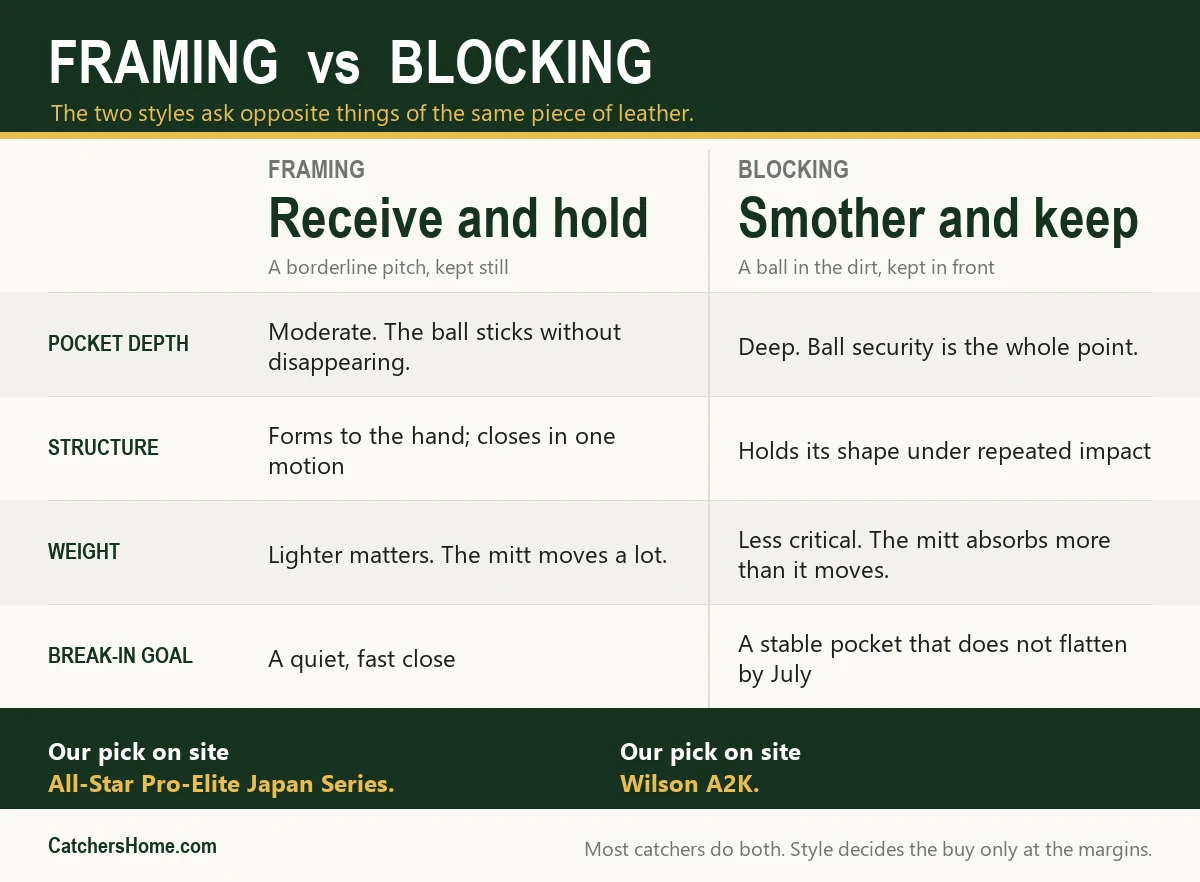
Framing vs blocking at a glance
| Framing | Blocking | |
|---|---|---|
| Duty | Receive a borderline pitch and hold it still | Smother a ball in the dirt and keep it in front |
| Pocket depth | Moderate — the ball sticks without disappearing | Deep — ball security is the whole point |
| Structure | Forms to the hand; closes in one motion | Holds its shape under repeated impact |
| Weight | Lighter matters; the mitt moves a lot | Less critical; the mitt absorbs more than it moves |
| Break-in goal | Quiet, fast close | Stable pocket that does not flatten by July |
| Our pick on site | All-Star Pro-Elite Japan Series | Wilson A2K |
What framing actually asks of a mitt
Framing is a presentation problem, not a catching problem. The umpire has already started forming an opinion when the ball arrives. So everything that happens after the catch — a shift, a re-grip, a wrist that rolls to settle the ball — is evidence against you. The mitt’s only job is to let the catch finish in one motion and then stop moving.
That points at three things.
- First, weight: a lighter mitt gets to the spot without the arm dragging it there.
- Second, close: a mitt that snaps shut with one hand is a mitt you never have to re-grip.
- Third, pocket depth in the middle of the range, because a ball that buries itself is a ball you have to dig for.
Neither of those points depends upon leather grade, which is why the leather explainer will not answer this question for you. Instead it is mostly pattern and break-in.
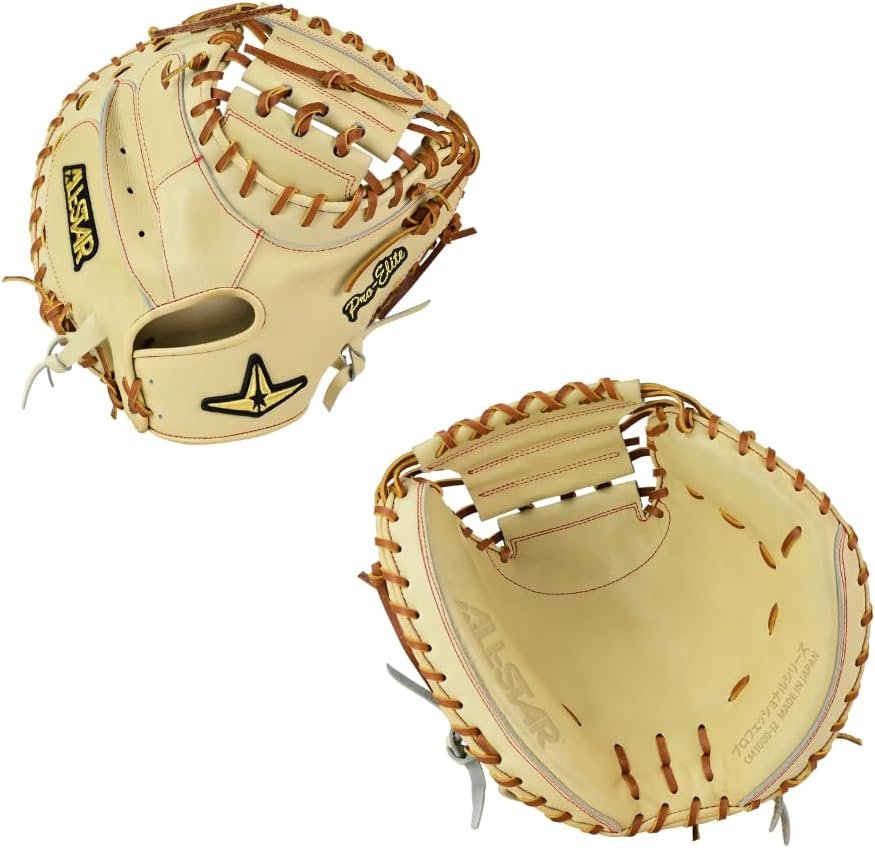
The one mitt in our coverage built explicitly for this is the All-Star Pro-Elite Japan Series, launched in 2025. It runs a rotated hand pattern with a wider palm, looser webbing, and a lower-profile pinky and thumb region. That is All-Star’s own description of a receiving-first design, rather than the block-and-smother shape the standard US pattern favors. One buyer called it noticeably larger and closer to a catcher and first-base hybrid than a traditional mitt. It comes in 34 inches only, so it is a commitment. Our All-Star Pro Elite review covers where it sits against the standard pattern.
What blocking actually asks of a mitt
Blocking is the opposite problem. Here the mitt is not presenting anything. Instead it is absorbing a ball that arrived on a bad hop with a runner on third. The only question is whether that ball stays in front of you.
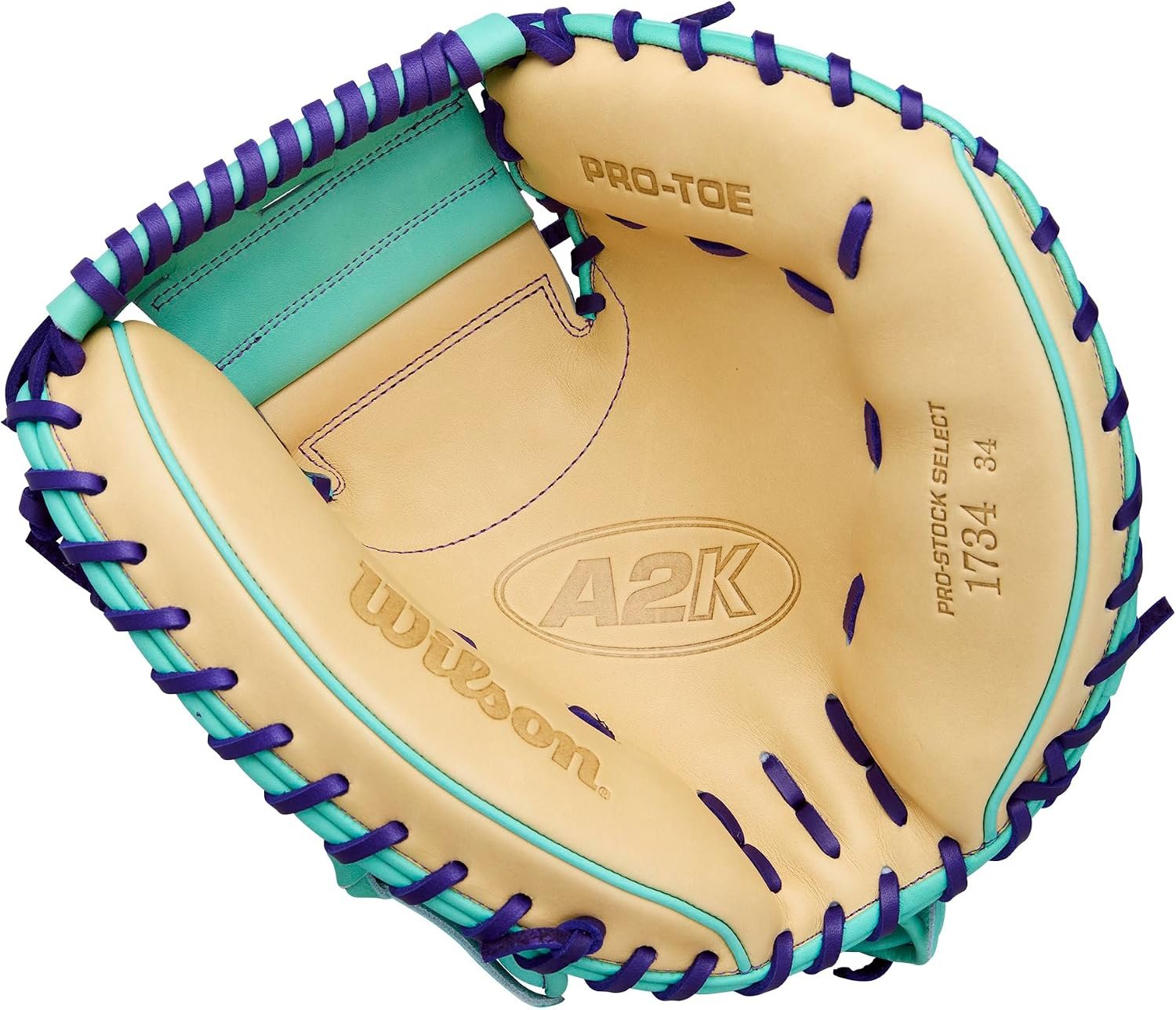
So a blocker is buying pocket stability above everything. The Wilson A2K is the clearest example we have reviewed: Double Palm Construction stitches a second layer of leather between the palm and the interior liner. Four independent sources confirm that build detail in our A2K vs A2000 comparison. That layer is not a spec-sheet flourish. It stabilizes the pocket under repeated impact, which means fewer balls squirting loose and less punishment for the catching hand across a season. Owners describe the pocket the same way over and over: the balls come in, and they do not come out.
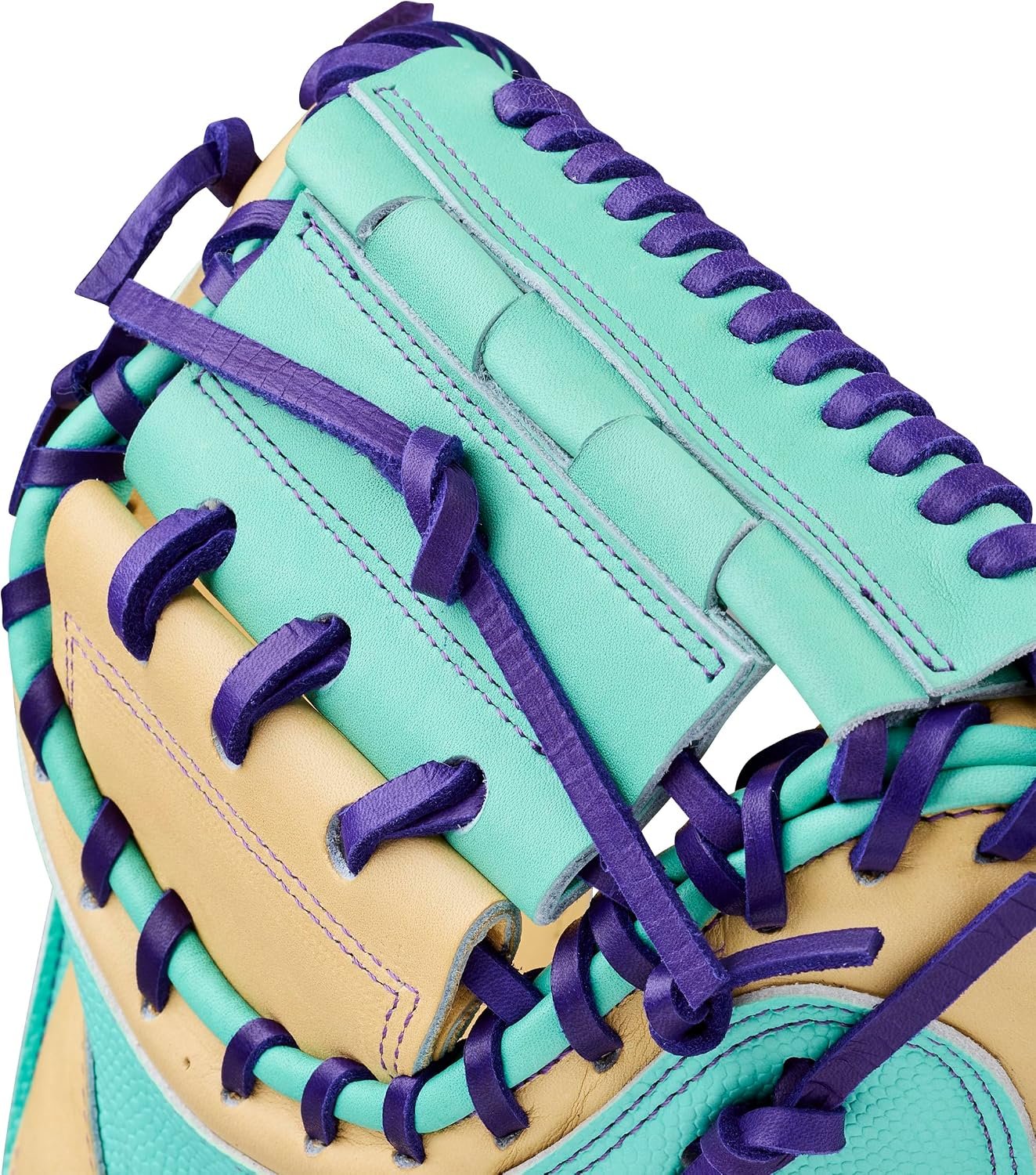
The All-Star Pro Elite CM3000 is the other blocking mitt on the site, and it gets there differently. Two leathers do two jobs there. A supple tan pocket shapes around the ball, while a stable black back holds structure through a season. On top of that sits a two-piece web and an extended pro pocket, which adds catchable surface on the pitches that miss low or arm-side. Both mitts sit in our premium roundup, scored on the same five dimensions.
The four specs that actually split the two styles
Brand does not decide this. These four do, and three of them never appear on a product page in these words.
- Palm construction. A second palm layer, like Wilson’s Double Palm Construction, buys pocket stability under impact. It also adds weight and stiffness. That is a blocker’s trade, not a framer’s.
- Pocket depth. Deeper means more ball security and a slower transfer. Moderate means the ball sticks without burying. Blockers want depth; framers want the middle.
- Pattern and palm width. A wider palm with looser webbing receives; a tighter, more structured pattern smothers. This is the axis All-Star’s Japan Series is built on.
- Break-in path. A mitt broken in by reps holds the shape those reps gave it. Framers feel that difference on every borderline pitch.
Note what is missing from that list: size. A bigger mitt is not a framing advantage. Wilson’s larger 1790 pattern specifically draws more tough-break-in complaints than the line’s reputation suggests, and the extended patterns generally mean a longer break-in. Size belongs to hand and level, which is what our size chart is for.
The mitts we have reviewed, mapped to style
Every mitt below is a baseball catcher’s mitt we have reviewed against the same rubric. Prices are the bands we recorded in July 2026, and premium leather prices move — check the live listing before you buy.
| Mitt | Leans | Why | Lowest price |
|---|---|---|---|
| Wilson A2K | Blocking | Double Palm Construction; deepest, most stable pocket of the four | |
| All-Star Pro Elite CM3000 | Blocking | Extended pro pocket, two-leather build, block-and-smother pattern | |
| All-Star Pro-Elite Japan Series | Framing | Rotated hand pattern, wider palm, looser webbing, receiving-first | |
| Wilson A2000 | Balanced | M1D SuperSkin extends the palm to cut rebound; most predictable break-in | |
| Rawlings Heart of the Hide | Balanced | Deepest pattern lineage (Rutschman AR35, Molina YM4); forms to the hand |
Two of those are worth reading side by side rather than in isolation. Our Heart of the Hide vs A2K comparison splits them on exactly this axis. Meanwhile the A2K vs A2000 comparison answers whether that pocket stability is worth roughly a hundred dollars.
Most catchers do both. So how do you decide?
Here is the honest version: playing style should break a tie, not start the search. If two mitts have survived your size, leather and budget filters, then style picks the winner. If you are still choosing between four brands, style is not your problem yet.
When it does come down to style, answer one question. What does a normal inning look like for you? A catcher working behind a staff that lives at the bottom of the zone spends real innings in the dirt. So that catcher should buy the stable pocket. Meanwhile a catcher behind a strike-throwing staff spends those innings receiving on the edges. There, a quiet close is worth more than an extra layer of palm leather.
Level matters too. Below high school, style is close to noise. A young catcher’s results are decided by whether the mitt fits and closes, not by pocket architecture. So size down, buy the mitt they can shut, and let style become a question when the innings get serious.
What this decision does not cover
This page is scoped to baseball catcher’s mitts. Fastpitch uses different patterns and sizing for a 12-inch ball. So the framing and blocking trade-offs do not transfer cleanly, and that is worth its own comparison rather than a footnote here. This page also assumes a mitt you intend to break in properly. After all, none of the above survives leather that was steamed soft in a hurry. Our break-in guide covers the part that actually determines how a mitt closes.
Try this before you buy
- Close the mitt one-handed, hard, ten times. If you need the throwing hand to finish it, it is either too big or too stiff for you right now.
- Have someone toss you ten balls at the knees. Count how many need a second motion to settle. That number is your framing tax.
- Put a ball in the pocket and turn the mitt over. A deep, stable pocket holds it. A shallow one drops it. Neither is wrong — it tells you which style the mitt is built for.
- Check the weight against a mitt you already own. Weight is a seventh-inning problem, not a first-inning one.
Framing and blocking mitt FAQs
What is the best catcher’s mitt for framing?
The best framing mitt is a lighter, moderately deep mitt that closes quietly with one hand and has been broken in to the shape of your hand. No model wins this outright. But the closest thing to a purpose-built framing mitt is All-Star’s Pro-Elite Japan Series. It uses a rotated hand pattern with a wider palm and looser webbing, built for receiving rather than smothering.
What is the best catcher’s mitt for blocking?
The Wilson A2K. Double Palm Construction adds a second layer of leather between the palm and the liner, and that is what keeps a pocket stable under repeated impact. Owners describe the result simply: balls come in and they do not come back out. Meanwhile the All-Star Pro Elite CM3000 is the other serious blocking mitt, with an extended pro pocket built for the block-and-smother style.
Should a framing mitt be stiff or soft?
Broken in, not soft. A stiff mitt forces a re-grip, and a re-grip drags the ball out of the zone after the umpire has already seen it. Yet a mitt that has gone genuinely soft loses the pocket shape that makes the catch quiet in the first place. So the target is a mitt that snaps shut in one motion, which is what a proper break-in is actually for.
Does pocket depth matter for framing?
Yes, but the deepest pocket is not the best one for framing. A deep pocket buys ball security, which is why blockers want it. However, it also buries the ball and slows the transfer. Framers generally do better with a moderate depth that lets the ball stick without bouncing and without disappearing.
Can one catcher’s mitt do both framing and blocking?
Yes, and most catchers should buy exactly that mitt. Playing style only decides the purchase at the margins, and the margins matter most at high school level and above. Below that, size and break-in matter more than style, so start with our five-decision guide instead.
Does a bigger catcher’s mitt help with framing?
No. Extra inches add surface area and weight, not strikes. Wilson’s larger 1790 pattern draws more tough-break-in complaints than the line’s reputation would suggest, which is the cost of size in plain view. A framer is better served by a mitt that closes fast than by one that covers more air.
Still narrowing the field? Start at how to choose a catcher’s mitt for the five decisions in order, then compare the finalists in our premium mitts roundup. Everything on this page sits under the baseball catcher’s mitts collection.