
Best Wheeled Catcher’s Bags: Rolling Bags Compared
CatchersHome may earn a commission from qualifying purchases made through the links on this page, at no extra cost to you. We only recommend gear we would put behind our own plate.
The best wheeled catcher’s bag for most players is the Bownet Commander — 127 liters sorted into fourteen compartments, with a molded helmet case and treaded wheels built for gravel. The All-Star S7 Elite Roller holds the most at 140 liters, and the No Errors NO E2 is the only bag that warranties its wheels for three years. We compare every bag on published measurements and owner reports, and we tell you when a bag we recommend isn’t one we earn from.
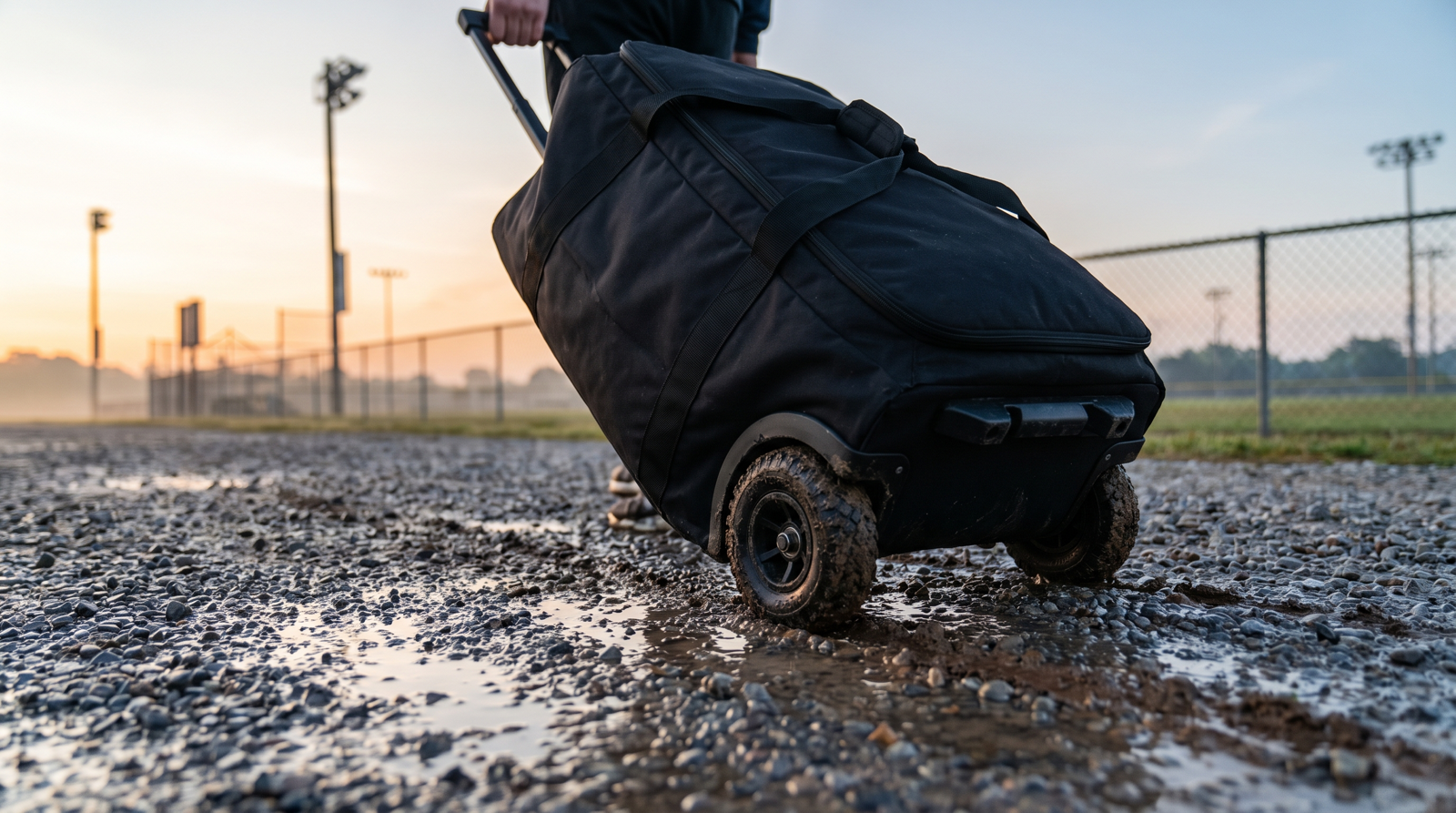
There is a moment every travel-ball family knows. It is 7:10 on a Saturday morning, the lot is gravel, the field is the far one, and somebody has to move forty-five pounds of catcher’s gear across three hundred yards of it.
That is the entire argument for a catchers bag with wheels. It is also, as it turns out, the entire argument against buying the wrong one.
Search this category and you will find every manufacturer ranking its own rolling bag first. But not one of them puts a Boombah next to a Bownet next to a Rawlings. So we did, using the only measurement all of them publish.
The picks at a glance
| Award | Bag | Volume | Why it won |
|---|---|---|---|
| Best overall wheeled bag | Bownet Commander | 127 L | Fourteen compartments, a molded helmet case, and treaded wheels built for gravel |
| Most capacity | All-Star S7 Elite Roller | 140 L | The ceiling in this category, plus six bat sleeves |
| Lightest full-size roller | Mizuno MX Equipment G2 | 133 L | 8.5 pounds empty, and running boards that keep it upright |
| Best warranty | No Errors NO E2 | 85 L | Three years on the wheels, which is the part that always fails first |
| Best for youth travel teams | Rawlings Gold Collection Wheeled | 74 L | Small enough that the player pulls it instead of fighting it |
| Best crossover batpack | Boombah Rolling Superpack 2.0 | 49 L | Four bats and a shoe compartment, but read the warning below first |
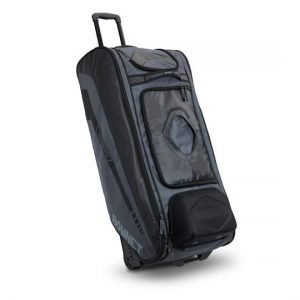
Bownet Commander
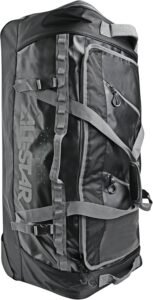
All-Star S7 Elite Roller
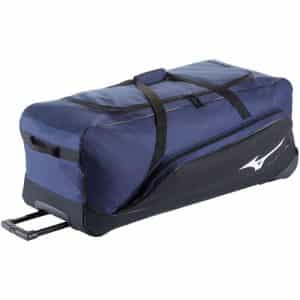
Mizuno MX Equipment G2
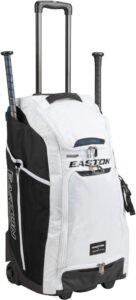
Easton Jen Schro (fastpitch)
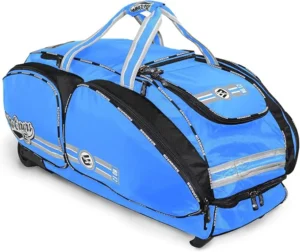
No Errors NO E2
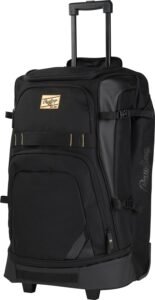
Rawlings Gold Collection
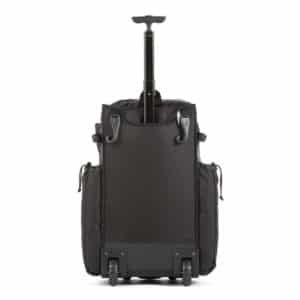
Boombah Rolling Superpack
First, the honest question: do you actually want wheels?
Wheels are not a free upgrade. They are a trade, and the trade goes badly in three specific places.
Gravel and grass. Small hard wheels stop dead in loose stone. Big treaded wheels handle it, and every bag on this page that costs real money has them for that reason. Still, on wet outfield grass you will end up carrying the bag. And now you are carrying the chassis too.
Dugout space. A rolling bag is rigid and tall. So in a crowded dugout it takes floor space that a duffel would give back by collapsing. In fact, some coaches ban them from the bench for exactly that reason.
Bus and carpool travel. A wheeled bag does not stack, does not squash, and does not go in an overhead rack. So if your season involves a team bus, ask before you buy.
Set against that, one thing decides it for most catchers: a loaded catcher’s bag weighs 35 to 50 pounds, and a twelve-year-old should not carry that on one shoulder twice a weekend for four months.
So the rule of thumb is simple. Pavement and a heavy load means wheels. Grass, stairs, and buses mean a backpack. If you land on the backpack side, our main catcher’s bag roundup covers the best of those.
Every wheeled bag, measured
Manufacturers publish dimensions but not capacity, so we converted every published dimension into bounding-box liters. Mizuno is the one brand that publishes both, and its stated 133 liters matches our calculation of 132.7 — which is what tells us the rest of the column can be trusted.
| Bag | Dimensions (in) | Volume | Empty weight | Bats | Wheels | Cleat storage |
|---|---|---|---|---|---|---|
| All-Star S7 Elite Roller | 36 × 17 × 14 | 140 L | Not published | Up to 6 | Heavy-duty, high clearance | Shared compartment |
| Mizuno MX Equipment G2 | 36 × 15 × 15 | 133 L | 8.5 lb | 1–4 | Off-road, running boards | Separate, ventilated |
| Bownet Commander | 38 × 17 × 12 | 127 L | 15 lb | 3 | Big Trax rubber tread | Separate, ventilated |
| Easton Jen Schro Wheeled (fastpitch) | 28 × 16 × 12 | 88 L | Not published | Yes | Inline | Yes |
| No Errors NO E2 | 36 × 12 × 12 | 85 L | Not published | 3 × 34 in. | FatBoy, any surface | 3 vented compartments |
| Rawlings Gold Collection Wheeled | 25 × 15 × 12 | 74 L | Not published | 2 | Rugged, telescoping handle | Internal, ventilated |
| Boombah Rolling Superpack 2.0 | 23.5 × 13.5 × 9.5 | 49 L | Not published | 4 | Standard, molded base | Separate shoe compartment |
Two things jump out of that table.
First, the spread is enormous. The largest bag here holds nearly three times what the smallest one does. So “rolling catcher’s bag” is not one product category. It is at least two.
Second, almost nobody publishes weight. Bownet and Mizuno do. That is worth noticing, because empty weight is the number a rolling bag most wants you to ignore.
The bags, one by one
Best overall: Bownet Commander
Bownet built the Commander around a simple idea: a catcher’s load is not one thing, so it should not go in one room.
Fourteen pockets and compartments split the 127 liters. The main compartment sits above a molded semi-hard case sized for a helmet and spikes. As a result, the two heaviest and dirtiest items stop crushing everything else. The interior shelving lifts out when you want the space back. Then bats ride in a three-bat side pocket, shin guards get their own side pocket, and cleats get ventilated storage. Finally, small pockets hold a phone, a water bottle, and batting gloves.
The Big Trax wheels are rubber and treaded rather than small and hard, so gravel is a non-event. Bownet also backs the bag with a one-year limited warranty.
Now the part the marketing does not lead with. It weighs fifteen pounds empty. That is the price of the molded case and the structure. But Bownet publishes it anyway. Load it out and you are pulling sixty pounds.
Best for: travel ball, multiple games a day, catchers who want everything in its own place.
Skip it if: you ever have to lift the bag over a fence or into a high trunk.
Price as of Oct 12, 2026 · may have changed
Most capacity: All-Star S7 Elite Roller
At 36 by 17 by 14 inches, the S7 Elite Roller is the biggest bag in this comparison at 140 liters. That is roughly a Commander plus a Boombah’s worth of extra room.
The padded bat sleeve holds up to six bats. That single spec changes what the bag is for, because six bats is not one player’s load. Instead, it is a catcher who also hauls the team’s lumber, and there are a lot of those.
The shell is water-resistant coated fabric with padded handles. A reinforced spine also gives it a stand-up design, so it holds its shape against a fence instead of folding. Then there is a personal pocket reachable from inside or outside, plus external loops for gear you want in hand immediately. Finally, heavy-duty wheels with real clearance handle the walk in.
Best for: high school and up, catchers doubling as the team’s bat mule.
Skip it if: you are under about fourteen. This bag will steer you.
Check today’s price on the S7 Elite Roller
Lightest full-size roller: Mizuno MX Equipment G2
The Mizuno is what happens when a company optimizes for the pull rather than the pockets.
133 liters puts it second on capacity. It weighs 8.5 pounds empty, undercutting the Commander by six and a half. Running boards along the base give it stability standing up, and the off-road wheels are built to survive a full season of dirt lots. You get a telescopic pull handle and a plain stitched top handle, which sounds minor until you need to lift it into a truck bed.
Footwear rides in its own ventilated compartment. The bag carries one to four bats and comes in black, navy, red, and royal.
The trade is organization. Mizuno gives you one very large, very well-built room. Bownet gives you fourteen smaller ones. Neither is wrong, and you probably already know which one describes how you pack.
Best for: catchers who want maximum space at minimum empty weight.
Skip it if: you want a pocket for everything.
Best warranty: No Errors NO E2
The NO E2 is the narrowest full-length bag here at 36 by 12 by 12 inches, or 85 liters, and it makes its case on details rather than volume.
Nine pockets, three of them ventilated, so wet gear dries instead of souring. An internal shelving system keeps the load stacked. The expandable shin-guard pocket runs the full 36-inch length and widens from 5 to 12 inches, which is enough to take leg guards with knee savers still attached. A heavy PVC panel armors the bottom. No Errors calls the wheels FatBoy wheels and builds them for any surface.
The warranty is the reason it sits in this list. One year against defects is ordinary. Three years on the wheels is not, and wheels are the single most common failure point on any rolling bag. No Errors is the only brand in this comparison that puts a number on them.
Owners are consistent in their praise and consistent in their one complaint. It is a big bag, bigger-looking than most, and one owner reports it going lopsided once knee-saver leg guards fill the expanded side pouch.
Best for: anyone who has already killed a set of wheels.
Skip it if: you need maximum volume. Three of these bags hold more.
Full breakdown: our complete No Errors NO E2 review.
Price as of Oct 12, 2026 · may have changed
Best for youth travel teams: Rawlings Gold Collection Wheeled
Here is the mistake families make most often, and it costs real money. They buy the biggest wheeled bag on the wall for a ten-year-old, because the ten-year-old will grow into it. Then the bag is taller than the player, tips on the first curb, and a parent carries it all season anyway.
The Gold Collection Wheeled is the fix. At 25 by 15 by 12 inches it holds 74 liters, the most compact true wheeled catcher’s bag in this group, and a youth catcher can actually steer it.
Leg guards store externally, which matters at that age more than any spec on the box. A young player packing under time pressure will not dig through a main compartment. They will use whatever pocket is on the outside, or they will leave the guards on the bench.
Rawlings finishes it well: Heart of the Hide Speed Shell leather trim, a structured tarpaulin bottom, a fleece-lined glove compartment that helps a mitt hold its shape, deep side pockets for two bats or two large bottles, and an internal ventilated cleat compartment.
Best for: ages nine through roughly thirteen.
Skip it if: your catcher is already in high school.
Check today’s price on the Gold Collection Wheeled
Best crossover batpack: Boombah Rolling Superpack 2.0 — with a warning
Boombah’s rolling bags are the most searched in this category, so they need a straight answer rather than a polite one.
The Rolling Superpack 2.0 is a batpack, not a catcher’s bag. At 23.5 by 13.5 by 9.5 inches it holds 49 liters, roughly a third of the S7 Elite Roller and the only bag in this comparison under 50. It is very good at what it is: four bats, a separate shoe compartment, two side bat compartments, a two-position telescopic handle, reinforced J-hooks for the fence, a molded plastic base, and a valuables pocket.
For a corner infielder, that is an excellent bag. For a catcher carrying a chest protector and adult leg guards, it is the wrong size, and no amount of packing skill fixes a missing 40 liters.
Boombah does build a Rolling Catcher’s Superpack on the same footprint. Same caution applies: check the dimensions against the table above before you decide it is enough.
Best for: a catcher who keeps gear in a team bag and needs a personal bat bag.
Skip it if: this is the only bag you plan to own.
What size wheeled bag fits full catcher’s equipment?
Plan on 85 liters or more. That is where the wheeled field starts once you exclude the batpacks.
The evidence is in the table. Every bag in this comparison that its manufacturer builds and markets as a catcher’s rolling bag measures at least 74 liters, and the four full-size options all sit between 85 and 140. The only sub-50-liter entry is the one designed for bats.
Working backward from your own load:
- Gear only, no bats: 74 to 85 liters is enough.
- Gear, two bats, cleats, a helmet: 100 to 130 liters.
- All of the above plus team bats or a ball bag: 130 liters and up.
How to pack a rolling bag so nothing gets damaged
Rolling bags fail in a specific order, and it is nearly always the same order. Wheels, then the bottom panel, then zippers. Packing fixes two of the three.
Heavy and hard goes to the bottom, over the wheels. Helmet, cleats, and mask ride lowest and closest to the axle. This lowers the center of gravity so the bag tracks straight instead of fishtailing, and it stops heavy items from riding on top of soft ones. The Commander’s molded lower case exists precisely for this.
Leg guards go in the side pockets, never the main compartment. They are the most awkward shape you own. In the middle of the bag, everything packs around them. In a side pocket, the main compartment stays a usable rectangle.
Cleats never share air with the chest protector. Use the vented compartment. If your bag doesn’t have one, use a separate bag inside the bag, and leave it unsealed so it can dry.
Never zip a wet bag shut. This is the one that ends bags early. Mildew attacks the stitching and the foam padding, and it starts inside the seams where you can’t see it. Open every compartment when you get home. The ventilated compartments on the NO E2, Commander, and Mizuno only work when the zippers are open.
Empty the bag off the wheels. Standing a loaded bag on its wheels for six days between games flat-spots the tread and loads the axle. Lay it down or hang it on the fence hook.
Do those five and the bag lasts three seasons instead of one. That is a genuine saving, and it costs nothing but the habit.
Frequently asked questions
Wheeled or backpack — which is better for a catcher?
Wheels are better when the load is heavy and the surface is paved, which describes most tournament parking lots. A backpack is better on grass, stairs, and buses, and it keeps both hands free. Since a loaded catcher’s bag runs 35 to 50 pounds, most players above age twelve end up on wheels for tournament play and keep a backpack for practice.
What size wheeled bag fits a full catcher’s set?
At least 74 liters, and 100 to 130 liters if you also carry bats, cleats, and a batting helmet. In inches, the full-size rolling bags in this comparison run from 25 × 15 × 12 up to 38 × 17 × 12. Anything under 50 liters is a batpack, not a catcher’s bag.
What are the best wheeled bags for youth travel teams?
The Rawlings Gold Collection Wheeled at 74 liters is the best fit for ages nine to thirteen, because a young catcher can steer it and the leg-guard storage is external. Buy the size the player can move today rather than the size they will grow into, since a bag that a parent ends up carrying defeats the purpose of the wheels.
How do you pack a catcher’s bag to avoid damage?
Put the helmet, mask, and cleats at the bottom near the wheels, keep leg guards in the external side pockets, isolate cleats in a vented compartment, and open every zipper when you get home so the bag dries out. Store it lying down rather than parked on its wheels.
Are wheeled catcher’s bags allowed in dugouts?
That depends on the league and often on the coach. Rolling bags are rigid and take more dugout floor space than a duffel, and some programs require them to stay on the fence. Ask before the first tournament, and buy a bag with a fence hook either way.
What about softball and fastpitch?
Fastpitch catcher’s bags are cut and sized differently, and several brands run a separate fastpitch line. We compare those on their own page: fastpitch catcher’s gear bags.
The verdict
For most catchers, the Bownet Commander is the right rolling bag. It carries 127 liters, sorts them into fourteen compartments, rides on wheels that handle a gravel lot, and it publishes the fifteen-pound empty weight it could easily have left off the box.
If you need every liter available, the All-Star S7 Elite Roller holds 140 and swallows six bats. If empty weight is what you care about, the Mizuno MX Equipment G2 gives you 133 liters at 8.5 pounds. If you have already replaced a set of wheels once, the No Errors NO E2 is the only bag here that warranties them for three years.
And if you are buying for a young catcher, buy the Rawlings Gold Collection Wheeled and let them pull it themselves. A catcher who can move their own gear starts acting like a catcher who owns the position.
That is the whole point of the bag.
Still weighing wheels against a backpack or a duffel? Our full catcher’s bag rankings compare every style on the same scale, and the complete No Errors NO E2 review goes deep on the bag with the wheel warranty. Everything here lives under our gear bags pillar, alongside the youth and fastpitch collections.