
Wilson A1000 vs A2000: Is the Step Up Worth It?
Affiliate disclosure: CatchersHome earns a commission on qualifying purchases through the Amazon links below, at no extra cost to you. We only recommend gear we’d hand to our own catcher.
Buy the Wilson A2000 if you are the starting catcher and you want to pick your own size and pattern. Buy the A1000 if you catch part-time, or if 33 inches is already the size you want. The gap is $130. The A1000 CM33 was $199.95 and the A2000 SCM23SS $329.95 when we checked both listings on August 21, 2026. This page is about whether that $130 buys anything a catcher actually feels.
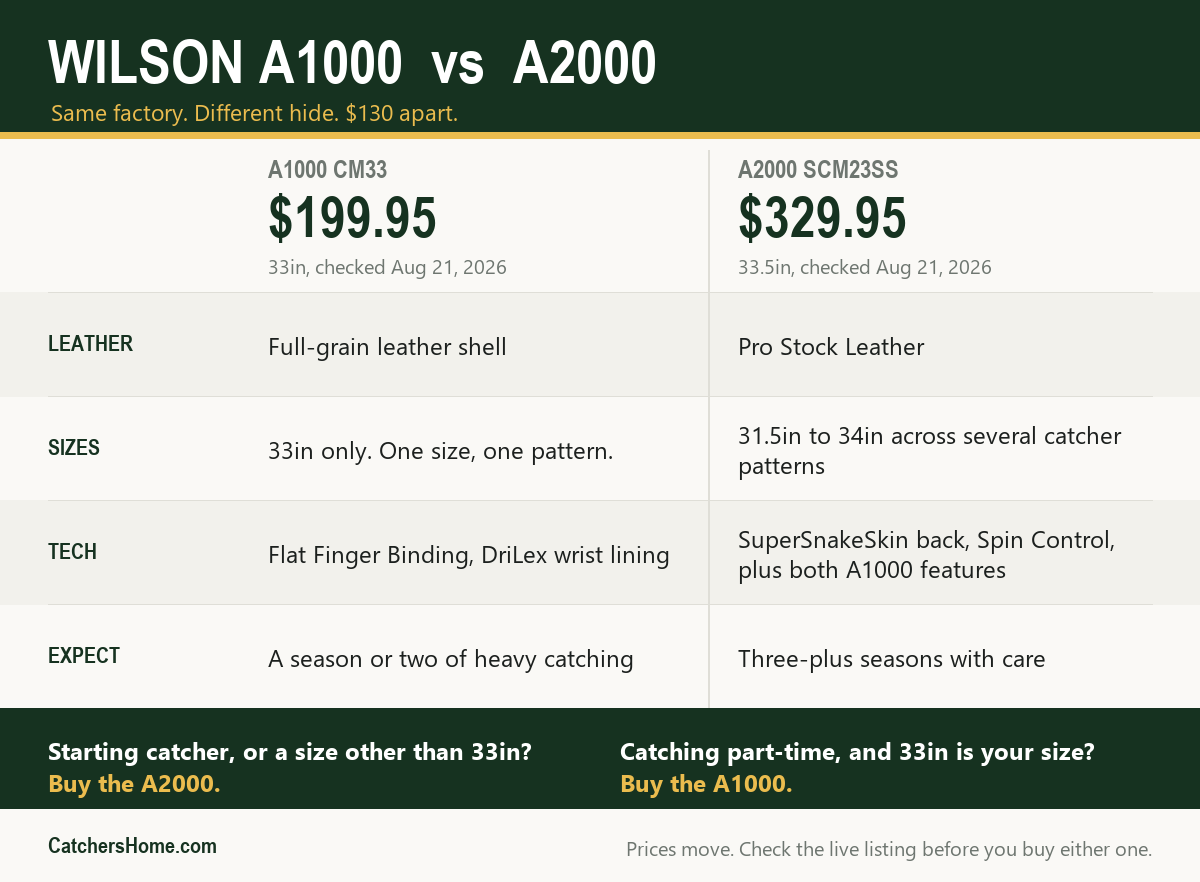
A1000 vs A2000 at a glance
| Wilson A1000 CM33 | Wilson A2000 SCM23SS | |
|---|---|---|
| Price | $199.95 (checked Aug 21, 2026) | $329.95 (checked Aug 21, 2026) |
| Leather | Full-grain leather shell | Pro Stock Leather |
| Catcher sizes | 33in — one size, one pattern | 31.5in–34in across several catcher patterns |
| Notable tech | Flat Finger Binding, DriLex wrist lining | SuperSnakeSkin back, Spin Control palm and web, Flat Finger Binding, DriLex |
| Web | Half moon closed web | Closed web, pattern-dependent |
| Built where | Wilson Pro Stock factory | Wilson Pro Stock factory |
| Expect it to last | A season or two of heavy catching | Three-plus seasons with care |
| Best for | Part-time catchers, second mitts, a 33in hand | Starting catchers who want to choose the pattern |
What the $130 actually buys
Three things, and the third one is the one nobody mentions. The first is leather. Wilson’s own listing describes the A1000’s shell as durable full-grain leather. The A2000 is Pro Stock Leather, the hide Wilson names, grades and builds its whole premium story around. Both mitts come out of the same Wilson Pro Stock factory, so the craftsmanship is not the variable here. The hide is. Our leather explainer covers why that one spec predicts more about a mitt’s fourth month than any feature list.
The second is technology you can point at. The A2000 adds a SuperSnakeSkin back panel, a microfiber Wilson describes as half the weight of Pro Stock leather and twice as durable. It also adds Spin Control, a dimpled palm and web pattern meant to grab the ball at contact. Whether Spin Control changes a catch is debatable. Whether a lighter, moisture-resistant back panel matters over a July doubleheader is not.
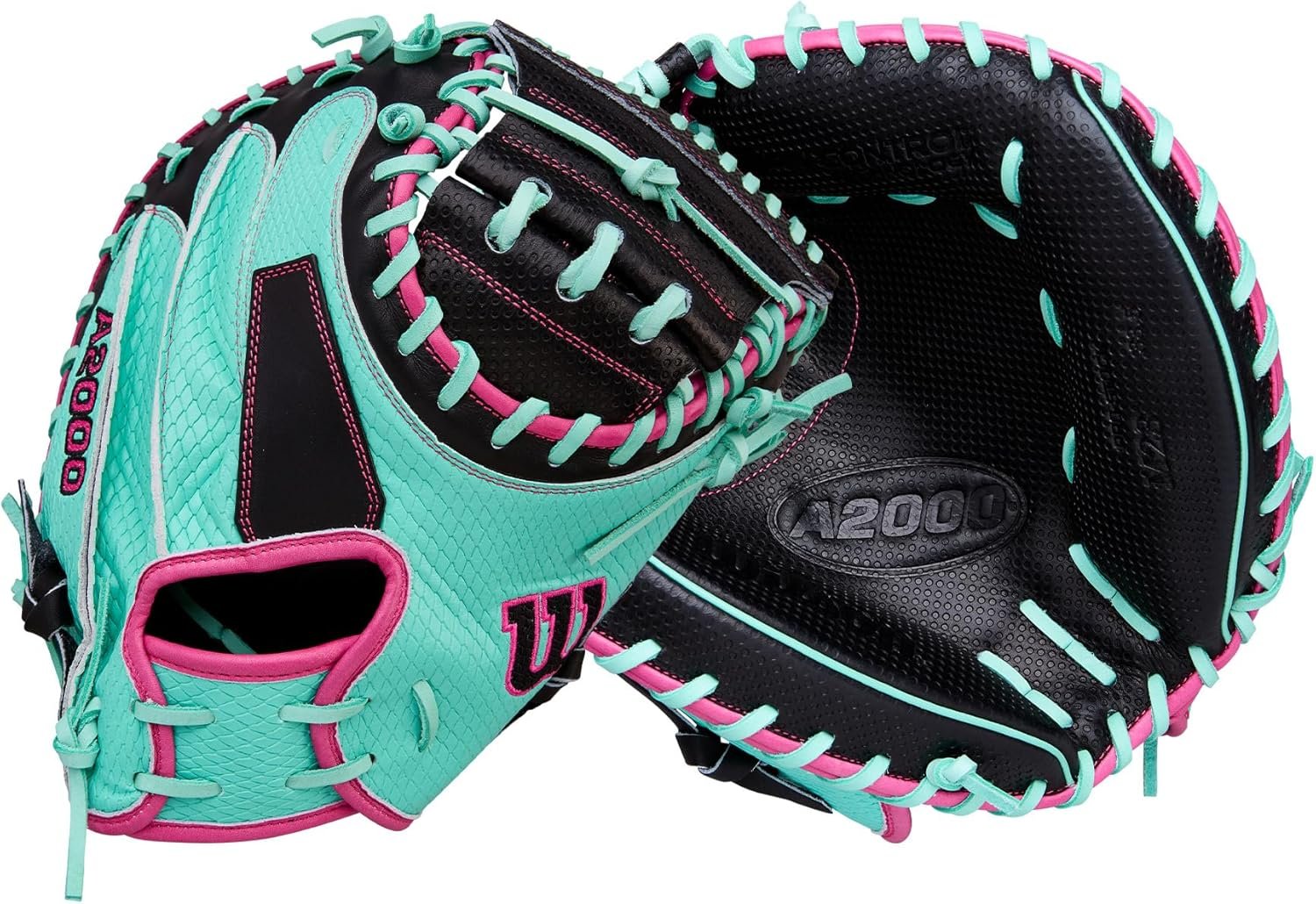
The third is choice, and it is the one that quietly decides this comparison. The A1000 catcher’s mitt exists in exactly one configuration: the CM33, at 33 inches. The A2000 catcher line spans 31.5 to 34 inches across several patterns. So if you have already worked out your size with a size chart, and the answer was not 33, the A1000 was never on the table.
Where the A1000 is genuinely good
It would be easy to write the A1000 off as the budget option, and that would be wrong. It is a full-leather mitt from Wilson’s own factory at a price where most of the shelf is synthetic or split leather. It carries Flat Finger Binding for catchers who ride an index finger outside the shell. Meanwhile the DriLex wrist lining does real work in August. Neither is a token feature.
It also plays soft early, which is worth more than it sounds. A mitt that is usable in week one is a mitt a young catcher will actually use. A stiff premium mitt that sits in a bag until June helped nobody. If your season starts in three weeks, that head start is real. Though reps still beat shortcuts on either mitt.
The honest ceiling is durability. Full-grain leather softened for a quick break-in gives up pocket stability sooner. So plan on a season or two of heavy catching, not four. If that horizon fits, the A1000 is a good buy and not a compromise. If it does not, see how long a catcher’s mitt actually lasts before you spend anything.
The cost-per-season math, worked
This is the price point where that argument stops being theoretical, so here it is with the two real numbers.
| Wilson A1000 CM33 | Wilson A2000 SCM23SS | |
|---|---|---|
| Price | $199.95 | $329.95 |
| Seasons of heavy catching | 1–2 | 3+ |
| Cost per season at the low end | $199.95 over 1 season | $110 over 3 seasons |
| Cost per season at the high end | $100 over 2 seasons | $82 over 4 seasons |
Read the right-hand column twice. The mitt that costs 65 percent more is cheaper per season at every point in the range. That is the same result our cost-per-season page reaches across the whole market. Two A1000s bought two years apart come to roughly $400. That is more than one A2000, for less mitt in both seasons.
The math only flips one way, and it is worth stating because it is the common case. Some catchers will not be back there in three seasons: a two-sport athlete, a utility player filling in, a kid still deciding whether he likes it. For them, the A2000’s extra seasons are seasons they will never spend. Then the A1000 is simply the right answer, and paying for leather you will not outlast is the mistake.
Before you buy: the A1000 listing trap
The A1000 catcher’s mitt is harder to buy correctly than it should be. Even so, two minutes here avoids the mistake.
- Old model years are still listed at premium prices. A 2019 A1000 CM33 was live on Amazon at $419.99 on August 21, 2026. That is more than a brand-new A2000, and more than twice the current A1000’s retail. It is not a better mitt. It is a leftover.
- The A1000 catcher’s mitt lives inside a listing full of fielding gloves. The current family runs 21 variations, most of them 11-inch to 12.5-inch gloves, and the parent title advertises those sizes. The catcher’s mitt is the child you select. Check the variation reads 33 inches and catcher’s mitt before you order.
- Fastpitch A1000 CM33 mitts share the model name. Wilson sells a CM33 in both baseball and fastpitch at the same $199.95. The listing title is the only thing that separates them, so read it rather than the photo.
None of that is a reason to avoid the mitt. It is a reason to buy the right one. The same discipline applies further up the ladder, where the A2K and A2000 also share pattern names across model years.
Which Wilson catcher’s mitt should you buy?
Buy the A2000 if…
Buy the Wilson A2000 if you are the starting catcher, if you want a size other than 33 inches, or if this mitt has to last three seasons. It is the mitt most catchers reading this page should buy. It is also the rung where Pro Stock leather starts. Our full A2000 review goes pattern by pattern.
Wilson A2000 SCM23SS 33.5in — check price on Amazon
Buy the A1000 if…
Buy the Wilson A1000 CM33 if you catch part-time, if you need a second mitt for the bag, or if 33 inches is your size and $130 is real money. You are getting full leather from Wilson’s own factory and a mitt that plays soft in week one. You are giving up pocket life and every other size.
Wilson A1000 CM33 33in — check the catcher’s mitt variation on Amazon
Buy neither if…
Buy neither for a first-year catcher or a growing kid. Both of these assume enough innings to pay back a break-in. Start with the youth mitt roundup instead. To see what $200 to $250 buys outside Wilson, the mid-range tier puts the A1000 against Rawlings, Marucci and All-Star at the same money. Or drop to the budget tier if this is a trial season.
Where the A2K fits above both
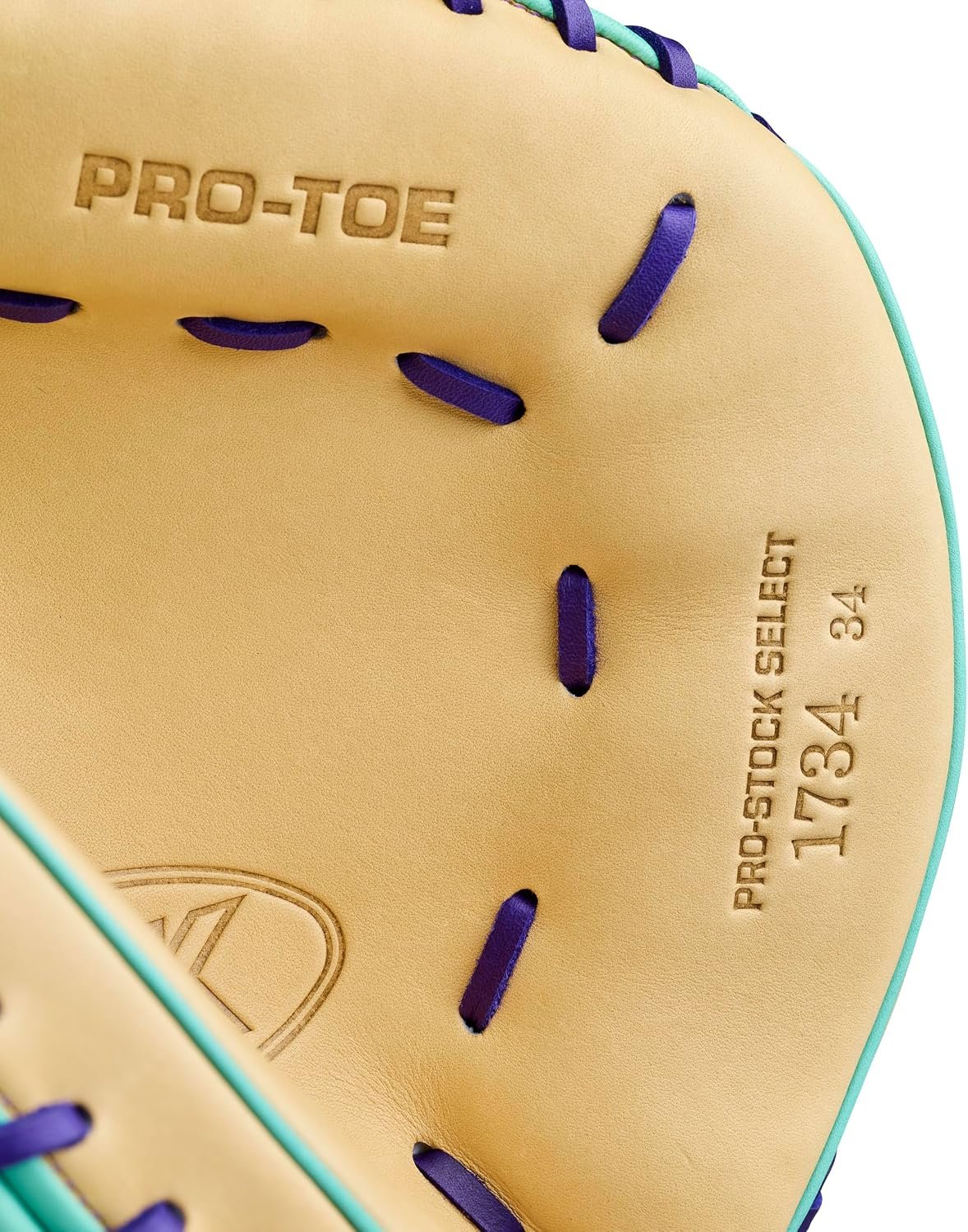
One rung further up, the A2K 1734SS was $419.95 on the same day — another $90 over the A2000. That step buys Pro Stock Select leather, triple-sorted from the top five percent of hides, plus a SuperSkin back panel. That is a smaller jump in money than the one on this page, and a smaller jump in mitt. We handle it separately in A2K versus A2000.
What we could not verify
- We show no photograph of an A1000 catcher’s mitt. We have no A1000 mitt in our own product library. The Amazon gallery serves images from a 21-variation family that is mostly fielding gloves. Rather than risk showing a different glove next to a buying recommendation, we show none.
- Wilson publishes no expected-lifespan figure for either line. The one-to-two versus three-plus season framing comes from owner reports, and from our own experience of how quickly a softened full-grain pocket goes flat. In short, it is not a manufacturer number.
- Wilson does not name the web pattern on the 2026 A1000 CM33 listing. The half-moon web recorded here comes from the 2019 CM33 listing, which does name it. Even so, the pattern code has not changed since. Confirm against the live photos if web shape is your deciding factor.
- Prices move, and model-year changeovers move them hardest. Both figures were read off the live listings on August 21, 2026.
Wilson A1000 vs A2000 FAQs
What is better, the Wilson A1000 or A2000?
The A2000 is the better mitt, and it should be — it costs $130 more. The real question is whether you need what the extra money buys. The A2000 gives you Pro Stock leather and catcher patterns from 31.5 to 34 inches. In addition, it is built to hold its pocket for several seasons. The A1000 gives you full-grain leather in one size, 33 inches, and a faster, softer start. For a catcher behind the plate every day, the A2000 is worth it. For a part-time catcher, it is not.
How much is a Wilson A1000 catcher’s mitt?
$199.95 for the 2026 A1000 CM33 at 33 inches, on Amazon and at major glove retailers when we checked on August 21, 2026. That is one price for one mitt, because Wilson makes the A1000 catcher’s mitt in a single size and a single pattern. Any A1000 catcher’s mitt priced far above that is an old model year being resold, not a better mitt.
What leather is the Wilson A1000 made of?
Full-grain leather, which is a real leather shell but not Wilson’s Pro Stock hide. Wilson’s own listing calls it durable full-grain leather on the outer shell. It also notes the mitt is built in the same Pro Stock factory as the A2000. The factory is shared; the hide is not. Leather grade is the single spec that most predicts how a mitt ages, so this is where the two lines genuinely part.
Is the Wilson A1000 good for a high school catcher?
Yes, if he is a backup or a part-time catcher. For a starter catching four or five games a week, buy the A2000. The A1000’s 33-inch pattern is a legitimate high-school size, and it plays soft early. That matters when a season starts before a mitt is ready. What it does not do is hold a crisp pocket through three seasons of that workload.
Does the Wilson A1000 come in a 34-inch catcher’s mitt?
No. The A1000 catcher’s mitt is 33 inches only. If you want 34 inches from Wilson, the ladder starts at the A2000 and continues to the A2K. That single fact settles this comparison before price comes up. A catcher who has decided on 34 inches has no A1000 to consider.
How long does a Wilson A1000 last compared to an A2000?
Expect a season or two of heavy catching from an A1000, against three or more from an A2000 that is cared for. That gap is the whole cost-per-season argument. Two A1000s bought two years apart cost about $400, more than one A2000. So the cheaper mitt is only cheaper if you were not going to catch that long.
Still deciding between brands rather than between rungs? Our premium mitts roundup puts Wilson against Rawlings and All-Star. The five-decisions guide starts further back if size and pattern are still open. Everything here sits under baseball catcher’s mitts, inside our catcher’s mitts pillar.