
What Catcher’s Mitts Do MLB Catchers Use?
Affiliate disclosure: CatchersHome earns a commission on qualifying purchases through the Amazon links below, at no extra cost to you. We only recommend gear we’d hand to our own catcher.
MLB catchers overwhelmingly use Rawlings, All-Star or Wilson. The mitt is a pro-stock pattern at 33.5 or 34 inches, with a closed web and the top grade of leather each brand makes. What they do not use is the mitt in your cart. A big-league gamer is a customised build, and a retail model carrying a player’s name sells you the pattern rather than the glove. So this page covers what is actually knowable, and is honest about the rest.
The short answer, by brand
Three brands account for most of what you see behind the plate in a major league game. Furthermore, they have divided the position between them in a way that has held for years.
| Brand | Where it stands behind the plate | Its top catcher’s mitt | Price checked Aug 21, 2026 |
|---|---|---|---|
| Rawlings | Major League Baseball’s official glove, and the most common mitt in the majors. Owns most of the signature catcher patterns. | Pro Preferred (kip leather) | $419.99 |
| All-Star | A pure catching brand with a long pro following — several big-league catchers wear custom Pro Elite builds. | Pro Elite CM3000 | $449.95 |
| Wilson | A real but narrower presence; the A2K is the mitt at the top of its line. | A2K 1734SS | $419.95 |
| Mizuno and others | Smaller share, mostly through individual player relationships. | Pro / GPS series | Varies |
Above all, if you take one thing from that table, take the price column rather than the logos. Every one of these sits between roughly $330 and $450 at retail. That is the band our cost-per-season page argues about. Certainly whether you should spend there is a real question. Which of these three you spend it on is a much smaller one.
The pattern is the part you can actually buy
This is the most useful thing to understand about pro gear. Almost every page on the topic skips it.
A major league catcher’s mitt is a pro-stock build. The pattern is a template the manufacturer maintains: the shape, the depth, the break points, the size. The individual glove is then made to that player’s preferences — the exact hide, how stiff it is shaped, the lacing, how much padding sits in the heel. In fact, two catchers on the same pattern can be carrying noticeably different mitts.
So when a brand sells a signature model at retail, it is selling that pattern. Rawlings’ Heart of the Hide Adley Rutschman mitt, for example, runs the AR35 pattern at 34 inches with a 1-piece solid web. Rawlings’ own copy says it is crafted after Rutschman’s current gamer. That is a real and useful thing to buy, because it is a pattern a Gold Glove catcher chose. But it is not his glove.
Similarly, the older Heart of the Hide PROSCM41B makes the same kind of claim more bluntly. Rawlings’ listing describes it as a pro pattern with a 1-piece closed web. It also states that the same pattern is worn by Joe Mauer and Yadier Molina. Read that as a pattern claim, because that is what it says. It is not a promise about the object in the box.
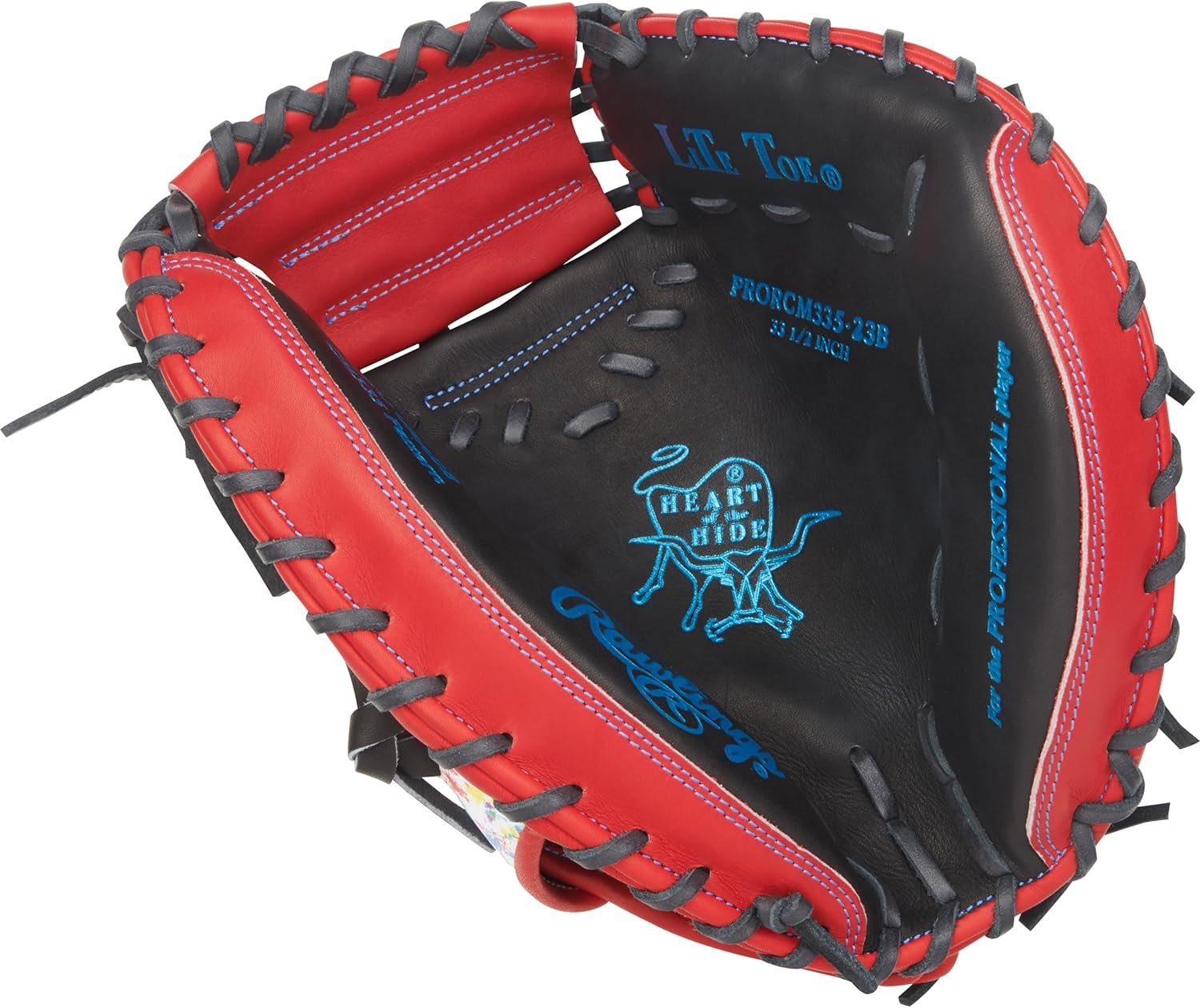
What every pro mitt has in common
Strip away the logos and the pro shelf converges on four things. Indeed these are the transferable lessons, and they are worth more to your next purchase than any player’s name.
- Size at the top of the adult range. 33.5 or 34 inches, almost without exception. A pro is receiving high velocity, so a big target is worth the weight. But only if the hand behind it can still close the mitt in the ninth inning. Size to your hand, not to the majors.
- A closed web, always. One-piece solid, one-piece closed or two-piece — never anything you can see through. Our web patterns guide covers what each shape changes. Meanwhile the stiffer end of that list is where framing catchers live.
- The brand’s top hide. Heart of the Hide or kip at Rawlings, Pro Stock Select at Wilson, Japanese-tanned steerhide at All-Star. Leather grade is the spec that most predicts how a mitt ages. That is why nobody at that level compromises on it.
- A deep pocket. At 95 miles an hour, holding onto the ball beats getting it out a tenth of a second sooner. Consequently almost every pro mitt is built to trap.
Notably, what is not on that list: colour, technology names, or the player on the hang tag. If you want to buy like a pro, buy those four properties. The five-decisions guide turns them into an order of operations.
All-Star: the catcher’s brand
All-Star deserves its own paragraph. It is the one brand here that is primarily a catching company, rather than a glove company that also makes mitts. The Pro Elite CM3000 is its flagship: Japanese-tanned steerhide, a two-piece closed web, and a long history in the majors. For example, Martin Maldonado has worn a custom Pro Elite build. That is the kind of relationship All-Star has cultivated for years.
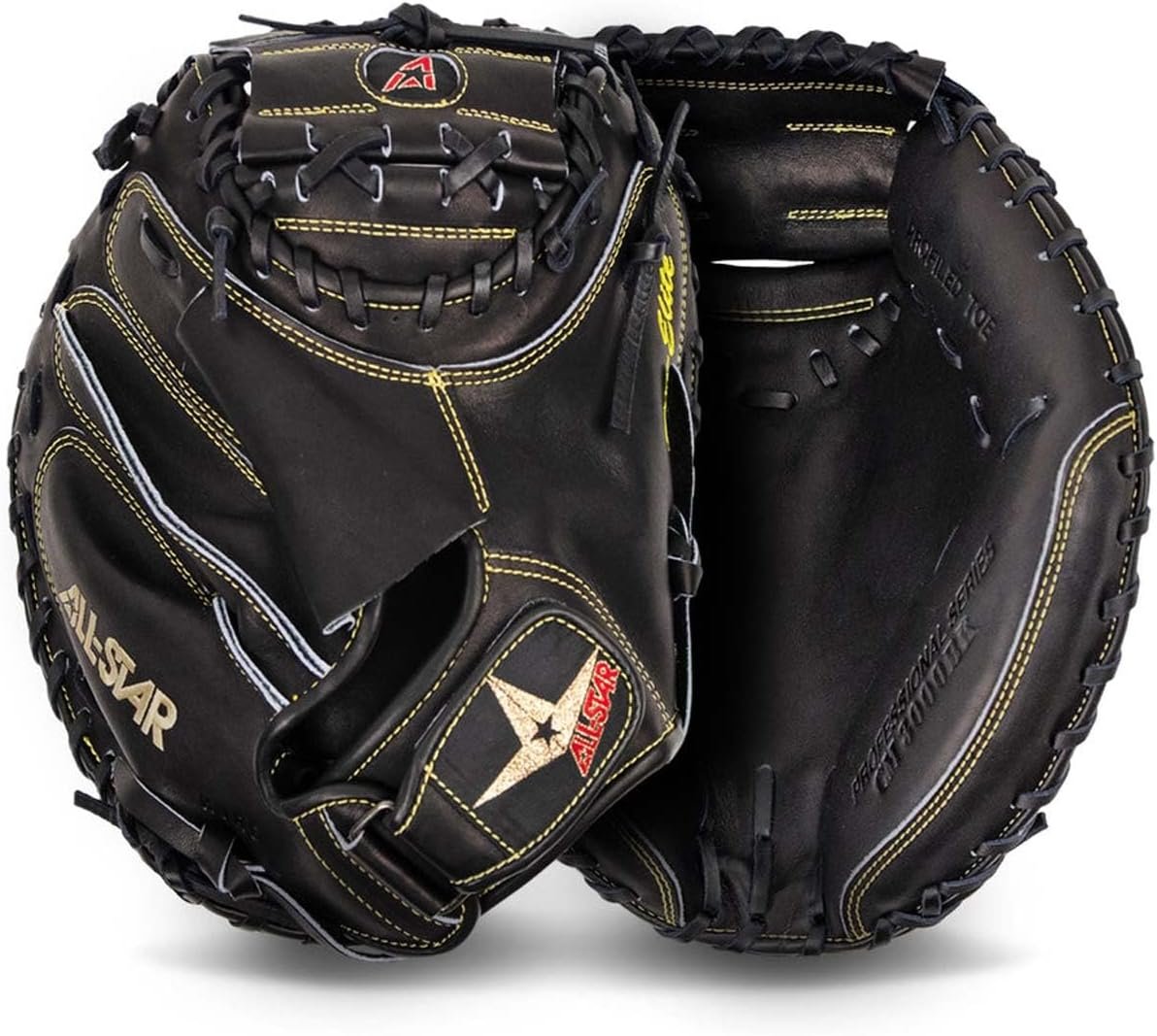
It is also the most expensive mitt on this page at $449.95. Meanwhile it is famously stubborn to break in: three weeks of real work, with no oil and no heat. Our full CM3000 review covers that. Meanwhile the CM3000 versus CM3100 comparison shows what happens one rung down. The Pro Elite Japan Series, at 34 inches, is a different shape again. It has a wider palm and looser webbing, built for receiving rather than smothering.
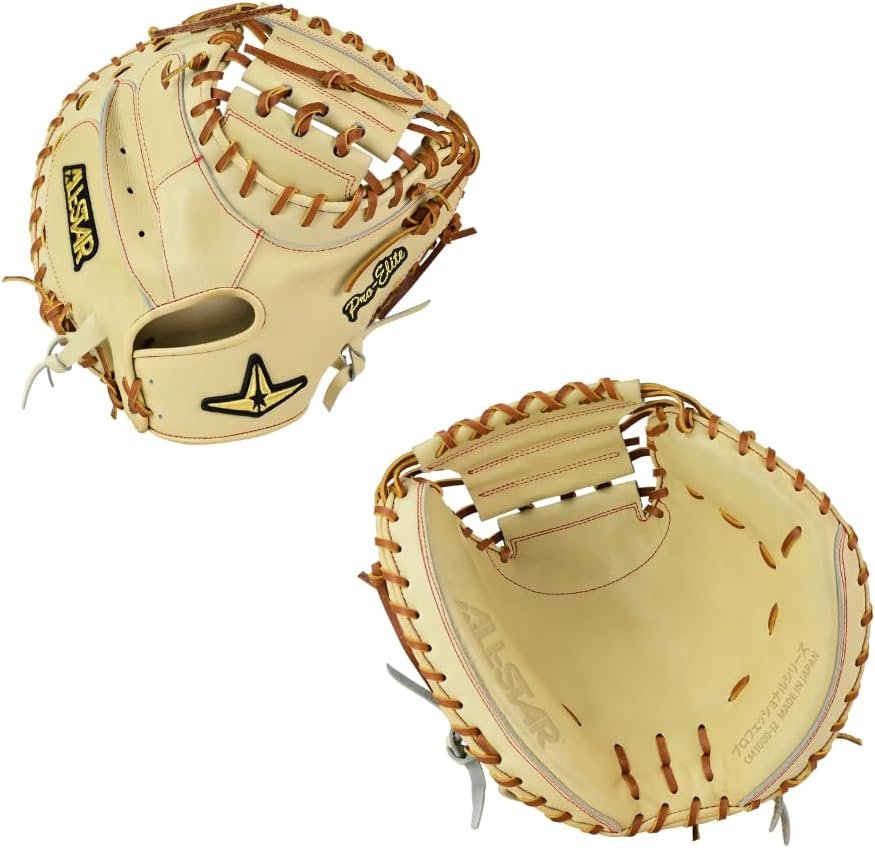
All-Star Pro Elite CM3000SBT 33.5in — check price on Amazon
Rawlings: the official glove, and the signature shelf
Rawlings is Major League Baseball’s official glove, and that licensing relationship is why it owns the signature catcher shelf. Therefore, if a retail mitt carries a current big-league catcher’s name, it is usually a Rawlings. The line runs Heart of the Hide steerhide in the middle, then kip leather at the Pro Preferred tier above.
Rawlings also does something practical that helps a buyer more than the endorsements do: it prints the web pattern on the product listing itself. You know whether you are getting a 1-piece solid or a single post double bar web before you order. It is a habit its main rival has not adopted.
Rawlings Heart of the Hide PROSCM41B 34in — check price on Amazon
Rawlings Pro Preferred 33in (kip leather) — check price on Amazon
Wilson: narrower behind the plate, deep at the top
Wilson’s pro presence is smaller at catcher than at other positions, but the A2K is a genuine top-tier mitt: Pro Stock Select leather, triple-sorted from the top five percent of hides, and handcrafted in Japan. Where Wilson is strongest for a buyer is the tier below. There the A2000 offers the widest catcher size range of any brand, 31.5 to 34 inches.
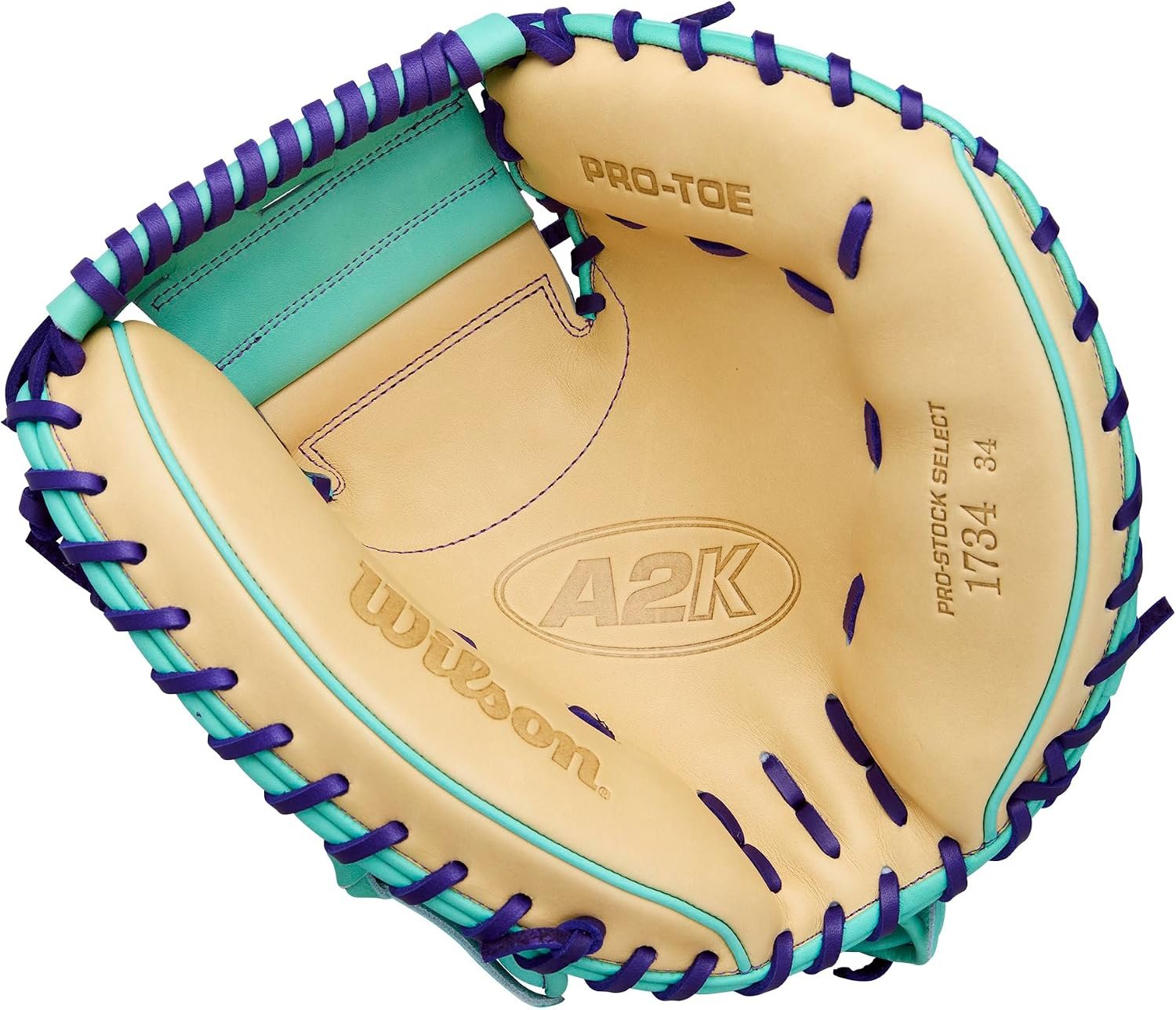
Our A2K review goes through the line. Meanwhile Heart of the Hide versus A2K is the head-to-head most readers of this page want next.
Wilson A2K 1734SS 34in — check price on Amazon
Should you buy what the pros buy?
Mostly no — and surprisingly, the reason is not money.
A professional catcher catches every day, with a clubhouse attendant maintaining his gear. Furthermore, he replaces mitts on the team’s schedule rather than his own. A mitt built to survive that, and to hold a frame at 100 miles an hour, is stiffer and heavier than a high school catcher needs. It is slower to break in, too. Buy the pro mitt and you may spend your whole season fighting it. That is the honest content of every break-in guide we have written.
Instead, what transfers is the four properties above, at the tier that fits your season. A catcher playing 40 games a year is better served at the $100–$250 tier in the right size and web than at $450 in the wrong one. Meanwhile a first-year catcher belongs at the budget tier until the position sticks. If your value is stealing strikes, the framing guide beats any list of pro gamers.
What we could not verify
- There is no reliable public registry of which mitt each MLB catcher uses, and we did not invent one. Our August 21, 2026 research sweep found manufacturer pages naming a handful of signature patterns. Everything else was unsourced or stale second-hand listing. In short, any page that hands you a confident thirty-name table is guessing at most of it.
- Player-brand relationships change between seasons and sometimes mid-season, so even a correct pairing has a short shelf life. Accordingly, that is a second reason we have written this page around patterns and properties rather than names.
- The Joe Mauer and Yadier Molina attribution on the PROSCM41B is Rawlings’ own listing copy, quoted as such. We have not independently confirmed it, and it refers to the pattern rather than to a specific glove.
- We could not confirm an Amazon listing for the Heart of the Hide Adley Rutschman PRORAR35 on August 21, 2026. So it is named here, but not linked. Its specification comes from Rawlings’ retail channel.
- Prices are a single-day snapshot from August 21, 2026. Premium leather moves fastest at model-year changeover.
MLB catcher’s mitt FAQs
What mitts do MLB catchers use?
Almost all of them use Rawlings, All-Star or Wilson. The mitt is a pro-stock pattern at 33.5 or 34 inches, with a closed web and premium leather. Rawlings is Major League Baseball’s official glove and the most common sight behind the plate. All-Star’s Pro Elite CM3000 has a long pro following, while Wilson’s A2K sits at the top of its line. Finally, Mizuno and a few smaller makers fill in the rest.
What size catcher’s mitt do MLB catchers use?
33.5 or 34 inches, at the top of the adult range. A professional catcher receives high velocity from a staff he has to keep happy. So the extra target area is worth the extra weight. That is not automatically the right answer for you. A mitt you cannot close one-handed by the seventh inning is a worse mitt, whatever the pros carry.
Can I buy the same catcher’s mitt an MLB catcher uses?
You can buy the same pattern. You usually cannot buy the same mitt. That is because professional gamers are pro-stock builds, frequently customised in leather, lacing, padding and stiffness beyond anything on a retail shelf. When a brand sells a signature model, it is selling the pattern and the spec sheet. It is not selling a copy of that player’s glove.
Do MLB catchers use Rawlings or Wilson?
Both, with Rawlings more common — it is MLB’s official glove and it owns most of the signature catcher patterns. Wilson’s A2K has a real pro presence, and All-Star is arguably the strongest pure catcher brand of the three. Still, for a buyer the brand matters far less than the pattern and the size.
Why do MLB catchers use closed webs?
Because a closed web hides the ball and the signs, and will not pop open when a fastball hits it. In fact every catcher’s mitt at every level uses a closed web for the same two reasons. What varies is the shape: one-piece solid, one-piece closed, two-piece, half moon. Consequently the face of the mitt is stiffer or softer.
How much do MLB catcher’s mitts cost?
The retail equivalents run roughly $330 to $450, and the pro versions are not sold. On August 21, 2026 a Heart of the Hide was $349.99 and an A2K $419.95. A Pro Preferred was $419.99, and an All-Star Pro Elite CM3000 $449.95. Meanwhile big-league catchers do not pay those prices at all — they are supplied under contract.
Want the shortlist rather than the survey? Our premium mitts roundup scores the CM3000, the A2K, the A2000 and the Heart of the Hide on the same dimensions. And the Heart of the Hide review is our deepest look at the pattern family the majors lean on hardest. Everything here sits under baseball catcher’s mitts, inside our catcher’s mitts pillar.