
The Best Catcher’s Bags: Measured, Compared, and Ranked
CatchersHome may earn a commission from qualifying purchases made through the links on this page, at no extra cost to you. We only recommend gear we would put behind the plate.
The best catcher’s bag overall is the Bownet Commander — 127 liters split into fourteen compartments, with a molded helmet case for the two dirtiest things you carry. A full set of gear needs at least 60 liters, closer to 90 with bats and cleats, and the 72-liter Rawlings Covert Duffel covers a light season for about a third of the price. We rank every bag on the same yardstick — manufacturer-published dimensions converted to liters — plus owner reports, and we say plainly when a bag we like isn’t one we earn from.
Every catcher learns the same lesson in the same parking lot. You carry more equipment than anyone else on the roster, and you carry it farther. A shortstop walks to the field with a bat bag over one shoulder. You walk out with a chest protector, leg guards, a mask, a mitt, a helmet, cleats, and whatever the team needs you to haul besides. Then it rains, and the whole load gets heavier.
So the bag is not an accessory. It is the piece of equipment that decides whether the rest of your gear arrives dry, organized, and ready.
Here is the problem with shopping for one. Search for a baseball catcher bag and every result is a manufacturer selling its own bag, each one claiming to be the biggest and toughest. None of them compare against each other, because none of them can. That is the gap this page fills.
We did the one thing nobody in this category does: we put every bag on the same scale.
The top picks at a glance
Best overall
Bownet Commander
Tap to see why it won
127 liters, 14 pockets, a molded helmet case, and the only published weight in the category
Most capacity
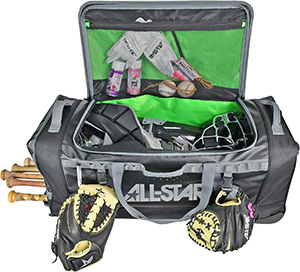
All-Star S7 Elite Roller
Tap to see why it won
140 liters and a padded sleeve that swallows six bats
Best backpack
Easton E610CBP
Tap to see why it won
The lightest way to carry a real catcher’s load, with two lined bat sleeves
Best proven workhorse
No Errors NO E2
Tap to see why it won
The category’s best-selling bag, backed by a three-year wheel warranty
Best for youth travel ball
Rawlings Gold Collection Wheeled
Tap to see why it won
The smallest true wheeled catcher’s bag, so a 10-year-old can actually steer it
Best value
Rawlings Covert Duffel
Tap to see why it won
72 liters of plain, honest space for roughly a third of the price of the premium rollers
Jump straight to the full measurement table, or to the pick-by-situation matrix if you already know your league.
How we ranked these bags
Manufacturers do not publish capacity in liters. Almost all of them publish outside dimensions. So we converted every published dimension into bounding-box volume — length times width times depth, in liters — and ranked from there.
That gives a single number you can compare across brands, which is a metric no product page will give you.
The method checks out. Mizuno is the one manufacturer that publishes both. It lists the MX Equipment Wheel Bag G2 at 36 by 15 by 15 inches, and separately at 133 liters.
One honest limit, because you should know where the number stops working. Bounding-box volume measures the box the bag occupies, not the usable space inside it. A bag with rigid molded shelving spends some of that volume on structure. A soft duffel keeps more of it. So use these liters to rank bags against each other, and use the compartment notes to judge whether a specific piece of gear will fit.
Beyond capacity, we weighted four things. Is the cleat compartment genuinely separated and vented? Do leg guards get their own external pocket? How many bats does the bag carry without a second bag? And what do owners report after a full season?
How much bag does a full catcher’s set actually need?
Short answer: at least 60 liters, and realistically closer to 90 if you also carry bats, cleats, and a helmet.
Here is how we know, and it comes straight out of the table below rather than out of a guess. Every bag in this roundup that its own manufacturer markets as a catcher’s bag measures 61 liters or larger. Every general-purpose batpack measures under 50. In other words, brands that build for catchers all landed above the same line independently. That happens because a chest protector and a pair of adult leg guards are bulky in a way a bat bag was never designed for.
That is why the “just use a batpack” plan fails around age twelve. Youth gear is compact and forgiving. Adult gear is not.
Every bag, measured & sorted
| Bag | Type | Dimensions (in) | Volume | Bats | Cleat compartment | Leg-guard storage |
|---|---|---|---|---|---|---|
| All-Star S7 Elite Roller | Wheeled | 36 × 17 × 14 | 140 L | Up to 6 | Shared with glove and helmet | Internal |
| Mizuno MX Equipment G2 | Wheeled | 36 × 15 × 15 | 133 L | 1–4 | Separate, ventilated | Internal |
| Bownet Commander | Wheeled | 38 × 17 × 12 | 127 L | 3 (side pocket) | Separate, ventilated | Dedicated side pocket |
| All-Star S7 Elite Duffel | Duffel | 36 × 15 × 12 | 106 L | — | Internal | Internal |
| Easton Jen Schro Wheeled | Wheeled | 28 × 16 × 12 | 88 L | Yes | Yes | Yes |
| No Errors NO E2 | Wheeled duffel | 36 × 12 × 12 | 85 L | 3 (34 in.) | 3 vented compartments | Expandable side pockets |
| Rawlings Mach Hybrid | Backpack-duffel | 27 × 13 × 13 | 75 L | Yes | Yes | Internal |
| Rawlings Gold Collection Wheeled | Wheeled | 25 × 15 × 12 | 74 L | 2 | Internal, ventilated | External |
| Rawlings Covert Duffel | Duffel | 26 × 13 × 13 | 72 L | — | None | Internal |
| All-Star MVP-Pro Batpack | Backpack | 26 × 13 × 13 | 72 L | Yes | Yes | Internal |
| Easton E610CBP | Backpack | 25 × 15 × 10 | 61 L | 2 (lined sleeves) | Separate, ventilated | Foldaway mesh sleeves |
| Boombah Rolling Superpack 2.0 | Wheeled batpack | 23.5 × 13.5 × 9.5 | 49 L | 4 | Separate shoe compartment | Not designed for it |
Volumes are bounding-box calculations from each manufacturer’s published dimensions. Mizuno’s own published figure of 133 liters confirms the method.
The bags, one by one
Best overall: Bownet Commander
CatchersHome rating: 4.8 out of 5.
The Commander wins because it is the only bag in this group that treats organization as the product.
At 38 by 17 by 12 inches it holds 127 liters, which puts it third on raw volume. Then it separates that volume into fourteen pockets and compartments. Underneath the main compartment sits a molded semi-hard case for a helmet and spikes. As a result, the two hardest and dirtiest items in your load stop crushing everything else. Above it, the shelving is removable. Finally, a three-bat side pocket and a shin-guard side pocket keep the long items out of the main cavity.
Bownet is also the only brand here that publishes a weight: 15 pounds, empty. That number is not flattering, and printing it anyway is the sort of thing that earns trust.
The Big Trax rubber treaded wheels are built for gravel rather than terminal carpet. Owners upgrading from Bownet’s smaller Cadet report three seasons of hard use before replacement. Coverage is a one-year limited warranty against defects.
Skip it if: you want the lightest bag on this page, or you carry more than three bats.
Most capacity: All-Star S7 Elite Roller
CatchersHome rating: 4.6 out of 5.
If your job is to move everything, this is the bag.
At 36 by 17 by 14 inches the S7 Elite Roller measures 140 liters, the largest in this roundup. The padded bat sleeve carries up to six bats, which quietly makes it a team bag as much as a catcher’s bag. The shell is a water-resistant coated fabric and the handles are padded. A reinforced spine also lets it stand up on its own instead of slumping against the fence.
There is a personal pocket you can reach from inside or outside. In addition, external equipment loops hold the things you want in hand the moment you arrive.
Skip it if: you are buying for a younger player. This is a large bag, and a large bag pulls a small catcher around rather than the other way.
Check today’s price on the S7 Elite Roller
Best backpack: Easton E610CBP
CatchersHome rating: 4.6 out of 5.
Not every catcher wants wheels, and the E610CBP is the argument for going without them.
It measures 25 by 15 by 10 inches, or 61 liters. That is the smallest bag here that still handles a full catcher’s set, and the design earns the space back through discipline. The main compartment is vented and carries an interior shelf. Cleats get their own vented compartment, so wet turf shoes never share air with a chest protector. Two fully lined bat sleeves mean you leave the second bag at home.
The leg-guard sleeves are the smart part. They are side mesh pockets that fold flat and buckle away when you aren’t using them, so the bag doesn’t wear its empty pockets like flapping wings.
Construction is coated 600D with 420D ripstop, and there is a fence hook — a small feature that stops mattering right up until the dugout floor is mud.
Skip it if: you carry a bucket of balls or a second helmet. At some point volume wins and you want wheels.
Check today’s price on the Easton E610CBP
Best proven workhorse: No Errors NO E2
CatchersHome rating: 4.7 out of 5.
The NO E2 is the bag you see most often behind a backstop, and there is a reason for that.
No Errors reports selling over 100,000 of them. Owner ratings average 4.7 stars. At 36 by 12 by 12 inches, or 85 liters, the design is narrower than the rest of the wheeled field. Still, it wins that space back with nine pockets, three of them ventilated so wet gear dries instead of souring.
The feature that separates it is the expandable shin-guard pocket. It runs the full 36-inch length and widens from 5 to 12 inches. That is exactly what it takes to swallow leg guards with knee savers still attached. Inside, a shelving system keeps the load stacked instead of settling into one heap at the bottom.
Then there is the warranty, and it is the real headline. One year against manufacturer defects is standard. Three years on the wheels is not. Wheels die first on every rolling bag ever made. Yet No Errors is the only brand here that puts a term on them.
The honest complaint: it is big, and owners say so. One reports the bag sitting lopsided once knee-saver leg guards go into the expanded pouch.
Read the full breakdown: our complete No Errors NO E2 review, including the head-to-head against the Bownet Commander.
Best for youth travel ball: Rawlings Gold Collection Wheeled
CatchersHome rating: 4.5 out of 5.
Most wheeled catcher’s bags are sized for a grown adult dragging them across a parking lot. This one isn’t, and that is precisely its argument.
At 25 by 15 by 12 inches the Gold Collection Wheeled holds 74 liters. That makes it the most compact true wheeled catcher’s bag in the group, and a twelve-year-old can steer it. The leg-guard storage is external, which matters more than it sounds like it should. After all, a young catcher packing in a hurry will not excavate a main compartment to find shin guards.
Rawlings finishes it with Heart of the Hide Speed Shell leather trim and a structured tarpaulin bottom. A fleece-lined glove compartment protects the mitt’s shape. Deep side pockets hold two bats or two large water bottles. Finally, an internal ventilated compartment takes cleats.
Skip it if: your catcher is already in high school. They will outgrow 74 liters.
Check today’s price on the Gold Collection Wheeled
Runner-up wheeled: Mizuno MX Equipment G2
CatchersHome rating: 4.5 out of 5.
The Mizuno is the bag that made this whole comparison possible, since it publishes both dimensions and liters. It is also genuinely good.
133 liters puts it second on capacity. It weighs 8.5 pounds empty, which undercuts the Commander by more than six. Running boards along the base give it stability when it stands, and off-road wheels handle the gravel. You also get both a telescopic pull handle and a plain stitched top handle. The footwear compartment is ventilated and separate. It carries one to four bats and comes in black, navy, red, and royal.
Skip it if: you want everything sorted into its own pocket. The Mizuno gives you one big excellent room, not fourteen small ones.
Best value: Rawlings Covert Duffel
CatchersHome rating: 4.3 out of 5.
Not every catcher needs a system. Some need a large, tough, uncomplicated bag.
The Covert is 26 by 13 by 13 inches, or 72 liters, and it does not pretend to be more. There are no wheels, no shelving, and no dedicated cleat compartment. What there is: enough room for a full set of gear at a price that leaves money for the mitt.
Skip it if: you play travel ball. Over a full tournament summer, wheels stop being a luxury.
Check today’s price on the Rawlings Covert Duffel
Backpack, duffel, or wheels?
Start here, because this choice matters more than the brand on the side.
Wheels win on weight and lose on terrain. A loaded catcher’s bag runs 35 to 50 pounds. Rolling that is easier than carrying it, right up until the path to the field is grass, gravel, or a curb. Then you are lifting the whole load anyway, plus the weight of the wheels and the handle. Look for large treaded wheels rather than small hard ones if your home field has a dirt lot.
Backpacks win on stairs, buses, and dugouts. Both hands stay free. The bag fits in an overhead rack and under a bench. Nothing tips over. The cost is that every pound rides on your shoulders for the whole walk, and backpacks top out around 75 liters before the load pulls you backward.
Duffels win on price and on simplicity. You get the most volume per dollar, and a duffel is the easiest bag to load fast. The cost is that one shoulder carries everything, and nothing inside stays organized without help.
There is no universal answer. There is, however, usually an obvious one once you know your situation.
Pick by situation
| Your situation | The style to buy | Our pick | The reason |
|---|---|---|---|
| Travel ball, weekend tournaments | Wheeled, 125 L+ | Bownet Commander | Multiple games a day means gear that never fully dries. Ventilated and separated compartments matter more than raw space. |
| High school, walk from the parking lot | Wheeled or large duffel | All-Star S7 Elite Roller | You carry team bats too. Six bat sleeves ends the second-bag problem. |
| Rec league, one practice and one game a week | Duffel | Rawlings Covert Duffel | Light use does not justify a rolling chassis. Spend the difference on gear. |
| Youth, ages 9–12 | Compact wheeled | Rawlings Gold Collection Wheeled | A bag the player can move without help is a bag the player will actually carry. |
| Fastpitch softball | Wheeled, fastpitch-cut | See our fastpitch catcher’s gear bags guide | Fastpitch lines are cut differently and sized differently. They deserve their own comparison. |
| Bus travel, no parking lot | Backpack | Easton E610CBP | Wheels are dead weight when you never roll them. |
| You also catch bullpens and haul a ball bag | Wheeled, max volume | All-Star S7 Elite Roller | 140 liters is the ceiling in this category. |
The features that actually matter
After measuring all twelve, five features separate a bag you keep from a bag you replace.
A separate, ventilated cleat compartment. Wet cleats in a shared compartment will make a chest protector smell for the rest of the season. Mizuno, Bownet, and Easton all isolate and vent footwear. The Covert does not, and that is the clearest thing you give up at that price.
External leg-guard storage. Shin guards are the most awkward shape a catcher owns. When they live in the main compartment, everything else packs around them. The NO E2’s expandable side pocket and the Gold Collection’s external storage both solve this properly.
Bat sleeves you don’t have to think about. Two lined sleeves cover most catchers. Six, on the S7 Elite Roller, covers a team.
A structured base. Rawlings uses a tarpaulin bottom, No Errors uses a heavy PVC panel, and Boombah uses molded plastic. The bottom of the bag meets wet concrete every single week, so this is where bags die.
A fence hook. It sounds trivial. Then you get a dugout with a dirt floor and standing water, and it is the best two dollars any manufacturer ever spent.
Can you just use a regular duffel bag?
For a season or two, yes. After that, no.
A regular duffel will physically hold youth catcher’s gear. What it won’t do is separate wet from dry, keep leg guards from crushing a mask, carry bats, or survive being dragged across concrete twice a week. Consumer duffels are built with light fabric on the bottom panel, because most duffels spend their lives on carpet and in car trunks.
There is also a practical failure that shows up fast. A catcher’s set does not pack flat. Load it into an unstructured duffel and the bag becomes a lumpy sphere that will not sit, will not stand, and will not fit under a dugout bench.
If money is the constraint, a purpose-built budget duffel like the Covert costs a fraction of a premium roller and solves every one of those problems.
Frequently asked questions
What size gear bag fits full catcher’s equipment?
Plan on 60 liters minimum, and 85 to 130 liters if you also carry bats, cleats, and a batting helmet. In inches, that means roughly 25 by 15 by 10 at the small end and 36 by 15 by 12 or larger at the full-load end. Every bag in this roundup that its manufacturer builds specifically for catchers measures 61 liters or more.
Backpack or duffel — which is better for a catcher?
A backpack is better if you carry your own gear across grass, up bleachers, or onto a bus, because it keeps both hands free and stays organized. A duffel is better if you want the most volume for the money and you load and unload from a car. Once the load passes about 40 pounds, most catchers move to wheels regardless.
What features make a good baseball bag?
Five: a separate ventilated cleat compartment, dedicated external leg-guard storage, at least two bat sleeves, a reinforced or molded base panel, and a fence hook. Capacity gets you in the door. These five decide whether the bag lasts.
Do baseball gear bags come with separate cleat compartments?
Most catcher-specific bags do, and it is worth confirming before you buy. Mizuno’s MX G2, Bownet’s Commander, and Easton’s E610CBP all isolate and ventilate footwear. Basic duffels like the Rawlings Covert do not, so cleats share space with everything else.
Can you use a regular duffel bag as a baseball bag?
You can, and youth players do it all the time. The limits show up in the bottom panel, which wears through on concrete, and in organization, since nothing separates wet gear from dry. A purpose-built budget duffel costs little more and fixes both.
How do MLB catchers carry their gear bags?
They mostly don’t. Major league clubs employ clubhouse staff who move equipment between the clubhouse and the dugout, and gear travels in team trunks on the road. The bags you see professionals carrying personally are usually glove and personal-item bags. Everyone below the majors carries their own.
The final word
If you want one recommendation, take the Bownet Commander. It is the most organized bag in the category, it publishes the numbers it could have hidden, and 127 liters is enough for anything short of a team load.
If you want the most space, take the All-Star S7 Elite Roller at 140 liters. If you never want to roll anything, take the Easton E610CBP. If you are buying for a young catcher who has to move it alone, take the Rawlings Gold Collection Wheeled.
And if you want the bag that the most catchers have already voted for with their own money, take the No Errors NO E2. It has sold over 100,000 units, and it is the only bag here that warranties its wheels for three years.
Whichever you pick, buy for the load you actually carry, not the load you imagine. A bag that is one size too big rides empty and tips. A bag that is one size too small gets replaced in April.
Sweat the gear. Then go catch.
Decided on wheels? The wheeled-bag comparison measures every roller side by side, and the complete No Errors NO E2 review covers the category’s best-seller in full. Everything here lives under our gear bags pillar, alongside the youth and fastpitch collections.