
Best Youth Catcher’s Mitts: Picks by Age, Size and Sport
Affiliate disclosure: CatchersHome earns a commission on qualifying purchases through the Amazon links below, at no extra cost to you. We only recommend gear we’d hand to our own catcher.
The best youth catcher’s mitt is the one your player can close, one-handed, today. That single test rules out most of what gets bought for young catchers. The reason is simple. The most common mistake in youth gear is buying a size to grow into. So this guide picks eight mitts across baseball and fastpitch. Each is sized 31.5 to 32.5 inches, for the players who actually wear them. Then it says which mitt fits which catcher. Not sure of the size yet? Start with our catcher’s mitt size chart and come back.
Our picks at a glance
| Mitt | Size | Ages | Lowest price | Best for |
|---|---|---|---|---|
| Rawlings Select Pro Lite | 32″ | 10–13 | Best overall, youth baseball | |
| Mizuno Prospect PowerClose GXC112 | 31.5″ | 7–10 | Best for the youngest catchers | |
| Rawlings Renegade | 32.5″ | 9–12 | Best first mitt on a budget | |
| Wilson A700 | 32.5″ | 10–13 | Best for small hands | |
| Marucci Krewe V3 | 32.5″ | 10–13 | Best outside the big two brands | |
| Rawlings R9 Youth Contour Fit | 32″ | 11–14 | Best for travel ball | |
| Rawlings Shut Out Youth | 31.5″ | 8–14 | Best overall, youth fastpitch | |
| All-Star Heiress CMW-H-Y | 32.5″ | 11–14 | Best fastpitch step-up |
Prices were checked 2026-08-18 and they move. So treat them as a band rather than a quote. Also, every mitt above was verified on the listing itself rather than on the product name. Catcher’s mitts usually sit inside a family listing that also holds fielder’s gloves.
The one rule that matters more than the mitt
Do not buy a youth catcher’s mitt with room to grow. It is the most expensive habit in youth baseball, and the cost never shows up on the receipt.
A mitt a player cannot close does not just drop balls. It teaches stabbing. The catcher reaches out at the ball instead of receiving it. After all, reaching is the only way to get leather on it. Then that habit hardens over a season. Worse, it follows the player into the next mitt, the one that finally fits. Meanwhile the mitt that fit this year cost sixty dollars, and it would have been outgrown anyway.
So buy for the catcher in front of you. Youth mitts are cheap on purpose. Receiving habits are not. Is the budget the real constraint? Then our budget catcher’s mitts guide covers the grow-fast years. Nobody has to swim in leather to save money.
What size does a youth catcher need?
Catcher’s mitts are measured by circumference around the outside edge. Fielder’s gloves are measured heel to fingertip. So a youth mitt reads 31 inches while a youth infield glove reads 11 inches. The two numbers are not comparable.
| Age | Baseball mitt | Fastpitch mitt |
|---|---|---|
| 7 and under | 29.5–30″ | 29.5–30.5″ |
| 8–10 | 30–31.5″ | 30–32″ |
| 11–13 | 31–32.5″ | 31.5–33″ |
| 14 and up | 32–33.5″ | 33–34″ |
Age picks the row. The hand picks the mitt. Two players born the same month can need different sizes. So measure from the index fingertip to the wrist crease, then fit from there. Our full size chart covers the measuring method. It also covers where a growing catcher should sit inside a band.
Youth vs adult mitts: what is actually different
Size is the difference everyone knows about. However, it is not the one that decides whether a mitt works.
- Finger stalls sit higher. A youth pattern moves the stalls up to meet shorter fingers. In an adult mitt, a young hand sits too deep and loses leverage on the close.
- The wrist opening is narrower. A loose wrist lets the mitt rotate on a foul tip. Wilson calls its version Pedroia Fit. Rawlings calls its version Contour Fit. Both do the same job.
- The leather is softer and lighter. Youth mitts ship 80 to 90 percent broken in. A young catcher simply cannot generate the hand strength for stiff steerhide.
- The pocket is shallower. Youth pitching does not arrive with the velocity a deep pocket is built to absorb.
That is why scaling down an adult mitt does not work. Likewise, a hand-me-down adult mitt is rarely the bargain it looks like. Do you want the full decision framework rather than the youth slice? Our guide to how to choose a catcher’s mitt walks all five decisions in order.
Best youth baseball catcher’s mitts
Best overall, youth baseball: Rawlings Select Pro Lite (32″)
CatchersHome rating: 4.8 out of 5.
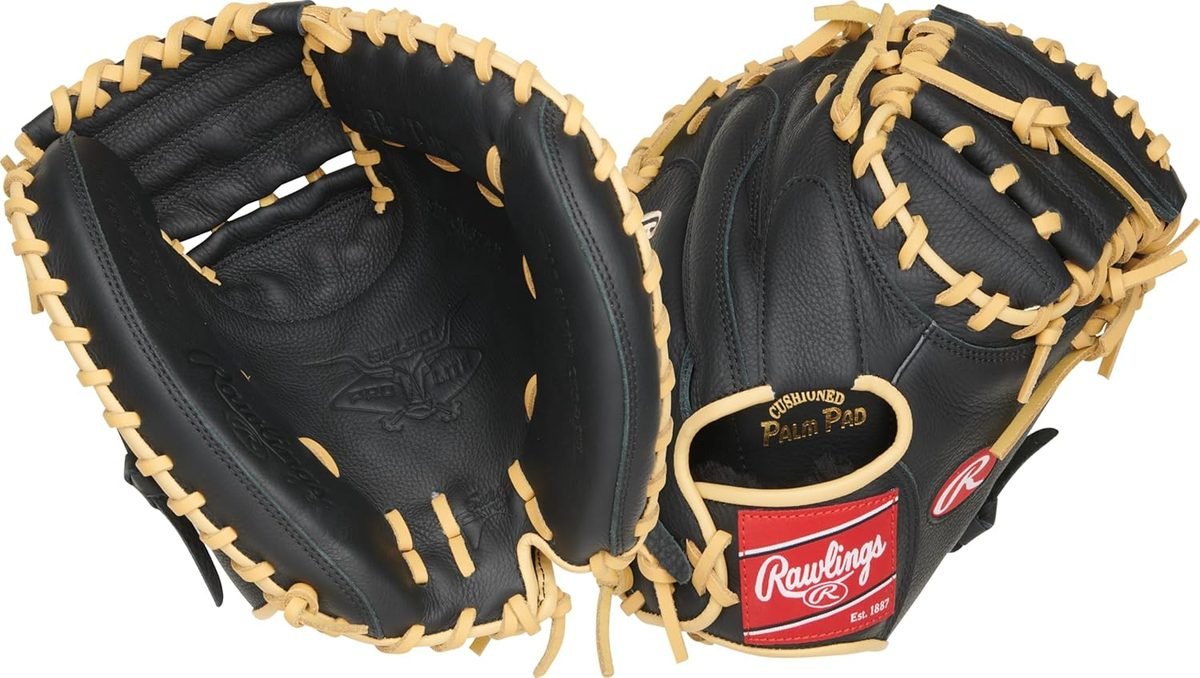
The Select Pro Lite is the mitt we hand most 10-to-13-year-old baseball catchers. Rawlings builds it on a Youth Pro Taper fit. That means a smaller hand opening and lowered finger stalls. In turn, that combination is what lets a young catcher actually close it.
It ships 90 percent broken in, so a week of catch finishes the job. The one-piece solid web is the standard catcher’s pattern. At 32 inches it sits in the middle of the 11-to-13 band. So it should stay useful for two seasons.
Rawlings Select Pro Lite — check price on Amazon
Best for the youngest catchers: Mizuno Prospect PowerClose GXC112 (31.5″)
CatchersHome rating: 4.6 out of 5.
Is your catcher seven, eight or nine? The Prospect PowerClose is the easiest mitt here to close. Mizuno builds a hinge into the pocket that does part of the work. For a first-year catcher, that is the difference between catching the ball and flinching at it.
At 31.5 inches it is genuinely small, which is the point. Add the Parashock palm pad and a young catcher takes fewer stings. Meanwhile, a catcher who does not fear the ball keeps catching.
Mizuno Prospect PowerClose GXC112 — check price on Amazon
Best first mitt on a budget: Rawlings Renegade (32.5″)
CatchersHome rating: 4.4 out of 5.
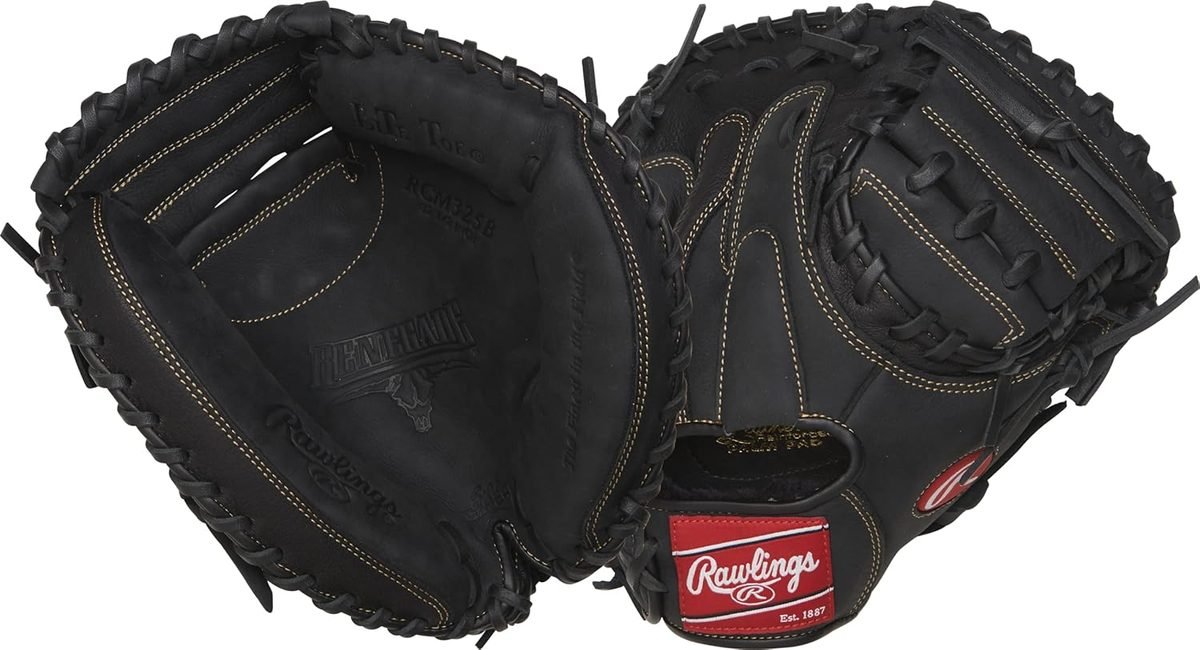
The Renegade is the honest first mitt. Rawlings sizes this one at 32.5 inches. The listing itself labels it for ages 9 to 12, so you are not guessing at the band.
It uses a leather-shell palm rather than full-grain, and it breaks in 90 percent at the factory. That is the right trade for a player who may or may not still be catching next spring. So buy this one, find out whether the position sticks, then upgrade when the innings arrive.
Rawlings Renegade — check price on Amazon
Best for small hands: Wilson A700 (32.5″)
CatchersHome rating: 4.6 out of 5.
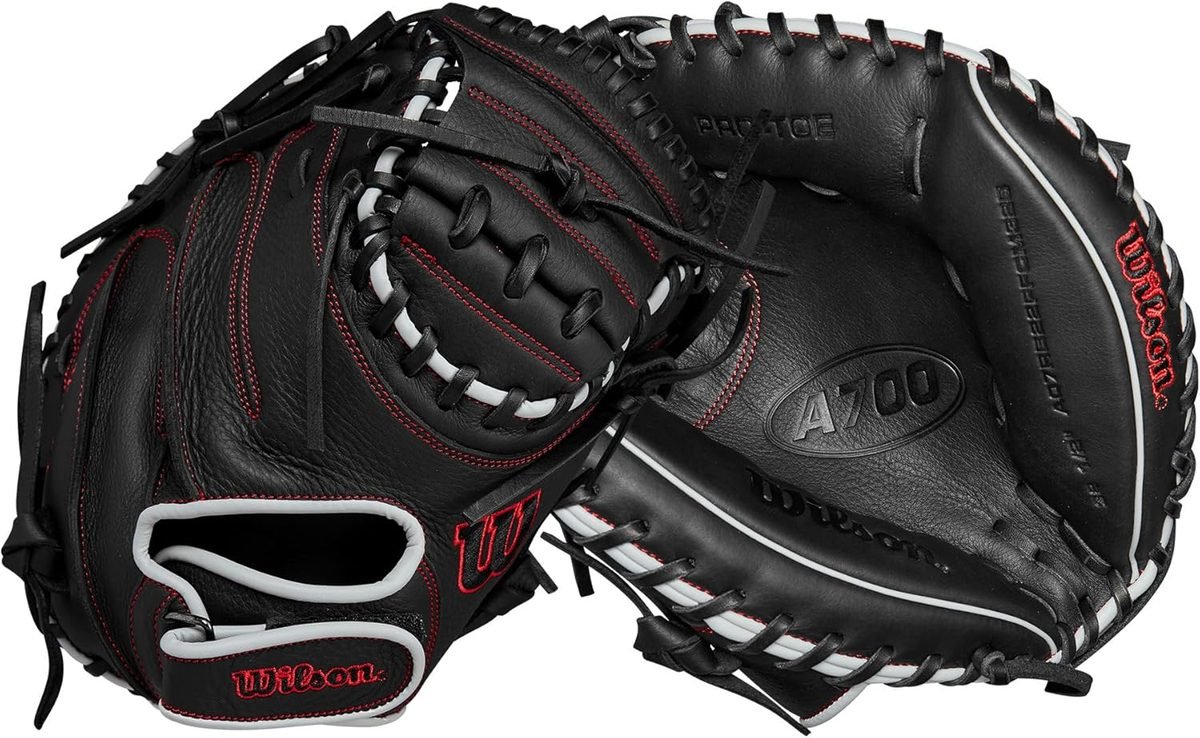
Does the size chart say 32.5 inches while the mitt still swims on the hand? Then the A700 is the answer. Wilson’s Pedroia Fit shortens the finger stalls and narrows the wrist opening, and it does so without dropping a size.
That matters, because sizing down to fix a fit problem costs pocket. Here you keep the 32.5 inches and fix the hand instead. Besides, the A700 leather is soft enough to use in games out of the box. Want the same idea for less? Wilson’s A500 at 32 inches is the cheaper rung, though it drops the Pedroia Fit pattern.
Wilson A700 — check price on Amazon
Best outside the big two brands: Marucci Krewe V3 (32.5″)
CatchersHome rating: 4.3 out of 5.
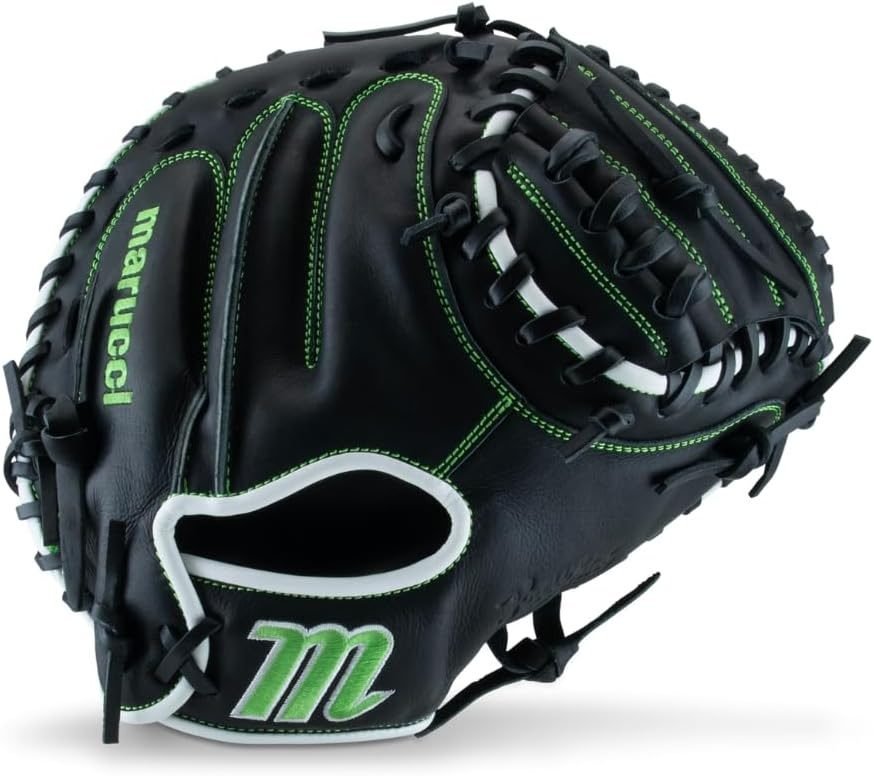
Four of the picks above wear a Rawlings or Wilson label. The Krewe V3 is worth a look for the catcher who would rather not. Marucci built its glove line around pro-pattern shapes, and the youth Krewe keeps that geometry at a youth size.
At 32.5 inches it sits alongside the Renegade and the A700, and at $90 it lands between them on price. The leather runs a touch stiffer out of the box, so budget an extra week of catch before game day.
Marucci Krewe V3 — check price on Amazon
Best for travel ball: Rawlings R9 Youth Contour Fit (32″)
CatchersHome rating: 4.5 out of 5.
The R9 Contour Fit is the top of the youth range, and most players do not need it. A travel-ball catcher does. This is full leather with a real break-in. Rawlings built it to survive a hundred games a year, not a rec season.
At $150 it costs more than two Renegades. So buy it for innings, not for potential. Does your catcher play year-round and no longer grow an inch a season? Then the math works. Otherwise, buy the Select Pro Lite and put the difference toward the next size. Our leather explainer covers what the grades actually buy you.
Rawlings R9 Youth Contour Fit — check price on Amazon
Best youth fastpitch catcher’s mitts
A fastpitch catcher needs a bigger, deeper pocket. A softball is 12 inches around against a baseball’s 9. So handing a fastpitch catcher a baseball mitt that happens to fit is how you get a season of snow-cones.
Best overall, youth fastpitch: Rawlings Shut Out Youth (31.5″)
CatchersHome rating: 4.7 out of 5.
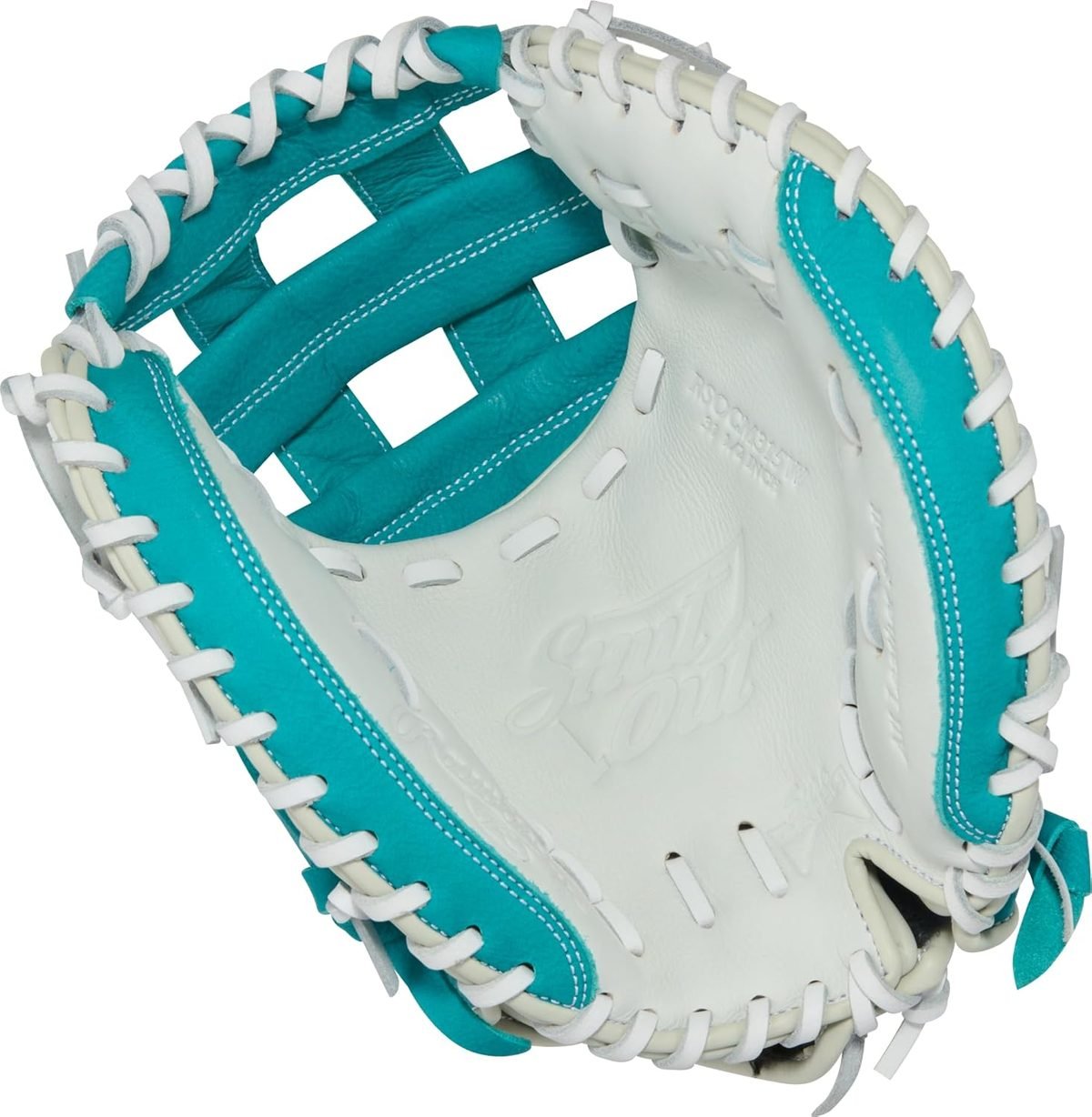
The Shut Out is Rawlings’ youth fastpitch catcher’s mitt. The listing states the band plainly: ages 8 to 14. It is full-grain leather with an 80 percent factory break-in and Zero Shock palm padding.
The modified H web is a fastpitch pattern rather than a baseball one, which is exactly the point. At 31.5 inches it fits a young hand while still swallowing the bigger ball.
Rawlings Shut Out Youth — check price on Amazon
Best fastpitch step-up: All-Star Heiress CMW-H-Y (32.5″)
CatchersHome rating: 4.5 out of 5.
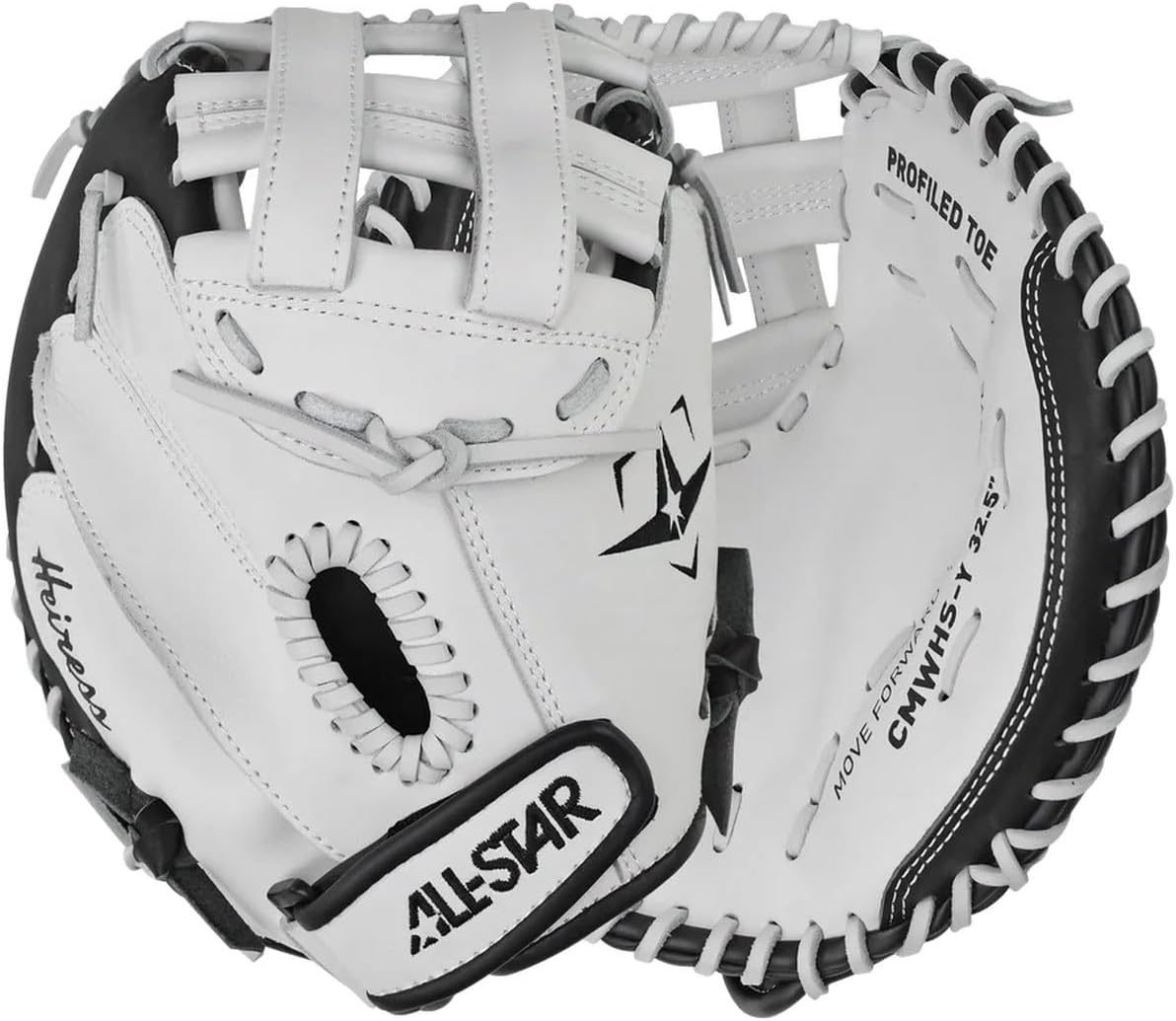
The Heiress is All-Star’s youth fastpitch mitt, and the model code says so: CMW-H-Y ends in Y for youth. Notably, All-Star is the one brand here that builds catcher’s gear first and everything else second.
At 32.5 inches it is the step up from the Shut Out for a catcher who has committed to the position. Watch the model code when you shop, though. All-Star sells an adult CMW-H-A and a youth CMW-FS-Y alongside it, and the listings look nearly identical. Shopping for a left-handed catcher? Read our left-handed catcher’s mitts guide first. The field is much narrower than it looks.
All-Star Heiress CMW-H-Y — check price on Amazon
Has your catcher grown past the youth range? Then our fastpitch catcher’s mitt roundup picks up where this one stops.
When to stop buying youth mitts
There are three signals. Any one of them is enough.
- The fingers reach past the stalls. The hand has outgrown the pattern, not just the size.
- The pocket bottoms out. The pitcher’s velocity starts stinging through the palm. In short, the mitt no longer absorbs what it is asked to absorb.
- The player closes it without thinking. A mitt that takes no effort has stopped teaching anything. Now a full-size pattern will reward the strength your catcher has built.
Most catchers hit all three somewhere between 13 and 15. That is the moment to buy a real one, and to buy it for the leather rather than the label.
Breaking in a youth mitt
A youth mitt does not need the two-to-four-week campaign a premium steerhide mitt demands. Most arrive 80 to 90 percent finished. So a week of catch and some hand work closes the gap.
What ruins them is the shortcut. An oven, a microwave or a heavy soak in oil takes the structure out of the leather. Besides, a youth mitt has less structure to spare than an adult one. Our break-in guide has the method, the timeline and the list of things not to do.
Mistakes we see every spring
- Buying two sizes up. Covered above, and worth repeating. It is the one that costs a season.
- Handing a fastpitch catcher a baseball mitt. The ball will not seat in the pocket, and the catcher learns to reach.
- Buying premium leather for a first-year catcher. Full-grain steerhide rewards innings. Meanwhile, a player who might quit the position in July does not have the innings.
- Trusting the product title. Catcher’s mitts sit inside family listings that also hold fielder’s gloves. So check the size and position on the listing before you buy.
- Skipping the return window. Fit is the whole decision here. You cannot fit a mitt through a screen.
FAQs
What size baseball mitt should a 10 year old boy use?
A 10-year-old baseball catcher usually needs a 30 to 31.5-inch mitt. Measure the hand rather than trusting the birthday. After all, two 10-year-olds can be a full size apart. Then run the squeeze test. If your player cannot close the mitt one-handed, it is too big, whatever the box says. Our catcher’s mitt size chart has the full range by age and level.
What is the difference between youth and adult baseball mitts?
Youth catcher’s mitts are smaller, lighter and softer out of the box. They also use shorter finger stalls and a narrower wrist opening. The size difference is the obvious one. However, the fit difference matters more. An adult mitt scaled down still has adult finger stalls. So a young hand sits too deep and loses control of the pocket. Youth patterns move the stalls up to meet shorter fingers.
Can an adult use a youth baseball glove?
An adult can use a youth catcher’s mitt, but should not. A 31-inch mitt leaves adult fingers past the stalls and closer to foul tips. It also gives up the pocket depth that adult velocity demands. Does an adult hand fit a youth mitt comfortably? Then the better answer is a small adult size at 32 to 33 inches, not a youth pattern.
Should a 13 year old use a youth baseball glove?
Many 13-year-olds are ready for a 32 to 33.5-inch high-school size. However, a smaller-handed 13-year-old is better served by the top of the youth range. Age 13 is where the two ranges overlap. So it is the one year the chart cannot settle for you. Fit the hand, and let the player tell you whether the mitt closes.
What are the different types of youth catcher’s mitts?
Youth catcher’s mitts split three ways: by ball type, by leather, and by fit pattern. Baseball mitts run smaller with a firmer pocket. Meanwhile, fastpitch mitts run larger and deeper for the 12-inch ball. Leather runs from synthetic and split-grain at the entry point up to full-grain at the top. Finally, fit patterns like Wilson’s Pedroia Fit and Rawlings’ Contour Fit shorten the finger stalls for smaller hands.
How to break in a youth glove?
Break in a youth mitt with catch, hand work and a ball tied in the pocket overnight. Skip the oven, the microwave and the heavy oil. Most youth mitts arrive 80 to 90 percent broken in. So the job takes days rather than weeks. Our guide to breaking in a catcher’s mitt covers the method and what ruins leather.
Bottom line
For most youth baseball catchers, the Rawlings Select Pro Lite at 32 inches fits, closes and lasts. For fastpitch, it is the Rawlings Shut Out at 31.5 inches. Meanwhile, for a first-year catcher on a budget, the Renegade does the job. It also asks no family to bet on the position.
Whichever you pick, size it to the hand in front of you. Then let the player close it once before you commit. A mitt a young catcher can work is the first thing that makes the position feel possible. Next, confirm the size on our size chart. Then browse the full catcher’s mitts guide, or the baseball and fastpitch lineups.