
Heart of the Hide vs Jen Schro: Fastpitch Mitts Compared
CatchersHome is reader-supported. When you buy through links on this page we may earn an affiliate commission, at no extra cost to you. It never changes which mitt we tell you to buy.
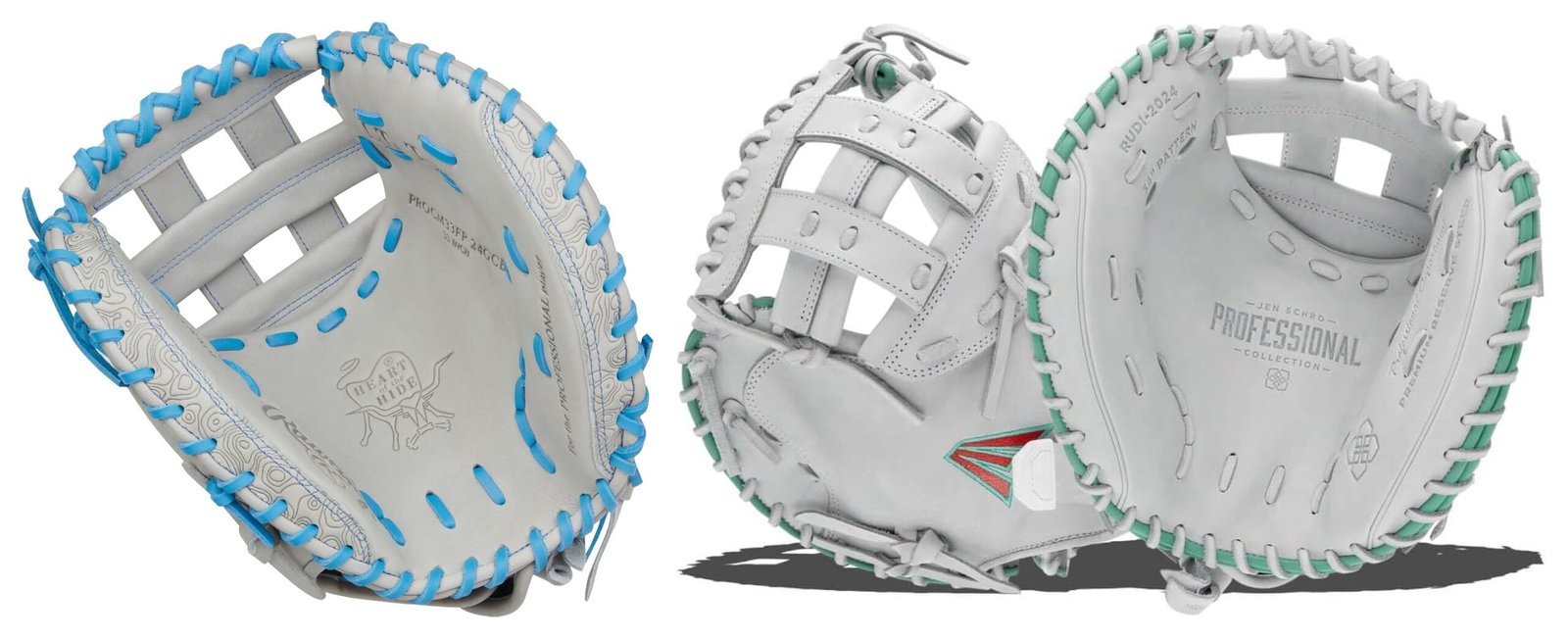
Heart of the Hide vs Jen Schro is the fastpitch version of a question baseball catchers have argued about for decades: two premium mitts, nearly the same money, and no obvious loser. The Rawlings Heart of the Hide fastpitch mitt is a 33-inch CM33 pattern.
The Easton Jen Schro “The Rudi”, from Easton’s Professional Collection, is a 34-inch H-web built to Jen Schroeder’s own specs. Both are real steerhide. Both are built to be the mitt she stops replacing.
They are not the same tool, though. And the difference that decides it for most catchers is not the one on the price tag.
The short answer
Buy the Rawlings Heart of the Hide 33″ if you want the quicker, more controllable mitt, you value a documented head start on break-in, and a 33-inch pattern fits the hand that has to close it. It is the easier mitt to live with in your first season.
Buy the Easton Jen Schro 34″ if you want the extra inch of reach and pocket, you like an H-web’s framing window, or — and this one is not close — you throw left-handed. Easton builds this mitt for lefties. In the Rawlings listing, this pattern is right-hand throw only.
Check today’s price on the Heart of the Hide 33″
Check today’s price on the Jen Schro 34″
Two good mitts, one real decision
You have already done the hard part. You decided to stop replacing a mitt every spring, and you decided your catcher has earned leather that will still hold its shape in August. Everything after that is a fit question.
That is where most buying guides quit. They list the leather grade, they list the web, and they leave you staring at two product pages that both say “premium” and “professional.” So let’s do the part they skip: what actually differs between these two, and which difference should decide it.
Side by side
| Rawlings Heart of the Hide | Easton Jen Schro “The Rudi” (Professional Collection) | |
|---|---|---|
| Model stamp | PROCM33FP-24GCB | RUDI2024 |
| Size | 33″ | 34″ |
| Pattern | CM33FP — traditional fastpitch catcher’s mitt | Jen Schroeder’s personal 34″ pattern |
| Web | Modified H-web (Rawlings’ spec table says Pro H) | H-web (Easton’s spec table says two-piece solid) |
| Leather | Heart of the Hide steerhide — listing cites the top 5% of U.S. steer hides | Premium Reserve USA steerhide |
| Palm lining | Padded thumb sleeve; Rawlings now lists a shell-leather lining (July’s listing said deer-tanned cowhide) | Classic cowhide, Ax Suede wrist liner |
| Factory break-in | 80% factory / 20% player on Rawlings’ current spec (July’s listing said 40% / 60%) | 40% factory / 60% player on Easton’s spec |
| Throwing hand | Right-hand throw in this pattern | Right and left |
| Colorway reviewed | Grey / Columbia Blue | White / Teal |
| Price band | High-$200s to low-$300s | Around $300 to mid-$300s |
Specs and price bands verified 2026-07-18; break-in, web and lining re-checked against the makers’ own pages 2026-09-18. Prices move — check the current number before you buy.
33 or 34 inches: the difference nobody explains
Here is the thing the spec sheets hide. This is not a mitt sold in two sizes. These are two patterns that happen to be one inch apart, and neither company offers the other’s number. Rawlings’ fastpitch catcher pattern is the CM33 — 33 inches is the pattern.
Easton’s Jen Schro model, “The Rudi” (RUDI2024), is a 34-inch pattern — and Easton sells a second, different Professional Collection catcher’s mitt at 34 inches, so check the model code. You are not choosing a size. You are choosing a mitt that comes in the size it comes in.
Worth knowing before you weigh the inch: fastpitch catcher’s mitts are commonly made in 32.5, 33 and 34 inches, and 34 is the most common adult size. So the Easton sits on the common adult number, and 33 is the size a lot of intermediate and advanced catchers settle into and keep using well past their youth years.
Both are standard. The inch is a preference, not a correction.
So what does the inch buy?
Thirty-four inches is reach. A longer mitt covers more of the strike zone’s edges without moving your body, and it gives you a deeper pocket for a ball that arrives with weight on it. Thirty-three is control. A shorter mitt closes faster, transfers quicker, and asks less of the hand squeezing it shut.
From the pop through the exchange to the throw, every inch you are not swinging around is time you keep.
The practical read: if a quicker transfer is the thing she’s chasing this season, the 33 is the friendlier tool. If she frames well already and wants the biggest target she can present to a pitcher who needs the confidence, the 34 earns its extra inch.
Neither answer is wrong. Just do not let a size chart written for baseball make it for you. Softball mitts are built longer with a deeper pocket because the softball is bigger, and fastpitch patterns are cut with a smaller wrist opening and shorter finger stalls. Rawlings says as much on its own listing.
A baseball sizing guide will steer you wrong here.
Leather and build: an honest tie
Both mitts are the top of their maker’s fastpitch line, and both are full steerhide. Rawlings leans on Heart of the Hide, the name it has built its premium tier around for generations; the listing cites the top 5% of U.S. steer hides. Easton answers with Premium Reserve steerhide and professional-grade rawhide lace.
The stamp inside the Easton reads PREMIUM RESERVE STEER, which is the company putting its claim where the owner will see it every time she opens the mitt.
Inside, they diverge in feel rather than quality. The Rawlings gives you a padded thumb sleeve — a softer landing for the hand, and a real consideration if sting has been part of the conversation.
The Easton runs a classic cowhide palm and an Ax Suede microfiber wrist liner that is breathable and water-resistant, the kind of detail that stops mattering in April and starts mattering in a July doubleheader.
Calling a category a tie is usually a cop-out. This one is earned. Two premium steerhides, two different comfort philosophies, no quality gap we can document.
Break-in: the one measurable edge
This is where the Rawlings separates itself, and it separates itself on paper rather than on folklore.
Rawlings’ listing in July stated the mitt arrives with 40% factory break-in, leaving 60% to the player. Its current specification goes further, listing just 20% left to the player, which matches the retailer that described the line as arriving further along. Treat either figure as the manufacturer’s claim rather than a settled number. Easton now publishes a figure for the Jen Schro as well, and it leaves 60% of the break-in to the player, the most of any mitt we have checked.
That is not a knock on Easton’s leather — a stiff mitt broken in by the person who will use it is how a lot of catchers prefer to do it — but it does mean both makers’ own numbers now point the same way: the Rawlings arrives further along, and the Easton asks more of the catcher.
Owner reports point the same direction, gently. Where the Easton comes up in reviews, “stiff out of the box” and “tough to break in” are the recurring notes.
The Rawlings splits: some owners say it breaks in beautifully, and at least one says it took longer than any mitt they had owned and was slick in the pocket until it wasn’t. Premium steerhide is like that. The grade that makes a mitt last is the same grade that makes the first month work.
Whichever you pick, here’s how we’d break it in: catch with it. Reps close a pocket in the shape of the hand that owns it. Condition sparingly with a leather conditioner made for gloves, work the pocket and the hinge by hand, and store it with a ball in it.
Skip the oven, the microwave, and the bucket of oil — heat and saturation break down the fibers you paid a premium for.
Left-handed catchers: this is the whole decision
If you throw left-handed, stop reading the other categories.
Easton builds the Jen Schro Professional Collection 34″ in a left-hand-throw model. Rawlings, in this Heart of the Hide fastpitch pattern, does not — the 33″ CM33 is offered right-hand throw only on the listings we verified. That is not a small preference difference. That is one mitt existing for your catcher and the other not.
Left-handed catchers already spend their careers hearing what they supposedly can’t do, and gear availability is a real part of why. When a company builds the lefty, that is worth saying out loud. Easton built it.
More on the gear gap lefties live with: left-handed catcher’s mitts.
Price: closer than the sticker suggests
Both mitts live in the same neighborhood. Across the configurations we checked in July of 2026, the Rawlings ran from the high-$200s to the low-$300s depending on colorway and retailer, and the Easton from around $300 into the mid-$300s depending on web and throwing hand. The Rawlings floor is lower. The overlap is large.
Which means price should not decide this. If you are cross-shopping these two, you are already past the question of whether to spend premium money. The real math is simpler than a spreadsheet: a mitt you replace every season is a purchase you make every season. The mitt is not the expensive part of catching.
The mitt you have to keep buying is.
Check today’s price on the Heart of the Hide 33″
Check today’s price on the Jen Schro 34″
What owners actually say — and how much to trust it
We are going to be straight with you here, because the alternative is the thing every other page does.
Verified owner feedback on these two exact configurations is thin. Not bad — thin. The retailer page carrying a confirmed review count for the Rawlings 33″ shows a single review. The retailer listing for the Easton RUDI2024 shows none at all.
There are star ratings floating around for “Jen Schro” mitts, and they are lower. We are not printing them, because when we traced them they did not belong to this mitt. One attaches to the two-piece-solid-web version — a different web on a different listing.
Most of the complaint text belongs to Easton’s Elite Series Jen Schro, a separate and much cheaper line that shares the name and nothing else. One review we found was about a knee pad and a set of straps, which is gear, not a mitt.
What we can say honestly: where reviews exist for these two, the recurring praise is build quality and the recurring complaint is break-in effort. Anyone quoting you a confident star rating on either of these mitts is quoting a different product.
Durability is the category we are not going to call. It is the one buyers ask about most and the one we have the least honest evidence for.
There are scattered reports of binding splitting and a pocket tearing on the Easton side inside the first year — worth knowing, and far too few to call a pattern, especially when the name is shared with a cheaper line whose reviews are easy to mistake for these.
Nothing comparable turned up against the Rawlings, but an absence of complaints across a single verified review is not evidence of durability either. If a page tells you confidently which of these two lasts longer, ask them where the number came from.
Who should buy which
Travel-ball catcher, 12U–14U, still growing. The Rawlings 33″. Faster to close, faster to throw, and the documented factory break-in means fewer weeks spent fighting a stiff mitt.
High-school starter who frames well. The Easton 34″. Give a good framer the bigger window and a pitcher who trusts her, and the inch pays for itself.
Any left-handed catcher. The Easton. Of these two, it’s the one offered in a lefty.
The catcher who takes a beating behind the plate. The Rawlings, for the padded thumb sleeve.
The catcher who wants what her college looks at. Both are pro-spec. The Easton carries a name your fastpitch catcher probably already knows, and there is nothing wrong with a mitt that makes her want to put it on.
Who should buy neither
If this is a first real mitt for a player who has caught two seasons, both of these are more mitt than the moment needs. Premium steerhide rewards a catcher who is putting in real reps every week; without them it simply stays stiff. Start on a mid-tier fastpitch mitt, and spend the difference on a helmet that fits.
And if you are not sure this is the position she wants for the next four years, that is a completely fine thing to not be sure about. Buy the mitt when the answer is yes.
Still deciding? Start with the full fastpitch mitt roundup.
Frequently asked questions
What size fastpitch catcher’s mitt should I get?
Fastpitch catcher’s mitts are commonly made in 32.5, 33 and 34 inches, and 34 is the most common adult size. Between these two you do not really pick a number — the Rawlings comes as a 33″ CM33 pattern and the Easton as a 34″ pattern.
Both sizes are standard, and plenty of intermediate and advanced catchers stay at 33 into adulthood. Choose 33 for a quicker close and faster transfer, 34 for reach and a deeper pocket.
See our catcher’s mitt sizing guide for the full chart.
What’s the difference between a fastpitch catcher’s mitt and a baseball catcher’s mitt?
Three things: length, cut, and ball. Softball mitts are built longer with a deeper pocket because the softball is bigger. Fastpitch patterns are cut with a smaller wrist opening and shorter finger stalls — Rawlings states this outright on its fastpitch listing. And the sizing guidance written for baseball mitts does not transfer.
Use a fastpitch guide for a fastpitch mitt.
How do I break in a new fastpitch catcher’s mitt?
Catch with it. Bullpens, soft toss into the pocket, and reps with a real softball shape the mitt around the hand that owns it. Our recommendation: condition sparingly with a leather conditioner made for gloves, work the pocket and the hinge by hand, and store it with a ball in it.
Skip heat, microwaves, and soaking in oil — they break down the fibers you paid a premium for.
Is the Jen Schro mitt worth it over the Heart of the Hide?
Worth it depends on which problem you have. They are close enough on leather and price that the decision comes down to pattern length, break-in expectations, and throwing hand. If you throw left-handed, the Easton is the answer by default. If you want the shorter, quicker mitt that arrives further broken in, the Rawlings is.
Heart of the Hide vs Jen Schro: the call
If we had to hand one mitt to a right-handed travel-ball catcher tomorrow, it’s the Rawlings Heart of the Hide 33″. It closes quicker, it arrives further broken in, and its price floor is lower.
For a left-handed catcher, or a framer who wants every inch of the zone the rules allow her, the Easton Jen Schro 34″ is the better mitt and it isn’t a close call.
What you should not do is agonize. Both of these are built to last, if she conditions them and catches with them. The mitt is not what makes a catcher. The reps are.
Sweat the gear, and never fear.
Check today’s price on the Heart of the Hide 33″
Check today’s price on the Jen Schro 34″
Browse more fastpitch catcher’s mitts, the full catcher’s mitts collection, or read up on the Wilson A2000 fastpitch mitt.