
Rawlings vs Wilson Catcher’s Mitts: Which Brand Should You Buy?
Affiliate disclosure: CatchersHome earns a commission on qualifying purchases through the Amazon links below, at no extra cost to you. We only recommend gear we’d hand to our own catcher.
Buy Rawlings if you want the widest choice of catcher patterns and sizes. Its listings also tell you the web shape before you order. Buy Wilson if you want a shorter line, a more predictable break-in and the moisture-and-weight technology. What you should not do is choose on price. When we priced both ladders on August 21, 2026, the two flagship mitts came out four cents apart — $419.99 against $419.95.
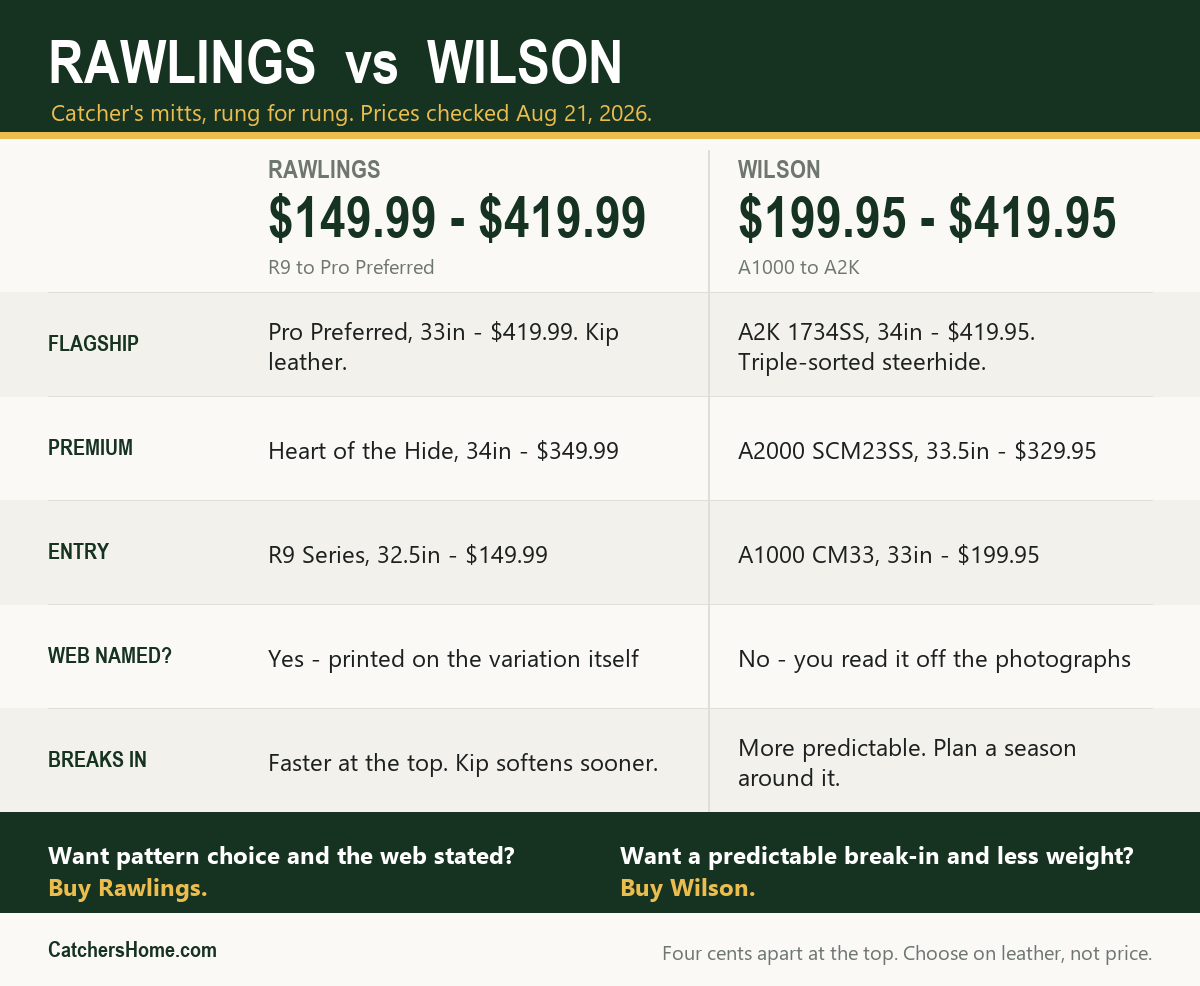
The two ladders, priced the same day
Brand comparisons usually founder because they compare a mitt from one brand against a different tier from the other. So here is the whole shelf, rung against rung, every price read off the live listing on August 21, 2026.
| Tier | Rawlings | Wilson |
|---|---|---|
| Entry / mid | R9 Series, 32.5in — $149.99 | A1000 CM33, 33in — $199.95 |
| Premium | Heart of the Hide PROSCM41B, 34in — $349.99 | A2000 SCM23SS, 33.5in — $329.95 |
| Flagship | Pro Preferred, 33in — $419.99 | A2K 1734SS, 34in — $419.95 |
| Flagship leather | Kip | Triple-sorted steerhide (Pro Stock Select) |
| Premium leather | Heart of the Hide steerhide | Pro Stock steerhide |
| Web named on the listing? | Yes — on the variation itself | No — you read the photos |
Read the flagship row again. Four cents. That is two companies watching each other’s pricing for a hundred years. So the money is genuinely not the decision here. Whether to spend at this tier at all is a real question. Which logo to spend it on is a smaller one than most buyers assume.
The real split: kip against steerhide
At the top of each line the two brands make opposite bets. This is the one difference a catcher feels in week one and again in year three.
Rawlings’ Pro Preferred is built from kip leather. Rawlings’ own listing calls it clean, supple kip, and adds 100 percent wool padding and a Pittards sheepskin palm lining. Kip is a lighter, finer-grained hide. It breaks in faster, feels quicker to close, and carries less weight on the arm across 120 pitches.
Wilson’s A2K goes the other way. Its Pro Stock Select leather is triple-sorted: Wilson inspects the hides at least three times and keeps the top five percent. It is also steerhide, which is thicker and tougher than kip by nature. It takes longer to open up and it stays open longer. Our leather explainer walks through what each hide does over a season. Read it before you spend $420 either way.
Neither bet is wrong. A catcher who wants the mitt light and quick, and who conditions it properly, should be looking at kip. A catcher who is hard on gear and wants one mitt for four seasons should be looking at the steerhide. That is the actual Rawlings-versus-Wilson decision, and it has nothing to do with which brand is better.
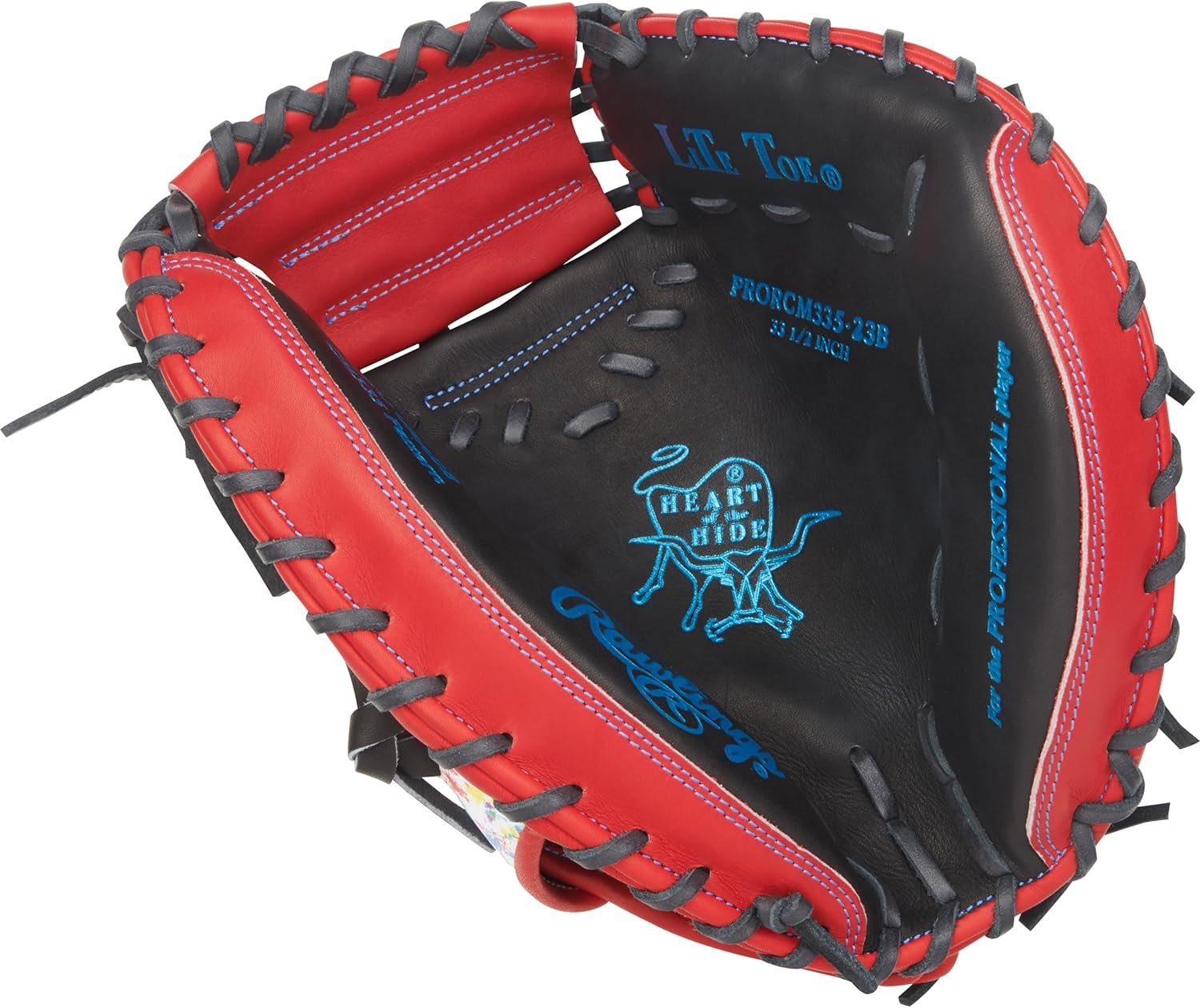
Where the fight is closest: Heart of the Hide against the A2000
Most catchers reading this are not shopping at $420. They are at the rung below, where the Heart of the Hide was $349.99 and the A2000 SCM23SS $329.95. That is twenty dollars apart, both premium steerhide, both from a brand with a century of catcher’s mitts behind it. This is the closest matchup in the whole comparison. We give it a page of its own against the A2K as well.
The honest way to split them is not by brand at all. The Heart of the Hide runs the classic 1-piece closed web, and it is famously stubborn to break in. That is the price of a hide still holding a pocket when a softer mitt has gone flat. The A2000 adds SuperSnakeSkin on the back panel, which cuts weight and sheds moisture, and Spin Control dimpling in the palm and web. It also has the more predictable break-in timeline of the two.
So: if you want the mitt that will still be good in four years and you are willing to work for it, Heart of the Hide. If you want to be game-ready on a schedule and you play in humidity, A2000. Both answers are right, and the size chart matters more than either. A 34-inch mitt on a 33-inch hand is a worse decision than picking the other brand.
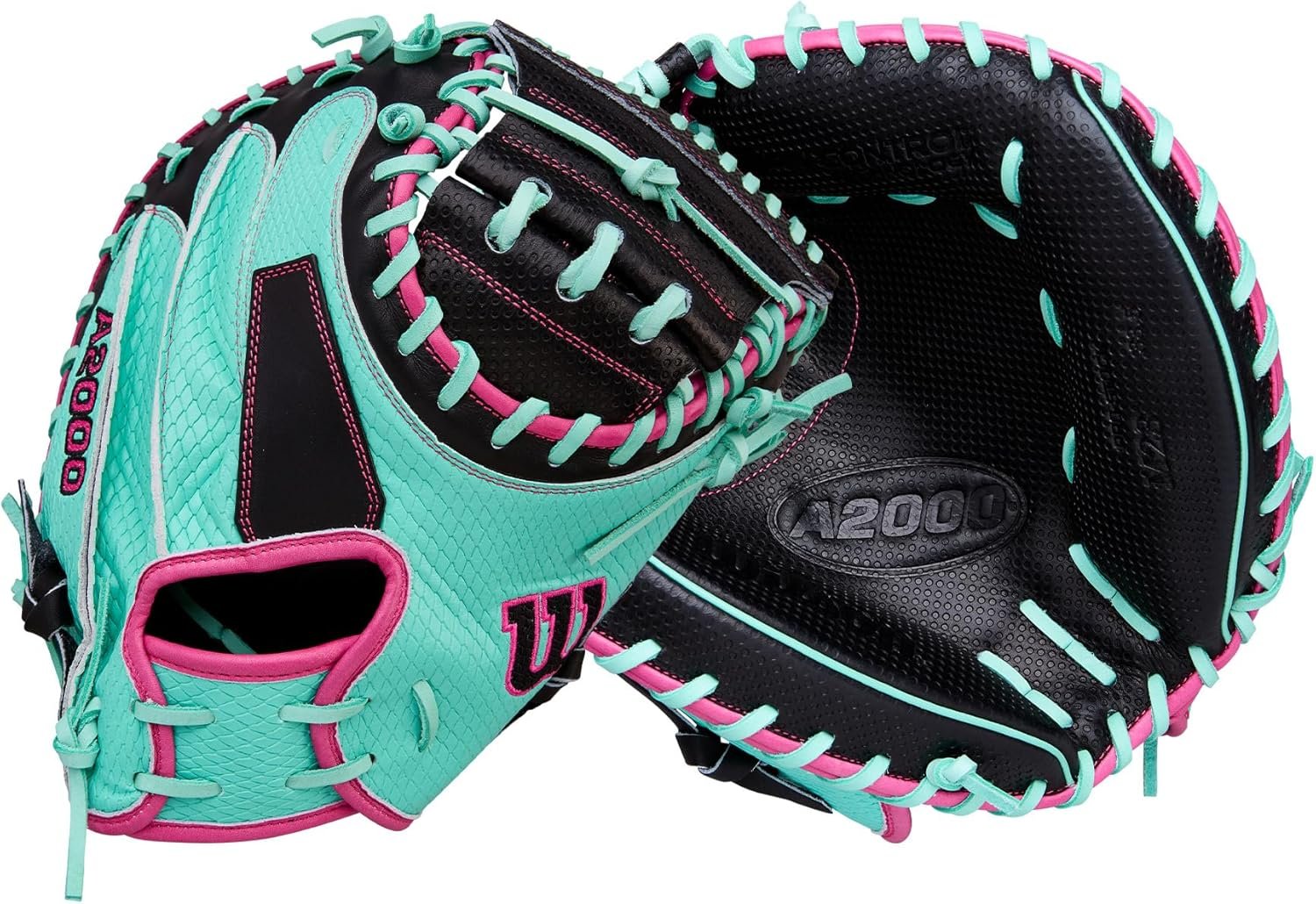
One practical advantage Rawlings has: they tell you the web
This sounds like a small thing and it is not. Rawlings names the web pattern on the product variation itself. The R9 listing reads Black / Columbia Blue | 1-Piece Solid Web. The Pro Preferred reads Black / Mint | Single Post Double Bar Web. You know the shape of the mitt’s face before you click.
Wilson’s catcher listings generally do not. The A2000 and A2K pages lead with leather and technology. So the web is something you work out from the photographs. Some catchers have already decided that pocket and web shape are the spec that matters. If you have read our web patterns guide, you probably have. For that reader, Rawlings is simply the easier brand to shop.
It cuts the other way on sizes. Wilson’s A2000 catcher line spans an unusually wide 31.5 to 34 inches. Meanwhile the A1000 exists in exactly one size. Rawlings spreads its size range across more models instead. Neither brand is hiding anything; they organise the shelf differently, and it is worth knowing which way before you start clicking.
Where each brand actually wins
Choose Rawlings if…
- You want the web pattern stated up front rather than inferred from a photograph.
- You want kip leather at the flagship tier — lighter and quicker to break in than steerhide.
- You want a pro signature pattern. Rawlings is Major League Baseball’s official glove and builds retail mitts on players’ own patterns. Its PROSCM41B listing names Joe Mauer and Yadier Molina as users of that pattern.
- You are shopping under $200, where Rawlings simply has more mitts on the shelf.
Rawlings Heart of the Hide PROSCM41B 34in — check price on Amazon
Rawlings Pro Preferred 33in — check price on Amazon
Choose Wilson if…
- You want the more predictable break-in and a mitt you can plan a season around.
- You play in heat or humidity, where SuperSkin and DriLex earn their place.
- You want a 33.5-inch mitt, which is Wilson’s most common catcher size and the one its patterns are built around.
- You would rather choose from a short, clearly tiered line than a wide catalogue.
Wilson A2000 SCM23SS 33.5in — check price on Amazon
Wilson A2K 1734SS 34in — check price on Amazon
Choose neither if…
Choose neither if the catcher is still growing, still deciding, or catching a handful of innings a week. Both brands assume a season’s worth of break-in to pay back. The budget tier exists for that catcher. Meanwhile the $100–$250 tier covers what Marucci, All-Star and Mizuno do in the middle, where the field is wider than these two brands alone.
The third brand this comparison keeps bumping into
All-Star is not in the title of this page, and it probably should be in the conversation. Its Pro Elite CM3000 is the mitt several pros wear. It competes squarely with the Pro Preferred and the A2K on leather. If you are shopping strictly at the flagship tier, read the CM3000 review before you commit to either brand here. A two-brand comparison is a smaller field than the one you are buying from. Our premium roundup scores all of them together. The Rawlings Pro Preferred and the Mizuno Pro Select each have a full review here too.
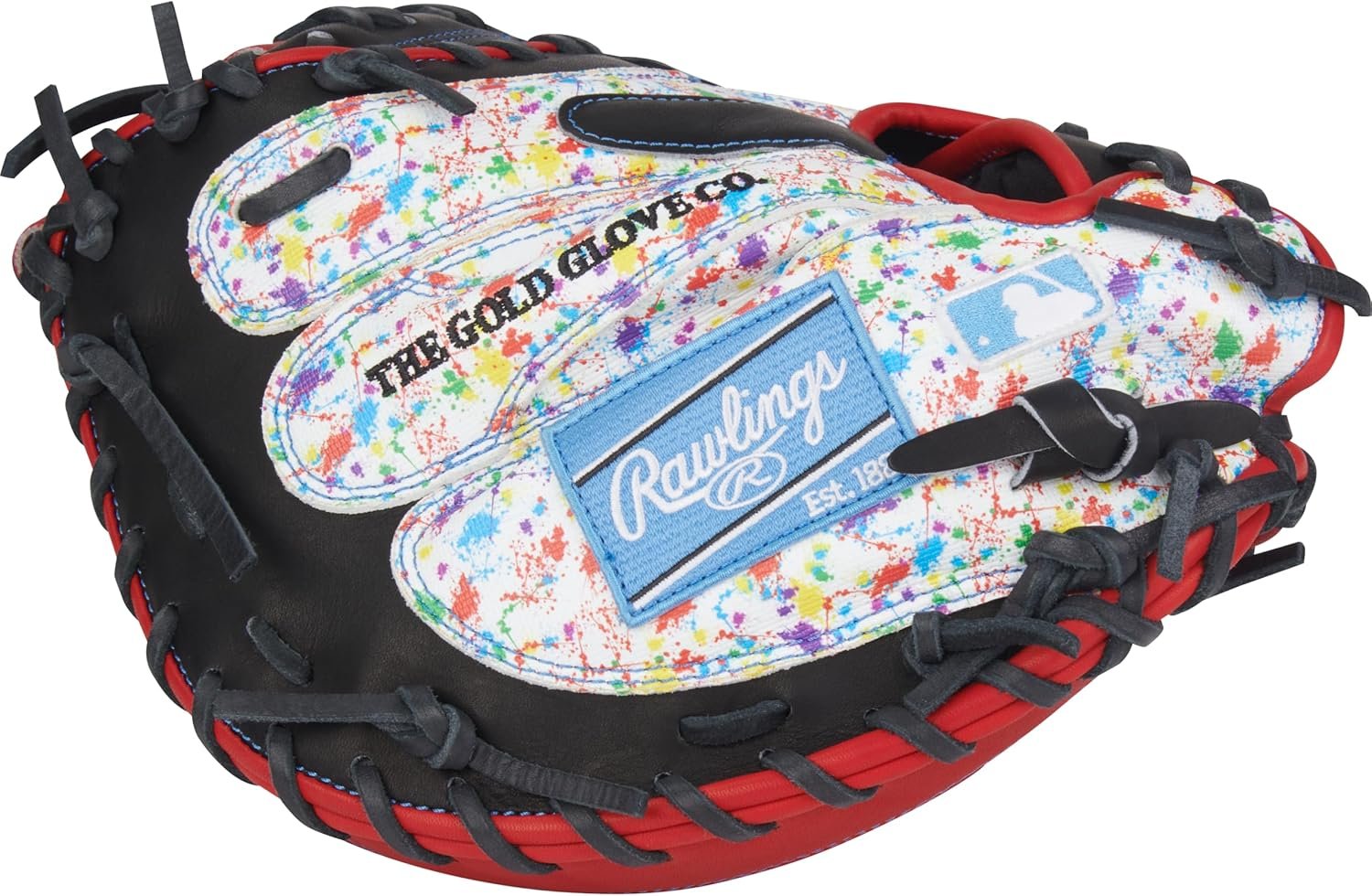
What we could not verify
- Neither brand publishes a lifespan figure. So the durability language here comes from owner reports and the behaviour of the hides, not from a manufacturer number.
- Prices are a single-day snapshot from August 21, 2026, on one retailer. Both brands run model-year changeovers that move a mitt $50 in a week. The flagship four-cent gap is a coincidence of that day, not a standing fact.
- We show no photograph of a Pro Preferred or an R9 here. We have images filed under both names. But neither carries a readable model stamp, and a folder label is not proof of what is in the picture. Rather than put an unverified mitt next to a buying link, we show the models we can confirm.
- Wilson does not publish web patterns on its catcher listings, so the web comparison in this article is asymmetric by necessity: Rawlings’ web names are quoted from the listings, Wilson’s are not stated at all.
Rawlings vs Wilson catcher’s mitt FAQs
What’s better, Rawlings or Wilson?
Neither, and the prices say so. The two brands’ top catcher’s mitts were four cents apart when we checked on August 21, 2026. Rawlings gives you more catcher patterns, names the web on every listing, and owns the pro signature models. Wilson gives you a tighter line, a more predictable break-in, and the moisture and weight technology. Pick on leather and pattern, because the money is a wash.
Do MLB catchers use Rawlings or Wilson?
Both, though Rawlings is the more common sight behind the plate and is Major League Baseball’s official glove. Rawlings leans on that with signature catcher patterns built from players’ own gamers. Wilson’s catcher presence is real but narrower. For a buyer this matters less than it sounds. A pro’s mitt is a pro-stock pattern, not the retail mitt in your cart.
Is the Rawlings Heart of the Hide better than the Wilson A2000?
They are the same rung of the same ladder, twenty dollars apart. So the honest answer is that the pattern fits your hand or it does not. The Heart of the Hide was $349.99 and the A2000 SCM23SS $329.95 on August 21, 2026. Both are premium steerhide from a brand that has built catcher’s mitts for a century. Choose on size, web shape and how the mitt closes for you.
What is the difference between kip leather and steerhide?
Kip is lighter and finer-grained, so it breaks in faster and feels quicker on the hand. Steerhide is thicker and tougher, so it takes longer and lasts longer. Rawlings’ Pro Preferred is kip; Wilson’s A2K is triple-sorted steerhide. That is the clearest philosophical split between the two brands’ flagship mitts. It is a genuine choice rather than a better-and-worse.
Which brand’s catcher’s mitt breaks in faster?
At the top of each line, Rawlings — kip leather softens sooner than triple-sorted steerhide. Lower down the ladder it flips. Rawlings’ Heart of the Hide is famously stubborn, while Wilson’s A2000 has the more predictable timeline. So there is no brand-level answer here, only a model-level one.
Is Rawlings or Wilson better for a high school catcher?
Rawlings, marginally, because it offers more mitts under $200 and names the web pattern on each one. The R9 at 32.5 inches was $149.99 and Wilson’s A1000 CM33 $199.95 on the same day. If the catcher’s hand wants 33 inches and a soft early feel, the A1000 is the better fit. Below that price band, Rawlings simply has more shelf.
Narrowing to one brand? The Heart of the Hide review and the A2K review go model by model. The A2000 review covers Wilson’s middle, and A2K versus A2000 settles the Wilson ladder on its own. Still open on size or pattern? Start at how to choose a catcher’s mitt, then break it in with the break-in guide. And if you catch left-handed, the left-handed shelf is much shorter than either catalogue suggests. Everything here sits under baseball catcher’s mitts, inside our catcher’s mitts pillar.